
 +86 15355323399
 En
En  中文简体
中文简体 日本語
日本語 Français
 Español
 Deutsch
 Türk
Türk عربى
عربى italiano
 русский
Honeycomb Filling Packing Paper: A High-Performance Plastic-Free Solution for Modern Packaging
Packaging manufacturers, e-commerce companies, exporters, gift brands, and logistics operators are under increasing pressure to protect products while reducing plastic consumption. Traditional materials such as bubble wrap, expanded polyethylene foam, and plastic air pillows can provide cushioning, but they also create disposal challenges, increase dependence on fossil-based materials, and may weaken a brand’s sustainability message. Honeycomb Filling Packing Paper offers a practical alternative by combining paper-based recyclability, cushioning performance, efficient storage, and attractive presentation in one packaging material.
Honeycomb Filling Packing Paper is an expandable paper packaging material made from kraft paper. Its surface is processed into a precision honeycomb pattern. When the roll or sheet is stretched, the cut pattern opens into a three-dimensional structure. This expanded structure creates flexible cells that wrap products, fill empty spaces, separate articles, and distribute impact forces during handling and transportation.
Unlike ordinary flat wrapping paper, honeycomb paper is engineered to become a cushioning layer during use. Unlike bubble wrap and foam, it is based on paper and can support plastic-free packaging systems. Its combination of performance, appearance, and operational convenience makes it suitable for both protective packaging and presentation-oriented packaging.
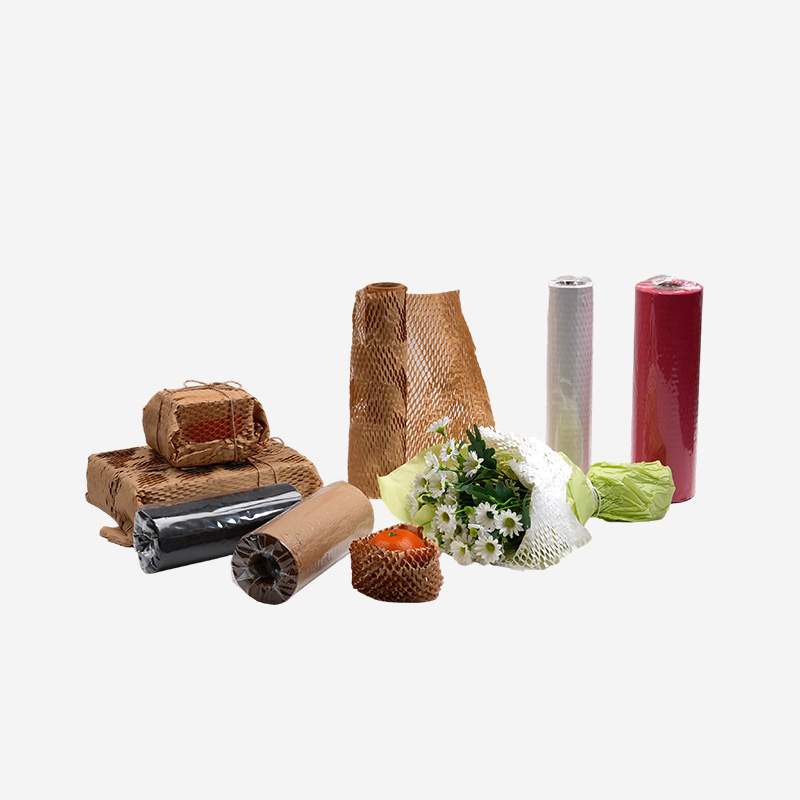
Honeycomb Filling Packing Paper
What Is Honeycomb Filling Packing Paper?
Honeycomb Filling Packing Paper is a stretchable kraft paper packaging material designed for product protection, void filling, wrapping, and decorative presentation. Before expansion, the material is compact and space-efficient. During packaging, an operator pulls and stretches the paper so that the honeycomb pattern opens and forms an elastic-looking cellular structure.
The resulting structure creates multiple contact points around the product. These contact points help distribute pressure and reduce direct contact between the packaged article and the outer carton. The paper can be wrapped around individual products, placed between products, or shaped into filling material inside gift boxes and shipping cartons.
The material is supplied primarily in rolls or cartons. Roll packaging allows businesses to store a substantial quantity of packaging material while using relatively little warehouse space. The paper can be manually expanded at a packing station or integrated into a semi-automated packaging workflow, depending on the customer’s equipment and operating requirements.
The basic structure is simple, but its value comes from the relationship between material strength, pattern geometry, expansion behavior, and conversion quality. A paper that is too weak may tear during stretching. A pattern that is too dense may require excessive pulling force. A pattern that is too open may not provide sufficient wrapping support. Professional manufacturing is therefore essential to ensure that the finished material expands consistently and performs reliably from batch to batch.
How the Honeycomb Structure Works
The paper substrate is processed with a repeated honeycomb pattern. The pattern contains carefully arranged openings and connecting areas that allow the sheet to expand in a controlled direction. When the material is pulled, the openings widen and form three-dimensional cells.
These cells create a cushioning effect in several ways. First, they increase the thickness of the material compared with the original flat paper. Second, they introduce air spaces between the packaged product and the surrounding surface. Third, the connected paper geometry helps distribute localized pressure across a broader area.
When a carton is dropped, compressed, vibrated, or moved through a logistics network, the product may experience forces from several directions. Honeycomb paper does not eliminate all risk, and packaging design must always consider product weight, fragility, carton strength, and shipping conditions. However, it can reduce direct impact and abrasion when correctly selected and applied.
The expanded material can also hold its shape after stretching. This characteristic helps maintain product positioning inside a carton. It is especially useful when several products must be separated or when a package contains irregularly shaped items that might otherwise move during transit.
From Flat Roll to Protective Packaging
Before use, honeycomb paper is compact, easy to transport, and convenient to store. During use, the operator expands only the amount required for the order. This makes it different from bulky preformed foam inserts or large-volume loose-fill materials, which occupy warehouse space even before they are placed around a product.
After expansion, the paper can be used in several forms. It may be wrapped around bottles, ceramics, candles, electronic accessories, or gift items. It may be layered around a fragile product. It may also be crumpled or positioned as a void filler where additional support is required.
The packaging team can combine honeycomb paper with paper shreds, raffia fibers, tissue paper, cartons, sleeves, or molded paper components. This allows businesses to develop packaging systems that balance impact protection, visual appearance, and cost.
Key Product Specifications
The following specifications describe the standard product configuration and the principal customization options available for business buyers.
| Item | Specification | Business Value |
|---|---|---|
| Product name | Honeycomb Filling Packing Paper or Honeycomb Paper Roll | Suitable for wrapping, filling, and protective packaging |
| Base material | Kraft paper | Provides a paper-based alternative to plastic cushioning |
| Paper weight | Custom GSM available | Allows adjustment for light, medium, or heavier products |
| Structure | Expandable honeycomb pattern | Creates a three-dimensional cushioning layer after stretching |
| Processing method | Precision laser-cut pattern | Supports consistent openings and controlled expansion |
| Expansion ratio | Approximately 1.5 to 2.5 times, depending on structure | Enables efficient use and space-saving storage |
| Standard colors | Natural kraft | Creates an authentic and environmentally conscious appearance |
| Custom colors | Dyed colors available | Supports brand identity and seasonal packaging |
| Surface treatment | Uncoated or optional eco coating | Provides different surface and application possibilities |
| Environmental characteristics | Recyclable, biodegradable, and plastic-free options | Supports sustainability targets and packaging compliance |
| Food-contact option | Food-grade paper available when specified | Expands suitability for selected food-related applications |
| Packaging format | Roll or carton packaging | Adapts to warehouse, retail, and production requirements |
Exact performance depends on the selected paper GSM, cell geometry, roll width, expansion ratio, product weight, wrapping method, and shipping environment. For this reason, B2B purchasers should provide application details before finalizing a production specification.

Main Advantages Over Conventional Packaging Materials
1. Paper-Based Plastic Replacement
One of the most important advantages of honeycomb paper is its ability to replace several common plastic packaging materials. It can be used instead of bubble wrap for many light and medium-duty applications. It can also reduce the need for EPE foam, plastic filling pellets, and plastic air pillows.
Paper-based packaging does not automatically solve every environmental issue, but it can simplify material separation and support recycling-oriented packaging systems. Businesses seeking to reduce plastic content can incorporate honeycomb paper into a broader transition that may also include paper tape, corrugated cartons, molded fiber inserts, and paper-based decorative fillers.
For brands communicating a plastic-reduction strategy, the visual appearance of kraft honeycomb paper is also valuable. Customers can immediately see that the package contains a paper-based protective material rather than a layer of plastic film or foam.
2. Efficient Storage and Transportation
Traditional protective materials may occupy considerable warehouse space before use. Bubble wrap rolls can be bulky, foam inserts require dedicated storage, and loose-fill products may be difficult to control. Honeycomb paper is stored in a compact format and expands at the point of packaging.
This compact form can help reduce the amount of warehouse space allocated to protective materials. It can also improve material handling and support more organized packing stations. The exact logistics benefit depends on roll dimensions and expansion behavior, but the general principle is clear: businesses transport and store a concentrated paper material, then create the protective volume when needed.
3. Faster Manual Packaging
Honeycomb paper is designed for straightforward use. Operators can pull the material, expand the cells, and wrap or place it around the product. In many applications, there is no need to pre-cut numerous small pieces or assemble complex inserts.
This can simplify the work of fulfillment teams that process many product sizes in the same facility. A single roll format may accommodate a range of products, reducing the need to maintain multiple preformed insert shapes. The material can be torn or cut to the appropriate length, while the honeycomb structure provides both cushioning and visual presentation.
For companies with semi-automated packaging lines, the product can be evaluated for compatibility with dispensing equipment and workstation layouts. Custom roll widths, winding formats, and packaging configurations may be developed according to production requirements.
4. Improved Product Presentation
Protective packaging is increasingly part of the customer experience. A package should not only arrive without damage; it should also communicate quality, care, and brand values. The three-dimensional honeycomb texture creates a more refined appearance than ordinary crumpled paper.
Natural kraft paper presents a warm, handmade, and environmentally aware image. Custom dyed colors can be used for holiday packaging, corporate gifts, cosmetics, lifestyle products, or limited-edition collections. When combined with printed cartons, labels, ribbons, paper raffia, or decorative yarns, honeycomb paper can become part of a coordinated packaging identity.
5. Flexible Cushioning and Filling
Because the material can be expanded to different degrees, it is suitable for several packaging functions. A lightly expanded layer may protect a surface from scratches. A more open structure may create greater volume for void filling. Additional layers can be used for fragile or irregularly shaped products.
The material can be placed between glass bottles, folded around ceramics, inserted into gift boxes, or positioned along the edges of a shipping carton. It can also stabilize products that might otherwise move during transportation.
6. Compatibility with Sustainable Packaging Programs
Many companies are building sustainability programs around recyclable packaging, reduced material complexity, lower plastic usage, and improved supply-chain transparency. Honeycomb paper can support these goals when its paper grade, coating, ink, adhesive, and packaging configuration are selected appropriately.
For export businesses, the material can also help address customer requests related to plastic reduction and recyclable packaging. Compliance requirements vary by destination, product category, and local regulation. Buyers should confirm the appropriate paper grade and documentation for their specific market rather than relying on general environmental claims.
Applications Across B2B Industries
E-Commerce and Cross-Border Logistics
E-commerce businesses often handle a large variety of products. Orders may include cosmetics, electronics, accessories, household goods, candles, ornaments, and fragile gift items. A packaging material that can adapt to different shapes is useful because it reduces dependence on product-specific foam inserts.
Honeycomb paper can be used around small electronics such as earphones, chargers, cables, devices, and accessories. It can protect cosmetic bottles and skincare containers from surface abrasion while helping restrict movement inside the carton. For glassware, ceramics, fragrance bottles, and decorative items, the material can add a paper cushioning layer around the product.
Cross-border shipments may pass through multiple sorting centers and experience vibration, compression, manual handling, and changes in transport conditions. Honeycomb paper should be used together with suitable outer cartons and, when necessary, additional corner protection or inner partitions. Its role is to contribute to a complete packaging system rather than serve as the only protective element in every application.
Gift and Premium Packaging
Gift packaging requires both protection and appearance. A product may need to remain secure inside the box while also creating a positive unboxing experience. Honeycomb paper can fill empty areas, frame the product, and provide a textured background for premium presentation.
It is suitable for seasonal gift boxes, Christmas packaging, birthday gifts, wedding favors, promotional kits, and corporate gift programs. Natural kraft is appropriate for rustic, handmade, and environmentally positioned brands. Colored paper can support holiday themes or match a company’s visual identity.
For premium packaging, honeycomb paper can be combined with paper raffia yarn, crinkle paper shreds, decorative cords, tissue paper, and printed cards. These materials can create layered presentation without relying heavily on plastic films or synthetic fillers.
Handmade and Lifestyle Brands
Handmade products often have unusual shapes, delicate surfaces, or an artisanal visual identity. Candles, soaps, fragrance products, small ceramics, art pieces, and home accessories benefit from packaging materials that appear natural and carefully selected.
Honeycomb paper can protect handmade goods while reinforcing the character of the brand. Its texture gives the interior of a parcel a more intentional appearance than random loose fill. For direct-to-consumer brands, this can contribute to a consistent opening experience across different product lines.
Warehousing and Industrial Logistics
In warehouses, products may need protection during storage before shipment. Honeycomb paper can be used as an anti-scratch layer, a separator between mixed products, or a buffer around items placed in shared cartons.
It can also help stabilize products during internal movement. When goods are transferred between production, storage, inspection, and dispatch areas, temporary paper cushioning may reduce surface contact and prevent items from shifting against one another.
Retail and Product Display Packaging
Retailers and distributors increasingly require packaging that functions well in transportation and still looks presentable when opened or displayed. Honeycomb paper can provide a consistent inner-packaging appearance for multi-unit product sets, seasonal collections, and promotional bundles.
Because the material is available in custom widths, GSM options, and colors, it can be adapted to different carton sizes and product combinations. Packaging distributors can therefore offer it as part of a wider protective-material portfolio.
Manufacturing Process and Quality Strengths
The performance of honeycomb packing paper depends heavily on manufacturing accuracy. A professional supplier must control the paper substrate, cutting pattern, expansion behavior, winding tension, roll dimensions, packaging method, and batch consistency.
Zhejiang Raffia Paper Products Co., Ltd. brings more than ten years of experience in paper-based craft and packaging-material manufacturing. The company originated from a craft materials business unit established in 2010 and was formally founded in 2014. Over time, it developed from a trading enterprise into an integrated manufacturer with capabilities covering material processing, production, testing, packaging, and shipment.
The company operates a modern production base in Dongyang, Zhejiang Province, covering approximately 20,000 square meters and employing more than 200 professional workers. Its manufacturing structure is supported by standardized procedures and a quality-control system designed to make production results consistent and repeatable.
Material Preparation and Paper Selection
The first stage of reliable honeycomb paper production is selecting and preparing the appropriate kraft paper. Paper GSM, fiber composition, moisture behavior, surface condition, and tensile strength all influence the final product.
Different packaging applications require different balances between flexibility and strength. A lightweight paper may be suitable for gift-box filling or small products, while a heavier grade may be preferred for larger items or more demanding shipping conditions. The company can support custom GSM selection to align the material with the customer’s product and packaging method.
Paper preparation must also consider the final expansion process. The material must be strong enough to open without uncontrolled tearing while remaining flexible enough for manual wrapping. Consistent input quality is therefore essential for stable conversion performance.
Precision Pattern Processing
The honeycomb pattern is created through a controlled laser-cutting process. Pattern accuracy affects cell size, opening behavior, expansion ratio, and tensile performance. Consistent processing allows the paper to expand more evenly across the roll.
Precision processing is particularly important for customers using high-volume packing operations. If the pattern opens inconsistently, operators may experience different pulling forces, irregular wrapping surfaces, or unexpected tearing. A controlled production process reduces these variations and improves the predictability of the material.
Pattern density can be adjusted for different applications. A denser pattern may provide a finer texture and more continuous contact around small products. A more open structure may provide greater volume and stronger visual expansion for filling applications. The appropriate design depends on the intended product category and performance target.
Slitting, Winding, and Roll Conversion
After pattern processing, the paper may be slit into specific widths and wound into rolls. Slitting accuracy is important because the roll must fit the customer’s packing station, dispenser, or automated equipment.
Winding tension must also be controlled. If a roll is wound too loosely, it may deform during storage or transport. If it is wound too tightly, operators may find it difficult to expand the material. Stable winding supports easier dispensing and more consistent use at the packing station.
The company’s experience in slitting, twisting, winding, and compression packaging provides a strong manufacturing foundation for paper-based packaging products. These processes are managed as part of an integrated production chain rather than as isolated operations.
Quality Inspection and Batch Control
Quality control should cover both the raw paper and the finished roll. Important checkpoints may include paper appearance, GSM, width, pattern accuracy, expansion behavior, tensile performance, roll condition, packaging integrity, and labeling accuracy.
For B2B customers, batch consistency is often more important than a single sample. A packaging operation may use the same material every day, and changes in expansion or strength can affect productivity and damage rates. A standardized quality-control system helps the supplier reproduce the approved specification across repeat orders.
Customers with special requirements can discuss inspection procedures, sample approval, packaging marks, testing documents, and product-specific acceptance criteria before mass production. This is especially important for export orders and private-label programs.
Integrated Packaging and Shipment
The company manages finished-goods packaging and shipment within its integrated manufacturing chain. Proper compression packaging helps protect rolls during transportation and keeps the product organized for warehouse handling.
Carton packaging can be selected according to roll size, order quantity, destination, and customer requirements. Clear labeling supports inventory management and helps distributors identify specifications quickly after receipt.
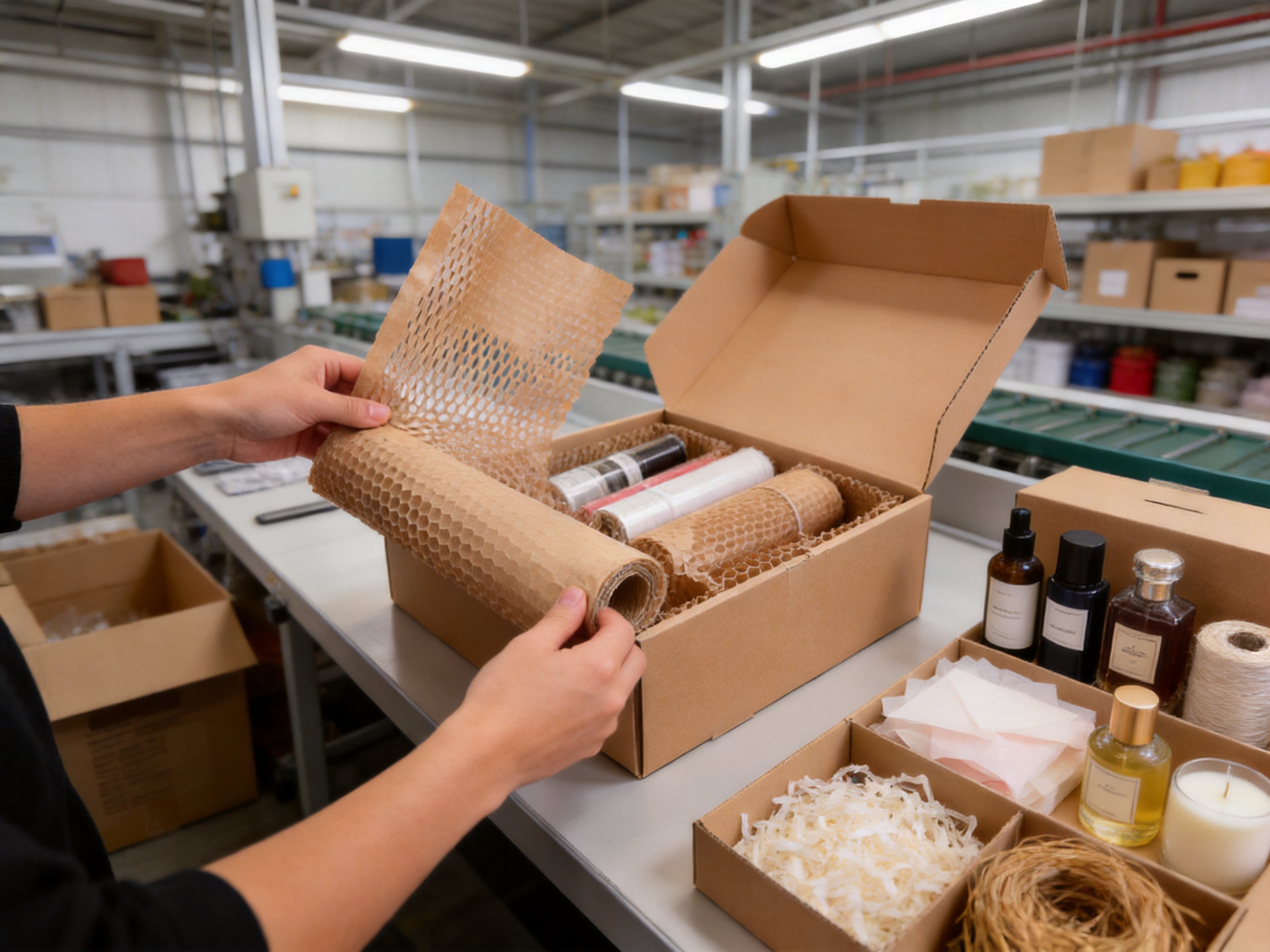
OEM and ODM Customization Capabilities
Many businesses do not want a generic packaging material. They need a product that fits their machinery, carton sizes, brand guidelines, sales channels, and target market. Honeycomb Filling Packing Paper can be customized in several important areas.
Custom Width and Roll Format
Roll width can be adjusted to suit the product dimensions and packing station. A narrow roll may be convenient for small gift boxes or individual products. A wider roll may be more efficient for larger cartons or broad wrapping applications.
Roll length, winding direction, core dimensions, and outer packaging can also be reviewed according to the buyer’s equipment and warehouse system. These details can improve material handling and reduce unnecessary conversion work after delivery.
Custom GSM and Strength
Paper GSM is one of the principal variables affecting product performance. Customers can select a lighter or heavier paper grade depending on the intended use. Fragile products, heavier items, and longer transportation routes may require a stronger specification than small decorative applications.
The supplier can evaluate the customer’s product weight, dimensions, carton type, expected handling conditions, and desired expansion ratio before recommending a suitable structure. Testing is advisable before a large-scale launch.
Custom Honeycomb Density
Honeycomb density influences the appearance, expansion behavior, and cushioning characteristics of the material. A fine honeycomb structure may be useful for small articles and premium presentation. A more open structure may be suitable when the primary objective is volume filling or rapid wrapping.
Customization allows businesses to avoid using the same material for every application. Instead, they can develop a packaging specification that matches the product category and operating workflow.
Custom Colors and Brand Systems
Natural kraft remains a popular choice because it communicates simplicity and environmental awareness. However, dyed colors can create stronger brand recognition or support seasonal campaigns.
Color development should consider visual consistency between the honeycomb paper, carton, label, ribbon, paper raffia, and other packaging components. For private-label customers, the manufacturer can discuss color references, packaging labels, and external carton design.
Logo Printing and Packaging Identification
Custom logo printing may be available for suitable product formats and order volumes. Brand marks can be used to reinforce identity within the package or on the outer packaging. Buyers should confirm print location, ink compatibility, print coverage, color requirements, and minimum order conditions.
Even when the honeycomb paper itself remains unprinted, customized cartons and labels can provide clear product identification for distributors and fulfillment teams.
Application-Based Development
Different industries require different packaging solutions. Electronics may require anti-scratch separation and compact wrapping. Cosmetics may require an attractive presentation and bottle stabilization. Wine or fragrance packaging may require greater attention to glass protection. Gift packaging may prioritize appearance and texture.
ODM development can address these differences through adjustments to paper GSM, pattern density, tensile strength, width, expansion ratio, and packaging format. This application-based approach is more effective than treating all honeycomb paper as an identical commodity.
Why B2B Buyers Choose This Material
Businesses usually purchase packaging material to solve operational problems. Environmental positioning is important, but it is only one part of the buying decision. The material must also be available in stable quantities, perform consistently, fit the packing process, and support acceptable total cost.
Reducing Shipping Damage
Shipping damage can result in refunds, replacement costs, negative reviews, customer-service workload, and loss of brand trust. Honeycomb paper helps reduce movement, abrasion, and direct impact when it is matched correctly to the product.
Its effectiveness depends on the entire packaging design. The outer carton must be strong enough, the product should be correctly positioned, and the paper should provide adequate coverage. Nevertheless, honeycomb paper can be an important part of a damage-reduction strategy.
Improving Packaging Efficiency
Businesses processing hundreds or thousands of orders need materials that are easy to use. Honeycomb paper can reduce the number of steps required to prepare protective packaging. Operators can pull, expand, wrap, and place the material without assembling a complex insert for every product.
This is particularly useful for companies selling products in multiple sizes. A flexible roll material can adapt to different order combinations and reduce the need for many specialized packaging components.
Controlling Warehouse Requirements
Compact roll storage can help companies manage limited warehouse space. Materials that expand during use are often more efficient to store than materials that arrive already expanded. Better storage organization may also reduce handling time and improve replenishment planning.
Supporting Brand Value
Packaging influences how customers perceive the product. A clean, well-organized interior suggests care and professionalism. Honeycomb paper provides a consistent texture and can help brands create a recognizable packaging style.
For private-label businesses and premium product manufacturers, the material can support a unified visual language across online orders, retail packaging, corporate gifts, and promotional shipments.
Supporting Global Sustainability Expectations
Customers and regulators in many markets are paying closer attention to packaging waste and plastic consumption. A recyclable and biodegradable paper-based option can support a company’s efforts to improve its packaging profile.
Businesses should still verify the exact requirements of each market. Environmental claims must correspond to the actual material, coatings, inks, adhesives, and disposal conditions. Zhejiang Raffia Paper Products Co., Ltd. can discuss suitable paper grades and documentation for different export applications.
Application and Performance Comparison
| Packaging Material | Main Strength | Common Limitation | Role of Honeycomb Paper |
|---|---|---|---|
| Bubble wrap | Lightweight air cushioning | Plastic-based and less aligned with plastic-free packaging goals | Paper-based alternative for many wrapping applications |
| EPE foam | Strong cushioning and formed protection | Requires more product-specific shapes and creates plastic waste | Flexible material for wrapping and filling without dedicated foam molds |
| Plastic air pillows | Rapid void filling | Plastic film disposal and equipment dependence | Paper-based void filling and separation option |
| Loose paper fill | Recyclable and easy to source | May shift inside the carton and provide inconsistent presentation | Structured filling with a more controlled appearance |
| Traditional flat paper | Simple and recyclable | Limited cushioning when used alone | Expanded three-dimensional protection with paper-based construction |
| Honeycomb Filling Packing Paper | Wrapping, cushioning, filling, storage efficiency, and presentation | Requires correct expansion and specification selection | Combines several packaging functions in one material |
This comparison is not intended to suggest that one material is suitable for every product. Heavy industrial goods, hazardous materials, high-value precision equipment, and extremely fragile products may require specialized protective systems. The advantage of honeycomb paper is its versatility across a broad range of light and medium-duty applications.
Recommended Use in a Packaging Workflow
A packaging team should begin by selecting an outer carton that is appropriate for the product’s dimensions and weight. The product should then be inspected for protruding edges, delicate surfaces, or areas that require additional support.
The operator can cut or dispense an appropriate length of honeycomb paper. The paper is gently stretched to open the cells. Excessive force should be avoided because it may damage the structure or reduce the material’s ability to wrap smoothly.
The expanded paper can then be wrapped around the product or positioned around it as a cushioning layer. For a carton containing several items, paper may be placed between products to reduce direct contact. Additional material can be inserted into empty spaces to limit movement.
After the carton is closed, the package should be checked for excessive movement. A properly packed carton should hold the product securely without applying damaging pressure. Packaging trials should include drop, vibration, compression, and handling tests appropriate to the product and shipping route.
For repeated orders, companies can establish standard operating procedures that specify roll width, material length per order, expansion method, wrapping sequence, and carton configuration. This can improve labor consistency and reduce material waste.
Quality, Compliance, and Purchasing Considerations
B2B buyers should review several factors before placing a production order. These include material grade, paper GSM, roll width, roll length, expansion ratio, honeycomb density, color, surface treatment, packaging method, labeling, and minimum order quantity.
If the material will be used near food or in food-related packaging, the buyer should specify the required food-contact grade in advance. Food-contact suitability depends on the paper, coating, ink, adhesive, and intended use conditions. It should be supported by relevant documentation rather than assumed from the appearance of the paper.
Export buyers should also confirm the environmental and regulatory requirements of their destination. Recyclability, biodegradability, and plastic-free status may depend on local collection systems and the complete packaging configuration. The manufacturer can help identify a suitable specification, while the buyer remains responsible for confirming market-specific obligations.
Samples are recommended before mass production. A sample evaluation can examine expansion force, tear resistance, product coverage, visual appearance, carton fit, and packing speed. For industrial buyers, a small production trial may provide more useful information than a visual sample alone.
Because this product is intended for B2B bulk procurement, production efficiency and order planning are important. Minimum order quantities may apply, particularly for custom colors, special widths, printed packaging, customized density, or application-specific development.
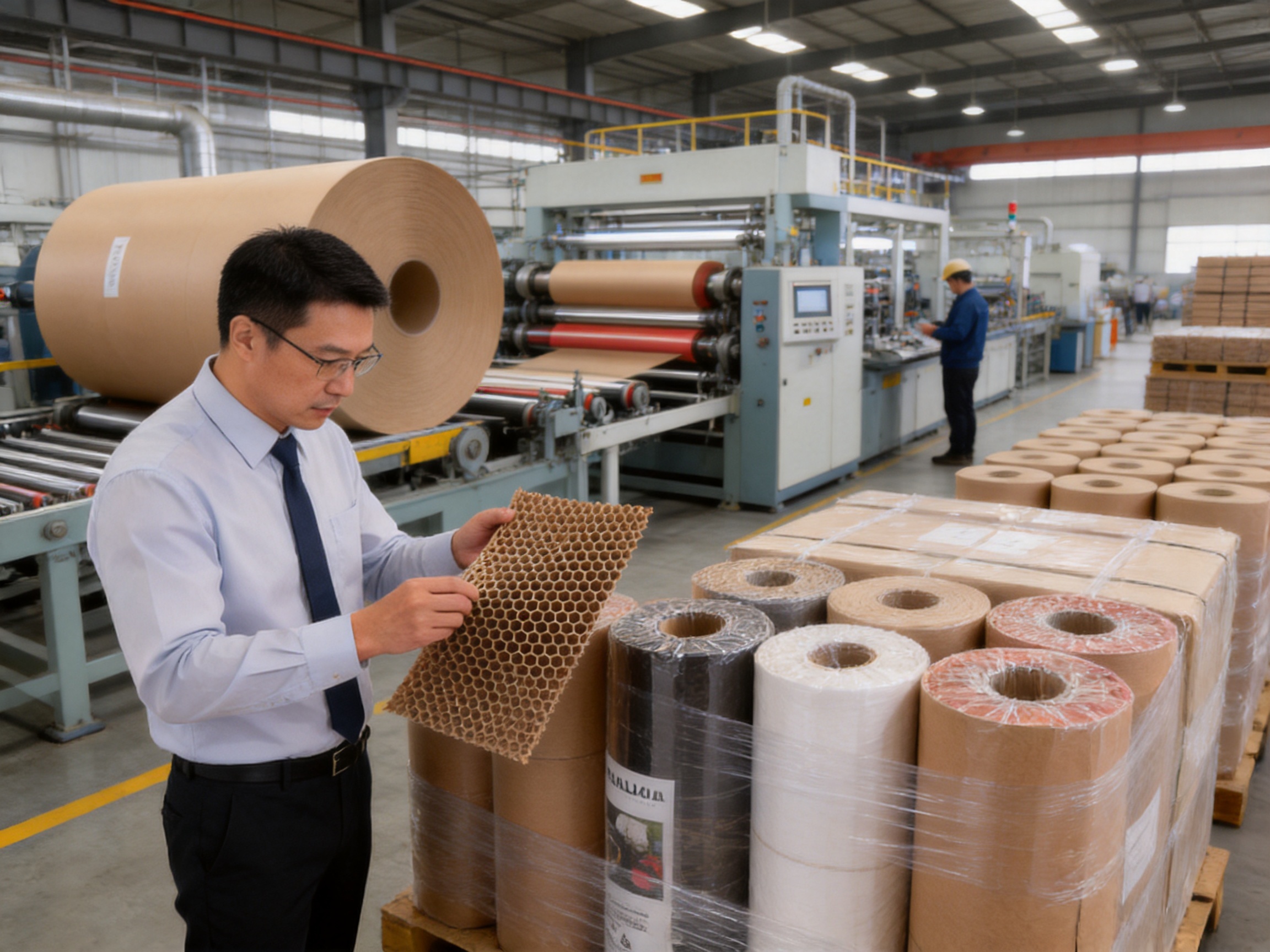
Company Manufacturing Capability
Zhejiang Raffia Paper Products Co., Ltd. is a professional paper-product manufacturer based in Dongyang, Zhejiang Province, China. The company specializes in paper raffia yarn, raffia paper, DIY cords, fancy yarns, gift packaging materials, and customized OEM and ODM solutions.
Its development from a craft-materials business unit into an integrated manufacturing company gives it experience in both decorative and functional paper products. This combination is valuable for buyers who want honeycomb paper to work together with paper shreds, raffia fibers, decorative cords, yarns, and other gift-packaging components.
The company’s production base covers approximately 20,000 square meters and includes more than 200 professional employees. Its annual production capacity exceeds 200 million pieces across its product range. The integrated chain includes raw-material processing, mass production, quality testing, finished-goods packaging, and shipment.
Manufacturing experience includes slitting, twisting, winding, and compression packaging, supported by standardized operating procedures. These capabilities help the company manage the detailed conversion requirements associated with paper rolls and packaging materials.
The company serves customers in China and exports to Europe, North America, South America, Asia, and other regions. Its products and services have been used by brands including Costco, IKEA, LOKLIK, Disney, Lancôme, Chanel, Dior, and Primark. Such customer experience reflects the company’s ability to support quality consistency, customization, and supply requirements across different markets.
For B2B customers, the company emphasizes consistent batch quality, on-time delivery, sustainable supply-chain development, flexible OEM and ODM services, custom size development, and long-term bulk-order cooperation.
Frequently Asked Questions
What is Honeycomb Filling Packing Paper used for?
It is used for protective wrapping, carton filling, product separation, gift-box presentation, anti-scratch buffering, and shipment stabilization. Typical products include cosmetics, candles, glassware, ceramics, fragrance bottles, electronics accessories, handmade goods, and premium gifts.
How is honeycomb paper different from bubble wrap?
Honeycomb paper is made from an expandable paper structure, while bubble wrap is made from plastic film containing air pockets. Honeycomb paper supports paper-based and plastic-reduction packaging systems and provides a textured appearance suitable for gift and brand packaging.
Can it protect fragile products?
Yes, it can help protect fragile products such as glass, ceramics, cosmetic bottles, and fragrance containers. The correct paper GSM, honeycomb density, wrapping method, carton strength, and additional protective components should be selected according to product fragility and shipping conditions.
Does honeycomb paper replace all foam and plastic packaging?
It can replace bubble wrap, some EPE foam applications, plastic filling pellets, and plastic air pillows in many light and medium-duty packaging situations. It is not automatically suitable for every heavy-duty or highly specialized application. Product testing is recommended before full adoption.
How much does honeycomb paper expand?
The approximate expansion ratio is 1.5 to 2.5 times, depending on the structure, pattern density, and selected specification. Actual expansion also depends on how far the operator stretches the material during use.
Can the material be customized?
Yes. Available customization may include GSM, roll width, roll format, honeycomb density, tensile strength, expansion behavior, color, surface treatment, packaging, labeling, and logo printing. Customization depends on the order volume and technical requirements.
Is custom color available?
Yes. Natural kraft is a standard choice, and dyed colors can be developed for brand programs, seasonal packaging, corporate gifts, and coordinated product presentation.
Can honeycomb paper be used with other filling materials?
Yes. It can be combined with paper shreds, raffia fibers, tissue paper, decorative yarns, cartons, and molded paper inserts. Combining materials can improve visual layering, product separation, and cushioning performance.
Is food-grade paper available?
Food-grade paper can be available when specified during product development. Buyers should identify the intended food-contact use in advance and request the appropriate documentation and material configuration.
Is the product suitable for small retail orders?
The product is designed primarily for manufacturers, brand owners, e-commerce companies, packaging distributors, and supply-chain businesses purchasing in bulk. Minimum order quantities may apply, and the company does not position this product as a small DIY retail item.
What information should a buyer provide for a quotation?
A buyer should provide product type, product dimensions, product weight, carton size, intended application, expected monthly quantity, roll width, preferred GSM, color, expansion requirements, destination market, packaging requirements, and any OEM or ODM expectations.
Can the product be used in automated packaging equipment?
It can be evaluated for semi-automated or automated packaging processes. Compatibility depends on roll dimensions, core size, dispensing direction, winding tension, expansion behavior, and machine design. Equipment requirements should be discussed before production.
Conclusion
Honeycomb Filling Packing Paper is more than a decorative paper filler. It is a functional packaging material that expands into a three-dimensional structure for wrapping, cushioning, filling, separation, and presentation. Its kraft-paper construction offers a practical route toward reducing plastic packaging, while its compact roll format supports efficient storage and distribution.
The material provides value to e-commerce companies, exporters, gift brands, handmade businesses, logistics operators, packaging distributors, and manufacturers seeking more flexible packaging systems. Compared with conventional bubble wrap, foam, plastic pellets, and loose-fill solutions, it combines paper-based sustainability, adaptable use, attractive appearance, and convenient handling.
Its performance depends on correct specification and manufacturing precision. Paper GSM, pattern density, expansion ratio, roll format, cutting accuracy, winding quality, and batch control all affect the final packaging result. This is why an experienced integrated manufacturer is important for buyers requiring reliable supply and repeatable quality.
With a modern production base, more than ten years of industry experience, standardized manufacturing procedures, integrated quality control, and OEM and ODM capabilities, Zhejiang Raffia Paper Products Co., Ltd. can support businesses developing plastic-free packaging systems and customized paper-based presentation solutions. Through appropriate testing and application design, honeycomb paper can become a dependable component of a safer, more efficient, and more environmentally responsible packaging program.
References
1. Zhejiang Raffia Paper Products Co., Ltd., Product Specification Information for Honeycomb Filling Packing Paper.
2. Zhejiang Raffia Paper Products Co., Ltd., Company Manufacturing and OEM/ODM Capability Profile.
3. General principles of paper-based protective packaging, packaging-material selection, and distribution testing.
4. General industry guidance on recyclable packaging design, plastic reduction, and sustainable supply-chain development.
Product: Honeycomb Filling Packing Paper

 +86 15355323399
 kevin@raffia-paper.com
 No. 151 Guanshan North Road, Dongyang City, Zhejiang Province, China

Copyright © Zhejiang Raffia Paper Products Co., Ltd. All Rights Reserved.

Paper Raffia Yarn & Gift Packaging Factory