
 +86 15355323399
 En
 中文简体
 日本語
 Français
 Español
 Deutsch
 Türk
 عربى
 italiano
 русский
Paper Raffia Fancy Yarn: An Industrial Material for Consistent Weaving and Sustainable Packaging
Introduction
Paper Raffia Fancy Yarn is a specialty paper-based yarn developed for industrial weaving, gift packaging, craft-kit production, and standardized supply chains. Unlike ordinary decorative string or short-run handmade raffia, it is designed as a repeatable manufacturing input for buyers who require stable quality, scalable production, and flexible packaging options.
The yarn is produced from raffia-specific specialty craft paper, a high-tensile paper-based material selected for its lightweight structure, shaping performance, and suitability for twisting and winding. Through controlled slitting, forming, twisting, coloring, winding, and packaging processes, the material achieves a visual effect similar to natural straw fibers while offering greater consistency from batch to batch.
For manufacturers, distributors, packaging suppliers, and cross-border e-commerce brands, this consistency is one of the product’s most important advantages. Natural straw and other plant-based fibers can vary in color, moisture content, thickness, texture, and tensile behavior. Paper Raffia Fancy Yarn is designed to reduce those fluctuations and provide a more predictable material for repeatable production.
The product is available in multiple strand structures, winding formats, colors, weights, diameters, and packaging configurations. It can also be customized through Pantone color matching, twist adjustment, coating, blending, private labeling, and OEM packaging development. These capabilities enable buyers to use one material platform across weaving products, gift packaging, DIY kits, retail displays, and industrial bulk applications.
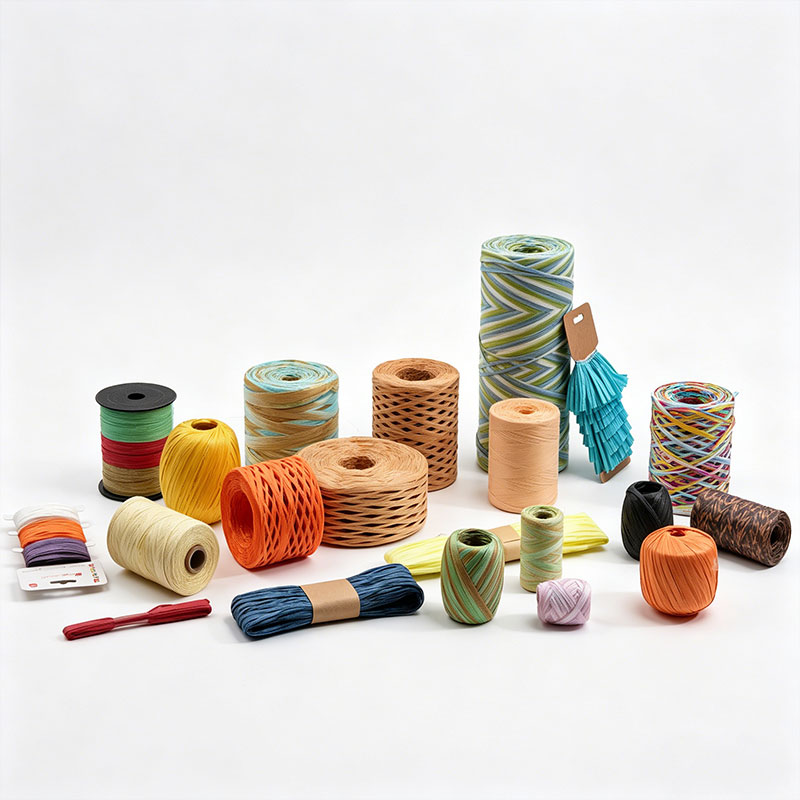
Paper Raffia Fancy Yarn
What Is Paper Raffia Fancy Yarn?
Paper Raffia Fancy Yarn is an industrial weaving yarn made from raffia-specific specialty craft paper. The paper is processed into narrow strips or suitable base forms and then converted into yarn through specialized forming and twisting procedures.
Although the finished product has a soft, natural, straw-like appearance, it is not simply a decorative cord. It is a structured production material. The yarn can be supplied in single-strand, double-twisted, triple-strand, or multi-strand configurations, depending on the required strength, flexibility, appearance, and application.
The product is suitable for manufacturers that need an alternative to less consistent natural fibers. Its paper-based construction provides a balance between low weight, visual appeal, and shaping capability. When used in weaving, it can help products retain their intended form. When used in packaging, it can provide a refined natural look while supporting standardized filling, tying, and bundling operations.
Its industrial positioning also distinguishes it from ordinary consumer craft yarn. The material can be ordered in bulk, supplied in different winding formats, packed under a customer’s brand, and adjusted to meet a specific product specification. This makes it suitable for wholesalers, OEM manufacturers, brand supply-chain departments, packaging companies, and cross-border e-commerce sellers.
Core Material Characteristics
Paper-based structure: The main raw material is raffia-specific specialty craft paper. This construction supports lightweight production and contributes to the product’s natural visual character.
Shaping capability: The yarn has useful stiffness and form retention. It can support woven structures, decorative bows, packaging arrangements, and handmade products that require the material to retain a designed shape.
Adjustable flexibility: Twist level and softness can be customized. Low-twist versions are suitable for more flexible applications, while higher-twist formats can offer a firmer and more stable structure.
Standardized appearance: Controlled production helps maintain more consistent color, diameter, texture, and winding quality compared with many unstandardized natural materials.
Multiple supply forms: The yarn can be supplied in bags, hang-tag cards, segmented cards, industrial rolls, bundled packages, and other formats created for distribution or manufacturing requirements.
Advantages Over Conventional Alternatives
More Consistent Than Unprocessed Natural Straw
Natural straw, grass, and similar fibers can provide an attractive organic appearance, but their characteristics may vary according to growing conditions, harvesting time, moisture, storage, and processing methods. Differences in fiber length, thickness, stiffness, and color can create difficulties for manufacturers working with standardized designs.
Paper Raffia Fancy Yarn is manufactured under controlled conditions. The paper base, slitting dimensions, twisting process, winding tension, and packaging procedures can be managed according to defined production standards. This helps buyers reduce variation in finished products and improve the repeatability of manufacturing operations.
For brands selling the same woven bag, hat, gift box, or craft kit across multiple markets, predictable material behavior is particularly valuable. A consistent yarn can reduce adjustments on the production line, simplify quality inspection, and help maintain a more uniform appearance across production batches.
More Scalable Than Handmade Decorative Cord
Handmade decorative cords may be attractive for limited collections, but they are not always suitable for continuous industrial production. Manual processing can create differences in thickness, tension, twist, and overall appearance. It may also be difficult to maintain supply when order volumes increase rapidly.
Paper Raffia Fancy Yarn is produced using equipment and procedures designed for slitting, twisting, winding, compression packaging, and quality control. This makes it more suitable for bulk orders and long-term procurement programs. Buyers can establish repeatable specifications rather than relying on individual artisans or irregular small-batch sources.
The material is also compatible with private-label and OEM programs. A company can specify a color system, yarn diameter, twist level, winding shape, weight, packaging design, and labeling format. These requirements can then be integrated into a stable supply program.
More Flexible Than Single-Purpose Packaging String
Many packaging strings are designed only for tying cartons, gift boxes, or bags. Paper Raffia Fancy Yarn has a broader functional range. Depending on its structure, it can be used for weaving, crochet-style production, basketry, decorative filling, gift packaging, DIY kits, and retail display materials.
This multi-application capability allows buyers to consolidate procurement. A distributor may offer the yarn to packaging customers, craft retailers, textile manufacturers, and e-commerce brands. A brand may use different specifications of the same material family in gift boxes, product packaging, seasonal collections, and creative kits.
Lightweight and Efficient for Transportation
The paper-based structure provides a lightweight material option. Low weight can support efficient storage, handling, and transportation, especially when the yarn is ordered in large quantities or distributed through international supply chains.
Different winding formats can also improve warehouse organization. Compact egg rolls and small spools are suitable for retail distribution, while hollow large rolls and bundled packages are designed for larger production environments. Buyers can select a format that matches their equipment, packing process, storage conditions, and sales channel.
Suitable for Environmental Supply-Chain Goals
Paper Raffia Fancy Yarn is based on a paper structure and is positioned as an eco-friendly material option for craft, packaging, and weaving applications. The product is described as compatible with common EU environmental requirements such as REACH and RoHS, with test reports available upon request.
Environmental compliance should always be confirmed according to the exact product specification, destination market, applicable regulations, and available documentation. Nevertheless, the paper-based construction can support brands that are seeking alternatives to certain plastic-heavy decorative materials or less transparent raw-material sources.
For international buyers, documentation and traceability are increasingly important. A structured production system, standardized material specifications, and available compliance reports can make the procurement process more manageable than sourcing from fragmented informal channels.
Manufacturing Process and Technical Strengths
The performance of Paper Raffia Fancy Yarn depends not only on its raw material but also on the way that material is processed. The manufacturing system includes several connected stages, from paper preparation to final packaging and shipment.
Specialty Paper Preparation
The process begins with raffia-specific specialty craft paper selected for suitable strength, flexibility, surface quality, and processing behavior. The base material must be appropriate for conversion into narrow strands or yarn-like structures while maintaining an attractive finish.
Paper preparation may include inspection, conditioning, sizing, and preparation for slitting. Consistent preparation helps reduce defects during later processing. It also supports more stable results when the material is dyed, coated, twisted, blended, or wound.
Precision Slitting
Slitting converts the paper material into controlled widths or suitable strip structures. This stage is important because strip width affects the final yarn diameter, hand feel, visual density, twisting behavior, and finished-product strength.
Controlled slitting helps manufacturers produce different yarn specifications within a defined range. The available yarn diameter can be customized from approximately 1 millimeter to 7 millimeters, depending on the product design and application requirements.
Consistent slitting also improves downstream performance. When strips have a more uniform width, twisting equipment can operate more smoothly, and the resulting yarn is more likely to maintain a consistent profile across the roll or bundle.
Forming and Twisting
After slitting, the paper strips are formed into the selected yarn structure. Twisting combines the paper elements and determines much of the product’s strength, flexibility, softness, and appearance.
A flat single strand is lightweight and flexible. It can be used for openwork weaving, lightweight tying, and applications where a flatter visual effect is preferred. A double-twisted strand provides a balance between flexibility and strength and is a common general-purpose specification. Triple-strand and multi-strand structures provide a firmer construction for higher-load applications, industrial packaging, and larger woven products.
Twist level can be adjusted to produce low, medium, or high twist. Low twist may provide a softer and more relaxed appearance, while high twist can improve structure and handling stability. The appropriate selection depends on whether the final product requires drape, stiffness, load-bearing capability, or shaping performance.
Coloring and Color Control
Color is a critical factor in packaging, retail presentation, and brand development. Standard colors include off-white, beige, black, macaron pink, blue, and yellow, while custom colors can be developed according to customer requirements.
Pantone color matching is available for projects that require brand consistency. Gradient and mixed-color options can also be developed for seasonal collections, gift packaging, craft kits, and creative retail displays.
Color control is especially important in repeat orders. A stable color system helps brands maintain a consistent visual identity and reduces the risk of noticeable differences between production batches. The final color result may depend on the paper base, coating, dyeing process, lighting conditions, and destination-market requirements, so approval samples are recommended before mass production.
Coating and Blending Development
The yarn can support post-processing and product development involving coating, blending, or additional surface treatment. These options allow the material to be adapted for different appearance and performance goals.
Polyester blending can improve durability for everyday woven products. Metallic yarn blending in gold or silver can add a decorative shine suitable for festive packaging, holiday collections, weddings, and premium gift sets. Feather yarn blending can create a softer, fluffier texture for high-end handmade products and decorative applications.
Custom blending ratios are available according to the desired visual and functional result. The final formulation should be tested for compatibility with the intended production process, particularly when the material will be woven, crocheted, tied, compressed, or exposed to repeated handling.
Winding and Compression Packaging
Winding is more than a presentation step. It affects how quickly the material can be unwound, how much space it occupies, how easily it can be stored, and how well it fits a specific production or retail channel.
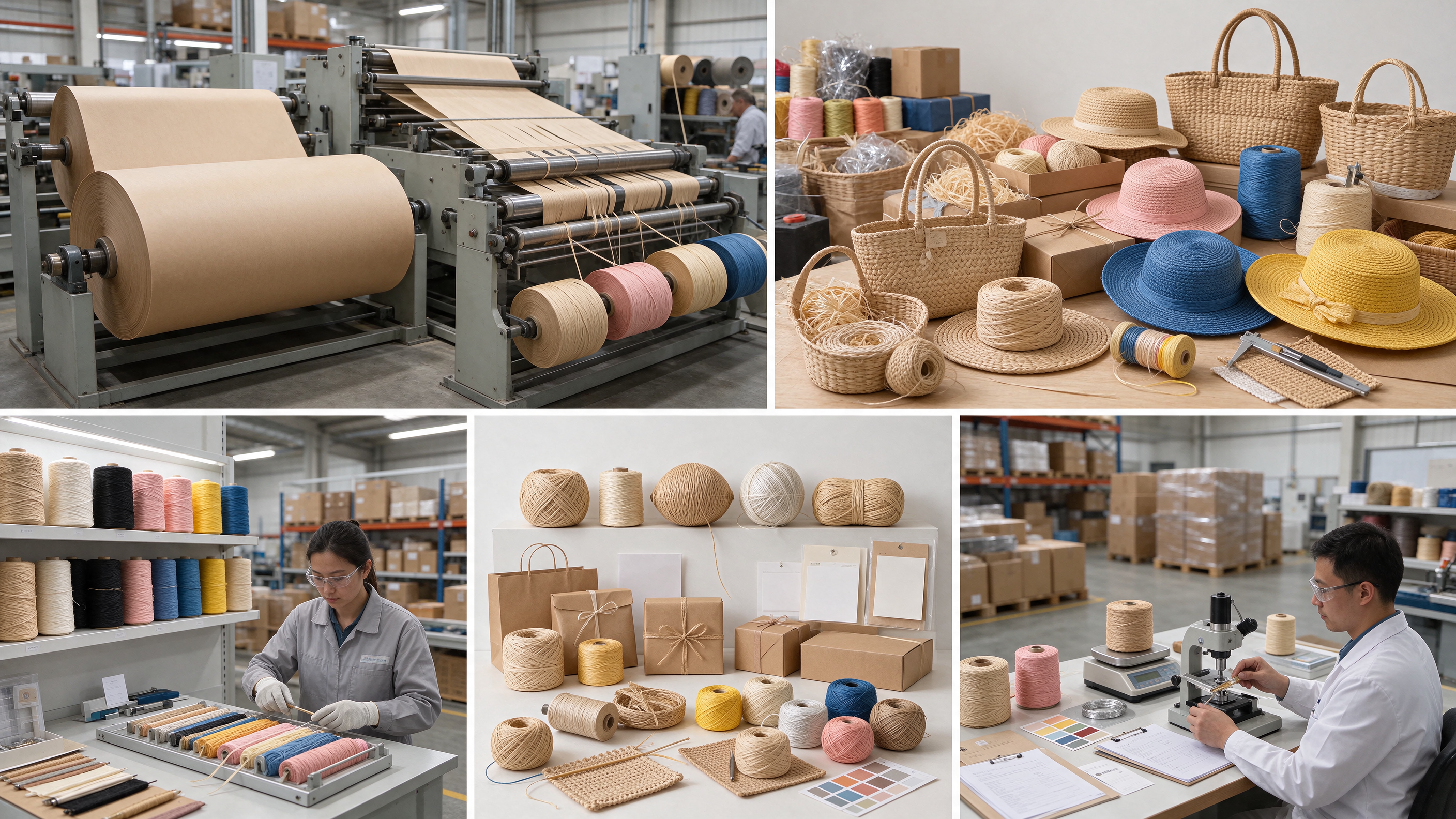
Modern winding equipment supports multiple forms, including compact egg rolls, small spool rolls, rugby ball rolls, balloon sphere rolls, hollow large rolls, and bundled packages. Compression packaging can improve shipping efficiency and help protect the product during transportation and storage.
Before shipment, finished goods can be packed in standard bags, cards, cartons, or industrial bulk formats. This integrated approach helps connect manufacturing with logistics and makes it easier to prepare orders for wholesale distribution, retail display, or OEM delivery.
Product Specifications and Customization
Item |
Typical Specification |
Product name |
Paper Raffia Fancy Yarn |
Raw material |
Raffia-specific specialty craft paper |
Available colors |
Off-white, beige, black, macaron pink, blue, yellow, and customized colors |
Weight range |
Customizable, commonly 50 g to 200 g |
Yarn diameter |
Customizable, commonly 1 mm to 7 mm |
Twist level |
Low, medium, or high twist |
Packaging types |
Bag, hang-tag card, segmented card, industrial bulk roll, or bundled package |
Environmental documentation |
REACH/RoHS-compatible positioning; test reports available upon request |
Minimum order quantity |
Starting from 500 units, subject to project specifications |
Standard lead time |
Approximately 7 to 15 days for standard production |
Weight and Diameter
Weight and diameter are two of the most important variables when selecting yarn for a project. Lightweight formats may be appropriate for gift tying, delicate weaving, openwork designs, and small craft kits. Heavier or larger-diameter structures may be better suited to baskets, storage products, large woven accessories, and industrial packaging.
Customization helps manufacturers align the yarn with existing equipment and product specifications. It can also support a coordinated product range in which several diameters are offered under the same brand or material series.
Twist and Softness
Twist level affects both the user experience and the final product’s appearance. A low-twist yarn can be flexible and easy to manipulate, while a high-twist yarn can provide a more compact and structured form. Medium twist is often selected for general weaving, DIY production, and standard packaging use.
Softness can be adjusted according to the application. A packaging supplier may require a firmer yarn that holds a bow or bundle shape. A craft-kit brand may prefer a more flexible option that is easy for beginners to handle. A woven-product manufacturer may select a specification that balances shaping performance with production speed.
Packaging and Private Labeling
OEM packaging is available for buyers that need a finished product prepared under their own brand. Options include printed logos, white cardboard hang tags, retail cards, segmented winding cards, cartons, labels, and customized color assortments.
Two-color, three-color, and five-color segmented cards are suitable for DIY kits, gift sets, seasonal packaging, and retail displays. Industrial bulk rolls and bundled packages are more suitable for factories and professional users that do not require consumer-facing presentation.
Packaging can be designed around the destination sales channel. Wholesale products may prioritize compact packing and efficient carton utilization. Retail products may require stronger visual presentation and barcode-ready labeling. Cross-border e-commerce products may need protective packaging, clear product information, and optimized dimensions for fulfillment centers.
Standard Winding Formats
Egg Roll Shape
The egg roll shape is compact and designed to reduce tangling. It is suitable for small DIY retail items, gift sets, craft kits, and applications where the product must be easy to display and handle.
Small Spool Roll
The small spool roll is a universal format for crochet-style production, weaving, and batch manufacturing. It can be suitable for retailers and workshops that require an organized roll with controlled unwinding.
Rugby Ball Roll
The rugby ball roll provides a distinctive appearance and can hold a larger quantity of yarn than compact retail forms. It is suitable for large woven products, premium DIY kits, and visually attractive product displays.
Balloon Sphere Roll
The balloon sphere roll offers high visual appeal and can be used in retail displays, gift sets, and creative packaging. Its shape can help a product stand out on a shelf while maintaining a practical winding structure.
Hollow Large Roll
The hollow large roll is intended for industrial-grade bulk supply. It can provide a larger continuous quantity for manufacturing lines and reduce the frequency of roll replacement during production.
Bundled Package
The bundled package is a straight, practical format for industrial and packaging applications. It is suitable when the buyer needs the yarn in a compact bundle rather than a consumer-oriented roll.
Across these formats, buyers can request custom weight, packaging, logo printing, and sample orders. Small sample production is generally available within approximately 7 to 15 days, depending on the specification and packaging requirements.
Applications Across Multiple Industries
Weaving and Textile Manufacturing
Paper Raffia Fancy Yarn can be used as a raw material for straw-style bags, tote bags, woven handbags, sun hats, fisherman hats, hollow crochet hats, and other fashion accessories. Its stiffness and shaping performance support products that need to maintain a defined silhouette.
It can also be used in home textile products such as coasters, placemats, mats, storage baskets, organizers, and decorative containers. Different yarn diameters and twist levels can be selected according to the scale and density of the woven structure.
Manufacturers can combine plain paper raffia yarn with metallic, polyester, feather, or other specialty yarns to create contrast in color, texture, and surface effect. This supports product differentiation without requiring a completely new material system.
Gift Packaging
The yarn is suitable for tying gift boxes, wrapping packages, bundling product sets, decorating seasonal displays, and creating premium alternatives to conventional fabric ribbons. Its straw-like appearance can reinforce natural, handmade, rustic, festive, or environmentally conscious packaging themes.
For Christmas, weddings, birthdays, corporate events, and promotional campaigns, buyers can request custom colors and blends. Metallic gold or silver blending may be used for holiday packaging, while soft neutral colors can support wedding and lifestyle branding.
Because the material is available in different winding and packing forms, packaging companies can select retail-ready rolls for small orders or bulk bundles for automated or semi-automated packing operations.
DIY and Cross-Border E-Commerce
DIY craft kits sold through online marketplaces can use Paper Raffia Fancy Yarn as a standardized component. The yarn can be divided into color assortments and supplied on segmented winding cards, making it easier to include in kits for basket making, gift decoration, weaving, handmade ornaments, and creative workshops.
For cross-border e-commerce sellers, consistency is important because product reviews, customer expectations, and repeat purchases depend on stable quality. Standardized weight, color, winding, and packaging can help sellers create clear product listings and reduce confusion among customers.
The material can also be sold as a bulk SKU to craft retailers, workshop operators, subscription-box companies, and creative gift-set brands. OEM packaging allows sellers to develop a recognizable product identity rather than offering an unbranded raw material.
Retail Display and Decorative Filling
Paper raffia yarn can be used as decorative filler in gift boxes, baskets, product displays, floral arrangements, and presentation packaging. Its lightweight structure allows it to add volume and texture without substantially increasing package weight.
Retail display suppliers can combine different colors, winding formats, and blends to create seasonal displays. Natural shades may be used for spring and lifestyle collections, while bright colors and metallic blends can support holiday or promotional merchandising.
Industrial OEM Supply
OEM manufacturers can use the yarn as a standardized input for private-label woven goods, packaging systems, and craft products. A customer may provide a target color, diameter, weight, twist, or packaging format, and the manufacturer can develop samples before proceeding to mass production.
This sample-to-production process helps reduce risk. Buyers can test the yarn on their equipment, evaluate the final appearance, confirm color under production lighting, and determine whether the selected winding form is appropriate before placing a larger order.
Quality Control and Production Reliability
For industrial buyers, product quality is not limited to visual appearance. It includes dimensional stability, roll weight, color consistency, winding quality, packaging accuracy, production timing, and documentation.
An integrated manufacturing system can control more stages internally. The company behind this product operates a production base in Dongyang, Zhejiang Province, with a reported area of approximately 20,000 square meters and more than 200 professional employees. Its manufacturing chain covers raw material processing, mass production, quality testing, finished-goods packaging, and shipment preparation.
This level of integration is important for buyers that require repeat orders. When production, inspection, packaging, and shipping are coordinated within one operational system, communication can be more direct and corrective action can be implemented more quickly.
Batch Consistency
Batch consistency is supported by standardized procedures for slitting, twisting, winding, and packaging. Production specifications can be recorded and reproduced for subsequent orders. This is especially useful for brands that need the same colors and material properties across multiple seasons.
Production Capacity
The manufacturer reports an annual production capacity of more than 200 million pieces. This capacity supports both standard products and larger OEM programs. It also provides a foundation for serving wholesalers, distributors, packaging companies, and international brand supply chains.
Production capacity alone does not guarantee suitability for every project, so buyers should confirm the exact available capacity for their specification, packaging requirements, delivery schedule, and destination market. However, a large-scale production base can provide greater supply stability than a small workshop or fragmented sourcing network.
Inspection and Documentation
Quality testing can be arranged according to the product specification and customer requirements. Buyers may request information related to material composition, color, weight, dimensions, packaging, and environmental documentation.
REACH and RoHS-compatible positioning is available, and test reports can be provided upon request. The exact report and compliance requirements should be reviewed according to the importing country, application, and customer’s internal standards.
OEM and ODM Capabilities
Paper Raffia Fancy Yarn is suitable for OEM and ODM projects because many product attributes can be adjusted without changing the entire material platform.
Color development: Pantone matching, gradient effects, mixed colors, and seasonal color collections can be developed.
Yarn engineering: Diameter, twist level, softness, strand count, and blending ratio can be adjusted to suit the final product.
Packaging development: Bags, cards, tags, cartons, segmented color cards, industrial rolls, and bundled packages can be prepared according to the customer’s sales channel.
Branding: Logos can be printed on cards, cartons, hang tags, labels, and other packaging elements.
Product-kit development: Exclusive DIY kits can be created with selected colors, lengths, instructions, accessories, and branded presentation.
Sample-to-mass-production transition: Buyers can begin with a small sample order, evaluate the material, and then move toward a larger supply program after approval.
These capabilities allow the product to serve both industrial users and brand owners. An industrial customer may focus on performance and bulk supply, while an e-commerce brand may prioritize color presentation, packaging design, and retail readiness.
Procurement Value for B2B Buyers
Professional buyers generally select this type of material for more than its appearance. They need a dependable input that supports manufacturing efficiency, product consistency, supply-chain planning, and commercial scalability.
Replacing unstable natural materials: The yarn offers a more standardized alternative for projects affected by irregular natural straw quality.
Reducing production variation: Consistent dimensions and controlled processing can help reduce line adjustments and rejected products.
Supporting private-label development: OEM packaging and color customization enable distributors and brands to create differentiated product lines.
Improving supply planning: Standardized formats and bulk production support scheduled procurement and repeat orders.
Expanding product categories: One material family can be used for bags, hats, baskets, gift packaging, craft kits, and decorative displays.
Supporting export requirements: Available environmental documentation and structured manufacturing procedures can assist international sourcing reviews.
Recommended Specification Selection
When selecting Paper Raffia Fancy Yarn, buyers should begin with the intended application rather than choosing only by color or price.
For openwork weaving and lightweight decorative tying, a flat single strand or low-twist specification may be appropriate. For general-purpose DIY and standard production, double-twisted yarn with medium flexibility is often a practical starting point.
For large woven goods, industrial packaging, or products requiring a firmer structure, triple-strand or multi-strand yarn may be more suitable. Buyers should test the tensile behavior, bending performance, and visual effect within the actual production process.
For retail DIY kits, compact egg rolls, small spool rolls, and segmented color cards can improve presentation and usability. For factories and packaging suppliers, hollow large rolls or bundled packages may offer better efficiency.
For premium or seasonal products, metallic blending, gradient colors, or custom Pantone shades can provide differentiation. For everyday products, polyester blending may be considered when additional durability is required.
Q&A
Is Paper Raffia Fancy Yarn easy to break?
No. The yarn is produced with a multi-strand twisting structure and can be customized according to the required strength and application. Final performance depends on the strand configuration, twist level, diameter, processing method, and intended use. Buyers should request samples for applications involving high tension or repeated mechanical stress.
Can the yarn be used for industrial weaving?
Yes. It is positioned as an industrial weaving material for products such as bags, hats, baskets, mats, coasters, and storage items. Different strand structures and diameters can be selected to match the desired strength, stiffness, and visual density.
Can colors be customized?
Yes. Standard colors are available, and customized colors can be developed through Pantone matching. Gradient and mixed-color options are also available for seasonal packaging, branded products, DIY kits, and creative collections.
Can the yarn be blended with other materials?
Yes. Polyester, metallic yarn, and feather yarn blending options are available. Custom blending ratios can be discussed according to the desired durability, shine, softness, texture, and final application.
What packaging options are available?
Available formats include OPP bags, hang-tag cards, segmented winding cards, industrial bulk rolls, and bundled packages. OEM branding, logo printing, cartons, and private-label packaging are also supported.
What is the minimum order quantity?
The listed minimum order quantity starts from 500 units, but the final requirement depends on the specification, color, winding form, packaging design, and customization level. Buyers should confirm the MOQ for each project.
How long does standard production take?
Standard production generally requires approximately 7 to 15 days. Customized colors, packaging, blending, sampling, and larger orders may require a different schedule. The delivery plan should be confirmed after all specifications are approved.
Is the yarn suitable for export to Europe and North America?
Yes. The material and production process are positioned as compatible with common REACH and RoHS environmental requirements. Test reports are available upon request. Importers should verify the documentation required for their specific product, use, and destination market.
Is this product intended for individual hobby users?
The product is primarily positioned as a B2B industrial raw material. It is most suitable for wholesalers, distributors, OEM manufacturers, packaging suppliers, brand procurement teams, and cross-border e-commerce sellers purchasing in bulk. Retail consumers with small personal requirements may need a retail-packaged version from a distributor.
Can samples be ordered before mass production?
Yes. Small sample orders are supported so buyers can assess color, twist, diameter, softness, winding, and compatibility with their manufacturing process. After sample approval, the specification can be transferred to mass production.
Conclusion
Paper Raffia Fancy Yarn combines the visual appeal of natural straw-style fibers with the repeatability required by modern manufacturing and international supply chains. Its paper-based structure provides a lightweight and shape-supporting material, while controlled slitting, twisting, winding, packaging, and quality procedures help improve consistency.
The product is suitable for weaving, crochet-style production, gift packaging, retail displays, DIY kits, decorative filling, and industrial OEM supply. Its wide range of diameters, strand structures, winding formats, colors, blends, and packaging options allows buyers to select a configuration suited to their production process and market position.
The manufacturing company brings more than ten years of industry experience, an integrated production base, professional personnel, large-scale capacity, and capabilities covering material processing through finished-goods shipment. These strengths are valuable for customers that need stable quality, repeat orders, custom development, and reliable international supply.
For buyers seeking to replace inconsistent natural straw, expand a private-label craft range, standardize packaging materials, or develop a scalable woven-product supply chain, Paper Raffia Fancy Yarn offers a flexible material platform. The most effective procurement approach is to define the application, select the appropriate strand and winding format, test samples, confirm compliance documentation, and then establish a specification-controlled production program.
References
1. Product technical information for Paper Raffia Fancy Yarn, including material, dimensions, colors, packaging, MOQ, and lead-time specifications.
2. Manufacturer-provided information regarding paper processing, slitting, twisting, winding, compression packaging, quality control, OEM, and ODM services.
3. General guidance on REACH chemical safety requirements for products supplied to the European market.
4. General guidance on RoHS restriction requirements for products and materials supplied to applicable international markets.
5. Internal product-development descriptions covering paper raffia yarn applications in weaving, gift packaging, home decoration, DIY kits, and industrial supply chains.
Product: Paper Raffia Fancy Yarn

 +86 15355323399
 kevin@raffia-paper.com
 No. 151 Guanshan North Road, Dongyang City, Zhejiang Province, China

Copyright © Zhejiang Raffia Paper Products Co., Ltd. All Rights Reserved.

Paper Raffia Yarn & Gift Packaging Factory