
 +86 15355323399
 En
 中文简体
 日本語
 Français
 Español
 Deutsch
 Türk
 عربى
 italiano
 русский
PP Raffia Yarn for Durable Packaging, Outdoor Applications, and Scalable OEM Supply
Introduction
PP raffia yarn is a synthetic yarn made from polypropylene, a lightweight thermoplastic material known for its strength, water resistance, and stable performance. Originally associated with woven sacks and industrial packaging, polypropylene raffia has developed into a versatile material for retail bags, gardening products, gift packaging, decorative crafts, seasonal displays, and cross-border e-commerce product lines.
Modern buyers are no longer looking only for a basic plastic yarn. They need a material that combines attractive appearance, reliable performance, flexible packaging formats, consistent color, efficient transportation, and dependable long-term supply. PP raffia yarn meets these requirements by offering a practical balance between cost, durability, weight, and processing flexibility.
For manufacturers and distributors, the value of PP raffia yarn extends beyond the yarn itself. Its flat or twisted structures can be adapted to different end uses, from fine decorative wrapping to stronger tote bag construction. It can be supplied in retail-ready coils, DIY kits, industrial winding formats, bundled packaging, or customized branded packs. It can also be combined with polyester, metallic yarn, or feather fiber to create differentiated textures and visual effects.
Zhejiang Raffia Paper Products Co., Ltd. manufactures and supplies PP raffia yarn as part of a broader portfolio of raffia materials, fancy yarns, gift packaging products, and craft components. Supported by a modern production base, integrated processing capabilities, standardized quality procedures, and OEM and ODM services, the company is positioned to support both small creative projects and large-scale commercial supply chains.
This article examines the material characteristics, product structures, manufacturing advantages, packaging formats, customization options, applications, and purchasing considerations that make PP raffia yarn a competitive choice for global buyers.
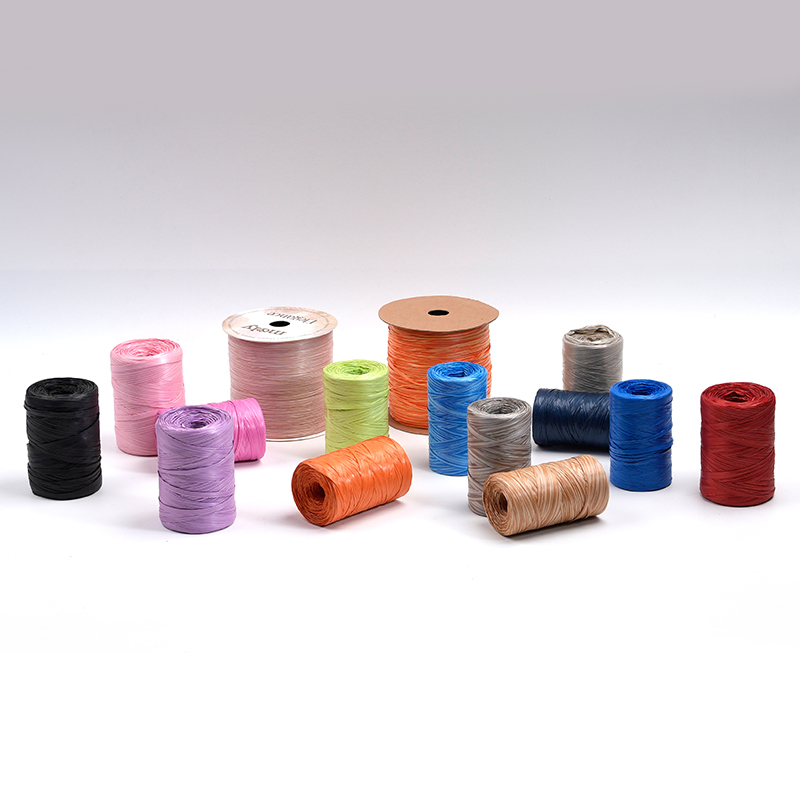
PP Raffia Yarn
What Is PP Raffia Yarn?
PP raffia yarn is a synthetic fiber yarn produced from polypropylene resin. During production, polypropylene material is processed into thin, flexible strands or tapes. These strands may be used as flat single yarn, twisted into double-ply structures, or combined into multi-ply reinforced yarn for higher-strength applications.
The term “raffia” describes the appearance and application style of the yarn rather than its botanical origin. Natural raffia is obtained from palm leaves and is valued for its organic appearance. PP raffia yarn is manufactured from synthetic polymer material, giving it more consistent dimensions, stronger resistance to moisture, and greater suitability for industrial-scale production.
Unlike many natural fibers, polypropylene does not readily absorb water. This makes PP raffia yarn suitable for products exposed to humidity, occasional splashing, damp storage conditions, or outdoor environments. It also resists mildew better than untreated natural fibers, which is important for gardening supplies, storage products, and export shipments that may pass through different climates.
PP raffia yarn is available in a wide range of colors, thicknesses, weights, winding styles, and surface effects. Its visual presentation can be simple and functional or highly decorative, depending on the final application. For example, a manufacturer may use a fine flat yarn for gift wrapping, a twisted yarn for craft kits, or a reinforced multi-ply construction for reusable shopping bags.
Basic Material Characteristics
Polypropylene has a low density compared with many other commonly used synthetic fibers. As a result, PP raffia yarn can provide useful volume and coverage without adding excessive weight. This can reduce handling costs, improve product portability, and help lower shipping expenses for international supply chains.
The material also offers good tensile performance for its weight. When the yarn is correctly designed and processed, it can withstand pulling, tying, weaving, and repeated handling. Strength depends on the yarn structure, thickness, twist level, winding method, and intended use, so product specifications should be selected according to the final application rather than based on appearance alone.
Another important characteristic is color stability. Industrial buyers often require repeat orders with consistent color across multiple batches. Through controlled raw material selection, color matching, and production management, PP raffia yarn can be supplied in standard or customized colors for coordinated packaging, private-label products, and branded seasonal collections.
Main Advantages of PP Raffia Yarn
Waterproof and Moisture-Resistant Performance
One of the strongest advantages of PP raffia yarn is its resistance to water and moisture. The material does not absorb water in the same way as many paper-based or natural fiber products. This helps preserve yarn performance during storage, transportation, and outdoor use.
For gardening applications, moisture resistance helps the yarn remain functional when used around plants, pots, support structures, and tying systems. For packaging applications, it can help decorative elements maintain their shape and color when exposed to humid conditions. For exporters, moisture resistance also provides an additional layer of security during ocean transport and warehouse storage.
High Tensile Strength
PP raffia yarn is designed to provide useful tensile strength while maintaining a lightweight structure. It is less likely to break during common operations such as tying, weaving, wrapping, winding, and manual assembly when the appropriate specification is selected.
Compared with delicate decorative fibers, reinforced PP raffia yarn is better suited to products that require repeated handling. These include reusable shopping bags, tote bags, bundled craft materials, support ties, and industrial packaging components.
Lightweight Structure
Low weight is an important commercial advantage. Retailers, wholesalers, and e-commerce sellers must often control transportation expenses while maintaining sufficient product volume and visual appeal. PP raffia yarn can provide a substantial decorative or functional effect without making the finished product unnecessarily heavy.
The lightweight structure also benefits workers during manual assembly and makes finished craft products easier for consumers to carry. In export supply chains, lower product weight can improve shipping efficiency, especially when products are ordered in bulk or combined with other packaging materials.
Resistance to Mildew and Long-Term Storage Stability
PP raffia yarn is suitable for long-term storage because it is resistant to moisture-related deterioration and mildew under normal storage conditions. This is particularly useful for seasonal products, retail stock, DIY kits, and packaging materials that may remain in warehouses for several months before sale.
Although proper ventilation and dry storage are still recommended, the synthetic structure of PP raffia yarn gives it an advantage over many untreated natural fibers when storage conditions are variable. This helps reduce the risk of damage caused by humidity, especially during international distribution.
Consistent Appearance for Mass Production
Industrial buyers need repeatable products. Differences in width, color, twist, or winding can create problems during assembly and lead to inconsistent retail presentation. PP raffia yarn can be produced with controlled dimensions and repeatable specifications, making it appropriate for organized production systems.
Consistent appearance is also valuable for private-label and branded collections. A buyer may need the same color family across gift packaging, decorative cords, craft kits, and retail accessories. Centralized production and documented specifications can help maintain visual continuity from one order to the next.
Competitive Cost Efficiency
PP raffia yarn provides a practical cost structure for high-volume manufacturing. Its raw material characteristics, lightweight transport profile, and industrial production suitability make it attractive for buyers who need to balance performance with budget requirements.
Natural raffia may be preferred for certain premium or organic-looking applications, but it can vary in texture, color, moisture content, and availability. PP raffia yarn offers greater consistency and can be produced in larger standardized quantities. This makes it a strong option for mass retail, promotional products, packaging programs, and long-term supply agreements.
PP Raffia Yarn Compared with Natural Raffia
Natural raffia and PP raffia yarn serve overlapping markets, but they provide different performance profiles. Natural raffia is often selected for its plant-based origin, organic texture, and handmade appearance. It can be attractive for rustic decoration, artisan crafts, and products that emphasize natural materials.
PP raffia yarn is generally selected when the buyer prioritizes water resistance, dimensional consistency, long storage life, color repeatability, and scalable production. It is particularly suitable for commercial applications in which hundreds, thousands, or millions of pieces must follow the same specification.
| Comparison Point | PP Raffia Yarn | Natural Raffia |
|---|---|---|
| Material origin | Synthetic polypropylene | Plant-based palm fiber |
| Moisture resistance | High resistance to water and humidity | More sensitive to moisture unless specially treated |
| Color consistency | Suitable for repeatable industrial color matching | May show natural variation between batches |
| Strength consistency | Controlled through yarn structure and processing | May vary according to fiber quality and preparation |
| Storage stability | Good resistance to mildew and long-term storage challenges | Requires greater attention to humidity and ventilation |
| Industrial suitability | Well suited to mass production and standardized supply | Often better suited to craft and natural-style applications |
| Visual character | Uniform, customizable, and available in many colors | Organic, textured, and naturally variable |
The choice depends on the product positioning. A brand promoting natural materials may choose genuine raffia, while a manufacturer seeking stable performance and efficient supply may prefer PP raffia yarn. In some product lines, both materials can be used for different collections or market segments.
Available Yarn Structure Types
Flat Single Yarn
Flat single yarn has a lightweight, flexible structure. Its smooth or ribbon-like appearance makes it suitable for decorative wrapping, fine weaving, gift presentation, craft projects, and applications where a clean visual surface is important.
Because the structure is relatively simple and flexible, flat single yarn can be used for manual work as well as selected low-speed industrial knitting or weaving operations. It can be supplied in different widths, thicknesses, and colors according to the needs of the buyer.
Double-Ply Twisted Yarn
Double-ply twisted yarn is created by combining two yarn elements through a controlled twisting process. This produces a balanced combination of strength, flexibility, and visual texture. It is widely used in DIY products, standard packaging, decorative cords, and craft materials that need more body than flat single yarn.
The twist can influence the appearance and handling performance of the product. A tighter twist may create a more compact and stable yarn, while a looser twist can produce a softer or more textured effect. The appropriate twist level should be selected according to the intended use and the desired final appearance.
Multi-Ply Reinforced Yarn
Multi-ply reinforced yarn is designed for applications that require higher strength and greater resistance to pulling or repeated handling. It can be used in tote bags, reusable shopping bags, industrial bundling, heavy-duty craft components, and other products where a lightweight decorative yarn may not be sufficient.
Multi-ply construction allows manufacturers to adjust the balance between thickness, strength, flexibility, and cost. The final specification can be developed through sampling so that the yarn performs correctly in the customer’s production process.
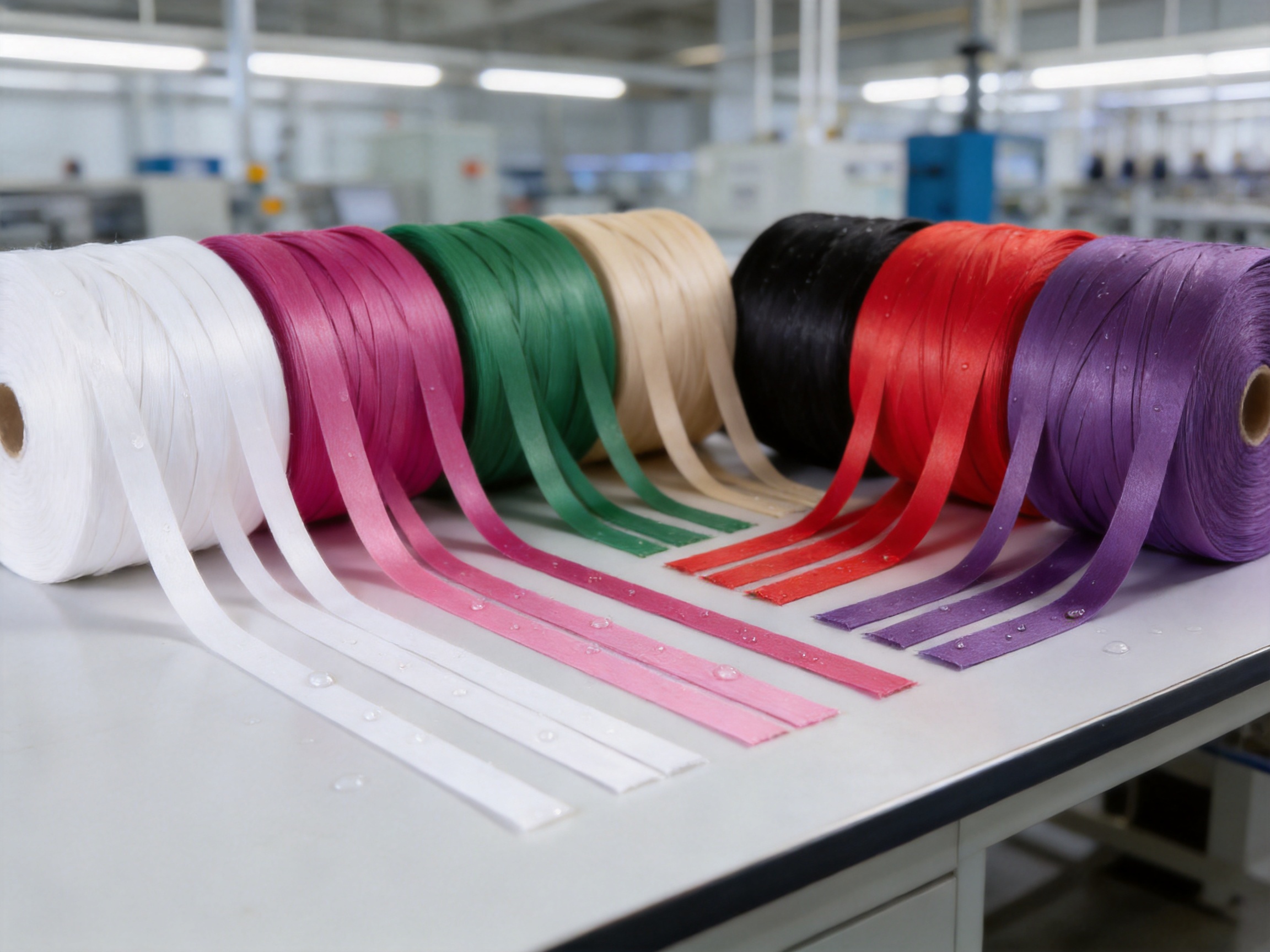
Manufacturing Process and Quality Control
The performance of PP raffia yarn depends not only on polypropylene as a raw material but also on the quality of the manufacturing process. Stable yarn requires careful control of material preparation, forming, slitting, twisting, winding, inspection, and packaging.
Raw Material Preparation
Production begins with the selection and preparation of polypropylene material. The material must be suitable for the required yarn structure, color, thickness, and end use. For customized orders, color requirements and performance expectations are reviewed before production begins.
Material preparation is an important stage because inconsistent raw material quality can affect yarn strength, surface appearance, color, and processing stability. A professional manufacturer uses standardized procedures to reduce variation and maintain predictable output across different production batches.
Film Formation and Slitting
Polypropylene material is processed into a suitable film or tape-like form before being divided into yarn elements. Slitting equipment controls the width and consistency of the strips. Accurate slitting is essential for producing uniform flat yarn and for ensuring that multiple strands work together correctly during twisting and winding.
Advanced slitting and processing equipment helps support different product specifications. Fine yarn for gift wrapping may require a different width from reinforced yarn for tote bags or industrial bundling. Flexible equipment allows a manufacturer to serve several market segments without relying on a single standardized product.
Twisting and Structure Formation
After slitting, the yarn can remain as a flat single strand or be twisted into double-ply and multi-ply structures. Twist level influences tensile performance, flexibility, surface texture, and the way the yarn behaves during weaving, knitting, wrapping, or manual crafting.
Controlled twisting helps ensure that the yarn maintains its intended shape and strength. It also creates opportunities for product differentiation. Buyers can request different twist levels, blended materials, or special visual effects for particular retail collections and craft programs.
Winding and Coil Formation
Winding transforms processed yarn into a usable commercial format. The winding method affects how easily the material can be dispensed, displayed, stored, and integrated into customer production lines. Stable tension during winding helps prevent tangling, uneven coils, and unnecessary material waste.
Different buyers require different winding formats. Retail customers may prefer compact balls or hanging coils, while factories may require larger tubes, hollow bulk coils, or bundled packaging. A manufacturer with flexible winding capabilities can support both retail and industrial distribution channels.
Inspection and Quality Verification
Quality control should cover more than visual inspection. Depending on the order specification, inspection may include color comparison, dimensional checks, weight verification, tensile evaluation, surface examination, winding quality, packaging integrity, and labeling accuracy.
Standardized quality procedures help ensure that products are consistent and repeatable. This is particularly important for buyers who use the yarn in automated or semi-automated production, where variations can cause downtime or increase rejection rates.
Compression Packaging and Shipment Preparation
After inspection, finished products are packed according to their distribution channel. Retail products may be placed in OPP bags with hanging cards, while export orders may use PE film, reinforced cartons, moisture-resistant packaging, or palletized shipment formats.
Packaging design is coordinated with product protection, warehouse handling, retail presentation, and shipping efficiency. For larger orders, compression packaging can help reduce volume and improve container utilization while maintaining product integrity.
Integrated Manufacturing Strengths
Zhejiang Raffia Paper Products Co., Ltd. has developed from a craft materials business unit into an integrated manufacturer specializing in raffia paper shreds, paper yarns, fancy yarns, and related packaging materials. The company’s development combines more than ten years of industry experience with continuous investment in production technology and equipment.
Its production base in Dongyang, Zhejiang Province, covers approximately 20,000 square meters and employs more than 200 professional staff. The factory integrates raw material processing, mass production, quality testing, finished-goods packaging, and shipment preparation. This structure can reduce the need to coordinate with multiple external suppliers and helps create a more direct path from specification development to final delivery.
The company’s equipment and processes cover key operations such as slitting, twisting, winding, and compression packaging. These capabilities are relevant to PP raffia yarn because product performance depends on accurate control across all of these stages. The ability to manage multiple operations within one manufacturing system also supports faster communication between production, quality, packaging, and customer service teams.
With an annual production capacity exceeding 200 million pieces across its product range, the company is equipped to handle substantial commercial orders. At the same time, its customization services support sample development, private-label packaging, color matching, SKU planning, and product adjustments for specialized projects.
A documented and replicable quality control system is particularly valuable for international buyers. When a product is reordered over an extended period, the customer expects the same color, weight, structure, and packaging standard. Standardized production procedures help improve batch consistency and support more dependable planning for global retail and e-commerce programs.
One-Stop Supply Chain Coordination
Many buyers of craft and packaging materials need more than raw yarn. They may also require retail cards, OPP bags, color assortments, printed labels, export cartons, customized SKU combinations, and coordinated delivery. An integrated manufacturer can manage these related requirements within one project rather than dividing them among several suppliers.
This approach may simplify purchasing, reduce communication costs, and improve accountability. It can also make it easier to develop a coordinated product family, such as a collection containing PP raffia yarn, decorative accessories, paper raffia, gift packaging, and DIY kits.
OEM and ODM Capability
OEM services allow buyers to supply their own brand identity, packaging design, label requirements, and product specifications. ODM services provide additional support for developing a product concept, selecting the appropriate yarn structure, creating color combinations, and organizing the final presentation.
Customization may include yarn thickness, weight, twist level, structure, color, winding format, packaging style, logo printing, private-label tags, and e-commerce SKU design. Sampling is supported, with a stated sample development lead time of approximately 7 to 15 days depending on the project requirements.
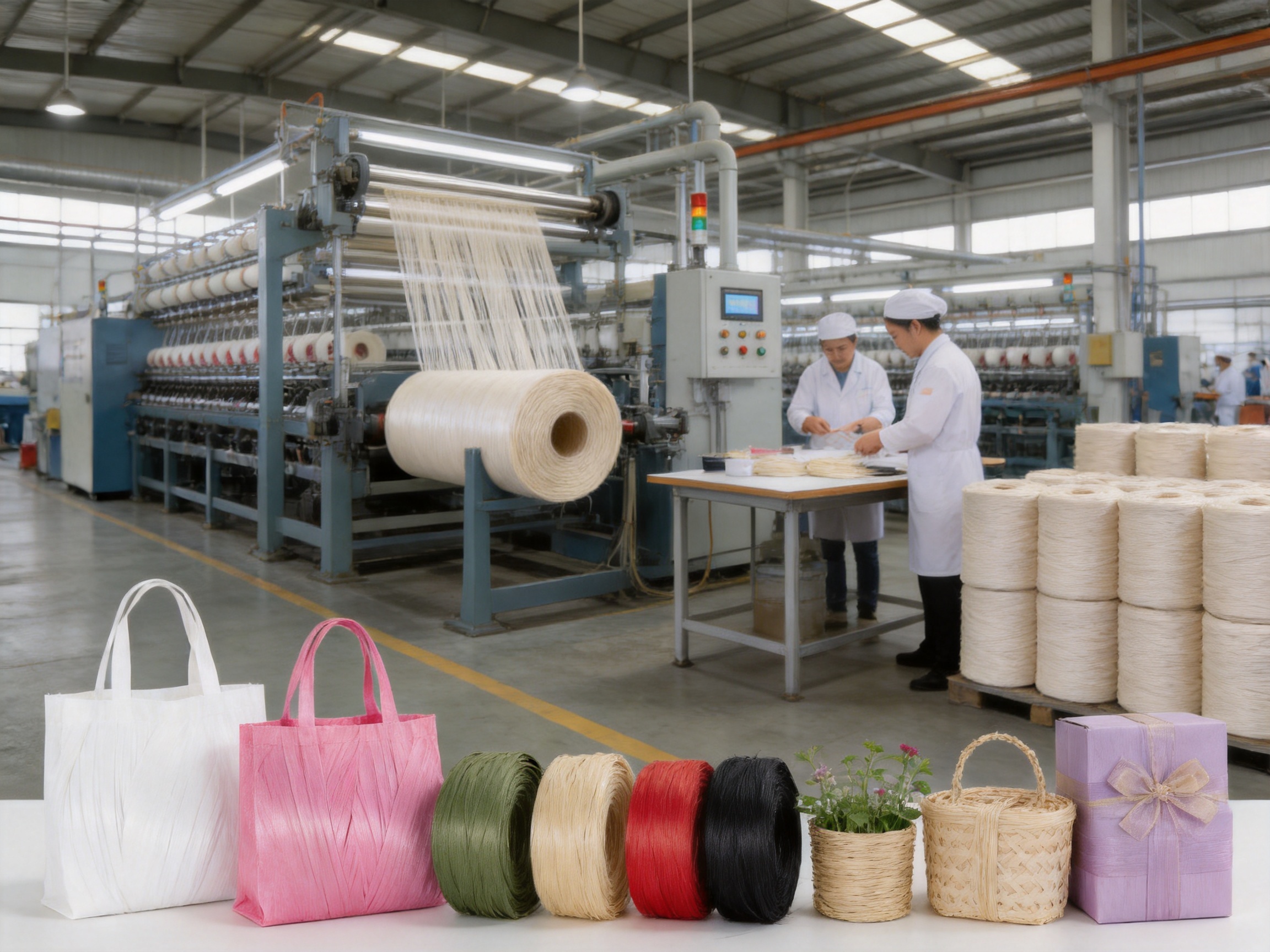
Applications of PP Raffia Yarn
Reusable Shopping Bags and Tote Bags
PP raffia yarn can be woven, knitted, or assembled into reusable shopping bags and tote bags. Its strength-to-weight ratio helps produce bags that are practical for daily handling without making them excessively heavy.
For bag manufacturers, structure selection is important. Flat single yarn may be appropriate for lightweight decorative panels, while double-ply or multi-ply yarn may be better for handles, high-stress areas, or stronger bag bodies. Color customization also allows retailers to coordinate bags with seasonal campaigns or brand identities.
Gardening and Plant Support Products
The moisture-resistant properties of PP make the yarn suitable for gardening applications. It can be used for plant tying, support systems, training structures, bundling, and related accessories.
Garden products are frequently used outdoors or in damp environments, so resistance to moisture and mildew is a practical advantage. The yarn should still be selected according to the load, exposure conditions, and expected service life of the specific application.
Gift Packaging and Decorative Wrapping
PP raffia yarn is a useful material for gift baskets, boxes, floral arrangements, retail packaging, seasonal wrapping, and event decoration. Flat yarn provides a clean ribbon-like appearance, while twisted and blended yarns create additional texture and visual depth.
Because the material can be supplied in a broad color range, buyers can create coordinated packaging for holidays, weddings, corporate events, product launches, and retail promotions. Metallic blends can add a festive effect, while feather fiber blends can provide a softer and more premium tactile impression.
DIY Craft Kits
DIY brands can use PP raffia yarn in weaving kits, decorative projects, handmade accessories, basket-style products, seasonal crafts, and educational activity sets. The material is lightweight, easy to package, and available in multiple colors, making it suitable for segmented kits.
Multi-color winding can combine two to six colors in one kit or product package. This makes it easier for consumers to begin a project without purchasing separate materials. For e-commerce sellers, organized color combinations can also improve product presentation and increase the perceived value of a kit.
Retail Craft Material Supply
Retailers often need products that can be displayed clearly and sold in manageable quantities. PP raffia yarn can be packed in 50-gram or 100-gram OPP bags with hanging cards for supermarket, stationery, hobby, and craft store displays.
Retail packaging should make the product easy to identify, store, and restock. Labels may include color information, weight, usage instructions, brand identity, and barcode details according to the buyer’s market requirements.
Seasonal Decoration and Event Styling
The material’s color flexibility and lightweight structure make it suitable for holiday displays, party decorations, wedding styling, retail window decoration, and themed events. Buyers can request customized colors or blended yarns for specific seasons and visual concepts.
For short-term event use, decorative appearance and packaging efficiency may be the main priorities. For reusable display components, buyers may place greater emphasis on yarn strength, shape retention, and resistance to handling.
Cross-Border E-Commerce Products
PP raffia yarn is suitable for e-commerce supply because it is compact, lightweight, customizable, and easy to divide into retail units. Manufacturers can create products designed for online marketplaces, including small DIY packs, color collections, starter kits, and private-label craft materials.
Packaging should be optimized for parcel delivery. Durable bags, protective cartons, clear labeling, and efficient dimensions can reduce the risk of damage and improve warehouse handling. The product can also be designed around platform-specific SKU requirements and consumer preferences.
Blended Yarn Options
PP and Polyester Blend
A PP and polyester blend can provide a balance of durability, structure, and cost efficiency. Polyester may contribute additional resistance and a different surface feel, while PP helps maintain a lightweight profile and moisture-resistant performance.
This combination can be considered for products that need a more refined appearance or improved handling characteristics. The final ratio should be selected according to the target application, cost objectives, and required texture.
PP and Metallic Yarn Blend
Metallic yarn can be combined with PP raffia to create decorative and festive effects. This type of blend is suitable for holiday packaging, celebration products, party decorations, gift wrapping, and seasonal retail collections.
Metallic elements can be used as a visual highlight rather than throughout the entire yarn structure. This allows buyers to achieve a decorative appearance while maintaining a practical base material.
PP and Feather Fiber Blend
PP and feather fiber blends are designed for products that require a softer, more tactile, or premium decorative effect. They can be used in selected DIY products, gift packaging, display materials, and creative craft collections.
Because feather fiber changes the surface and handling characteristics of the yarn, sampling is recommended before mass production. The blend ratio can be adjusted to achieve the desired balance between softness, appearance, strength, and cost.
Industrial Winding Formats
| Winding Format | Typical Use | Main Benefit |
|---|---|---|
| Egg Roll Coil | Retail and craft applications | Compact, attractive, and easy to display |
| Tube Coil | Factory and standard production use | Efficient dispensing and stable handling |
| Rugby Ball Coil | Large-item and ergonomic use | Comfortable handling for larger quantities |
| Display Ball Coil | Retail presentation | Strong visual appeal on shelves and displays |
| Hollow Bulk Coil | Industrial raw material supply | Suitable for bulk production and reduced packaging volume |
| Bundled Packaging | Bulk shipment and construction-related use | Practical for large-volume handling |
All of these formats can be adjusted according to product weight, customer handling requirements, packaging design, and shipment method. Retail formats focus on appearance and convenience, while industrial formats prioritize efficient production, dispensing, and transportation.
Packaging and Export Solutions
Packaging plays a major role in protecting PP raffia yarn and presenting it to the final customer. The appropriate packaging format depends on whether the product will be sold through a retail store, shipped to a factory, distributed through an online platform, or supplied as an industrial raw material.
Retail Packaging
Retail packaging commonly includes 50-gram or 100-gram OPP bags, hanging cards, printed labels, and display-ready formats. These packages are suitable for supermarkets, hobby stores, craft retailers, stationery channels, and online sellers.
Hanging card packaging helps products occupy vertical display space and allows the buyer to see the color and shape of the coil. Printed information can be customized to meet the requirements of the brand and destination market.
DIY Kit Packaging
DIY kit packaging may include multi-color segmented winding, instruction cards, accessory combinations, and branded gift-set presentation. Two to six colors can be combined depending on the project design and retail concept.
Well-organized kit packaging reduces the preparation required from the consumer and makes the product more suitable for gifting. It also creates a clear product story for online listings and seasonal retail promotions.
Export Cartons
For international shipments, common solutions include PE film, reinforced corrugated cartons, moisture-proof export cartons, and palletized shipment for full-container-load transportation. Packaging marks, carton labels, and shipping information can be customized according to customer requirements.
Moisture protection is especially important for long-distance transportation through changing climates. Carton strength should be selected according to product weight, stacking conditions, container loading, and destination handling practices.
Customization for Professional Buyers
Customization is one of the most important advantages for companies developing private-label or differentiated products. Rather than purchasing a fixed generic yarn, buyers can work with the manufacturer to define a product that matches their application, brand style, packaging channel, and target price.
Yarn Thickness and Weight
Thickness and weight influence appearance, strength, coverage, and cost. A fine yarn may be suitable for decorative wrapping, while a heavier specification may be required for bag production or industrial bundling.
Twist Level and Structure
Twist level affects flexibility, surface texture, and handling. Buyers can choose between flat single yarn, double-ply twisted yarn, and multi-ply reinforced yarn, then adjust the structure according to production requirements.
Pantone Color Matching
Full-color customization and brand-specific colors are available. Pantone references or physical color samples can be used as a starting point for matching. Because final color may be influenced by material, lighting, surface texture, and display conditions, approval samples are recommended before bulk production.
Branding and Packaging Development
Customization can include logo printing, private-label tags, retail cards, OPP bags, cartons, color boxes, and complete packaging systems. A coordinated packaging program can help create a recognizable product family across different yarn structures and SKU sizes.
E-Commerce SKU Design
Online products must be easy to understand, store, photograph, and ship. SKU design may include color sets, quantity combinations, starter packs, seasonal collections, and gift-ready packaging. The manufacturer can support product configurations suited to cross-border e-commerce and retail platform distribution.
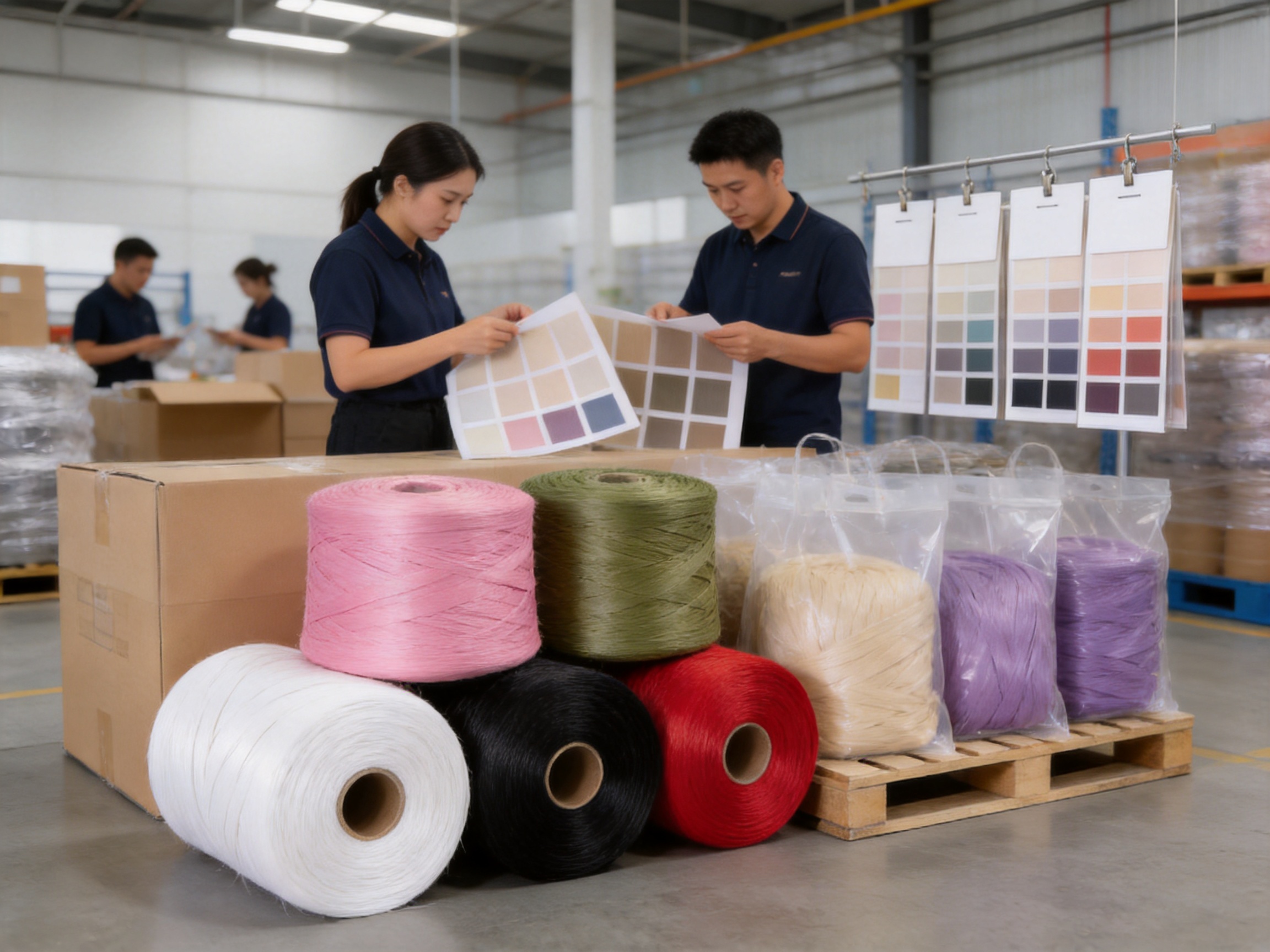
How to Select the Correct PP Raffia Yarn
Define the End Use
The first step is to determine whether the yarn will be used for wrapping, weaving, bag production, gardening, craft kits, display decoration, or industrial bundling. Each application has different requirements for strength, flexibility, texture, and packaging.
Choose the Yarn Structure
Flat single yarn is appropriate for lightweight and decorative applications. Double-ply twisted yarn offers a balanced combination of strength and flexibility. Multi-ply reinforced yarn is suitable for demanding applications that involve greater pulling force or repeated handling.
Confirm the Required Weight and Dimensions
Buyers should specify the desired yarn thickness, coil weight, total length where relevant, and package size. These details affect production planning, retail pricing, shipping calculations, and compatibility with customer equipment.
Evaluate Color Requirements
For standard products, buyers may select from existing color options. For branded or seasonal projects, custom color matching may be preferred. It is important to approve a sample because color perception can change according to lighting, material surface, and the surrounding packaging.
Review Packaging and Shipment Conditions
Packaging should be matched to the distribution channel. Retail products require attractive and manageable units, while factories may need bulk coils. Export shipments require suitable cartons, moisture protection, palletization, and clear shipping marks.
Request Samples Before Bulk Production
Samples allow buyers to test yarn strength, flexibility, texture, color, winding quality, dispensing behavior, and compatibility with their own manufacturing or packaging process. Sampling is especially important for blended yarns, customized structures, and new packaging formats.
Use on Low-Speed Industrial Machines
PP raffia yarn can be used on selected low-speed industrial knitting machines and related equipment. Machine compatibility depends on yarn thickness, twist, tension, feed method, needle configuration, and the specific structure of the machine.
Before placing a production order, the buyer should test the yarn under actual operating conditions. The test should evaluate feeding stability, tension consistency, breakage, surface friction, output appearance, and machine adjustment requirements.
A yarn that performs well in manual crafting may not automatically be suitable for industrial processing. Conversely, an industrial winding format may need to be adapted for retail use. Clear communication between the buyer and manufacturer helps ensure that the product is developed for the correct production environment.
Why the Product Is Suitable for Long-Term Supply
Long-term supply requires more than production capacity. It requires stable raw material sourcing, repeatable specifications, reliable color management, consistent packaging, quality records, and effective communication. PP raffia yarn is suitable for long-term programs because its synthetic material and industrial processing allow specifications to be documented and repeated.
Zhejiang Raffia Paper Products Co., Ltd. supports stable bulk supply and OEM cooperation for customers with ongoing requirements. Its integrated production chain allows the company to coordinate material processing, yarn production, inspection, packing, and shipment preparation within one manufacturing system.
The company serves domestic and international customers across Europe, North America, South America, Asia, and other regions. Its experience with global retail and packaging supply chains supports the requirements of buyers who need export-ready products, consistent documentation, and dependable delivery planning.
Long-term customers may also benefit from product-family development. A supplier that produces PP raffia yarn, paper raffia, fancy yarns, decorative accessories, and gift packaging materials can help coordinate multiple items under a unified purchasing and branding program.
Sustainability and Responsible Supply Considerations
PP raffia yarn is a synthetic material, so buyers should consider the full product life cycle when evaluating environmental performance. Product durability can help extend service life in reusable bags, gardening products, and storage applications. Lightweight construction can also reduce transportation weight compared with heavier alternatives.
Responsible sourcing should include appropriate material selection, efficient production, reduced packaging waste, optimized carton loading, and clear communication about product use and disposal. Buyers may also request packaging adjustments to reduce unnecessary components or improve shipping efficiency.
The manufacturer emphasizes eco-friendly concepts and green supply chain development as part of its broader business direction. For customers with specific sustainability requirements, material composition, packaging design, production waste management, and logistics planning should be discussed during project development.
Quality, Reliability, and Customer Support
A dependable supplier should provide clear specifications, responsive communication, sample confirmation, production updates, packaging verification, and shipment coordination. These services are particularly important when the buyer is ordering customized products or launching a new retail SKU.
Quality reliability begins with a clear product brief. The buyer should identify the intended use, yarn structure, color, weight, packaging, quantity, testing expectations, and delivery schedule. The manufacturer can then recommend the most appropriate production route and confirm the details through samples or pre-production approval.
For repeat orders, maintaining approved samples and written specifications helps reduce uncertainty. Batch records, packaging references, and color standards can support consistency across future production runs.
Frequently Asked Questions
Q1: Is PP raffia yarn suitable for outdoor use?
Yes. PP raffia yarn is waterproof, moisture-resistant, and resistant to mildew under normal conditions. It is suitable for gardening, plant tying, outdoor decoration, and other applications where the material may encounter humidity or occasional water exposure. The exact specification should be selected according to the load and environmental conditions.
Q2: What is the difference between PP raffia yarn and natural raffia?
PP raffia yarn is made from polypropylene and offers consistent dimensions, high moisture resistance, stable color, and strong suitability for industrial production. Natural raffia is made from plant fiber and is valued for its organic appearance and natural texture. The best choice depends on whether the project prioritizes industrial consistency or natural aesthetics.
Q3: Can PP raffia yarn be supplied in custom colors?
Yes. Full-color customization and brand-specific colors are available. Buyers can provide Pantone references or physical samples for development. A color approval sample is recommended before bulk production to confirm the final appearance.
Q4: Can PP raffia yarn be used on machines?
Yes. It can be used on selected low-speed industrial knitting machines and related equipment. Compatibility depends on yarn thickness, twist, tension, feed method, and machine design. Buyers should conduct a production test before confirming a large order.
Q5: What winding formats are available?
Available formats include egg roll coils, tube coils, rugby ball coils, display ball coils, hollow bulk coils, and bundled packaging. The format can be selected according to retail presentation, factory dispensing, storage conditions, and shipment requirements.
Q6: Can PP raffia yarn be blended with other fibers?
Yes. Available options include PP blended with polyester, metallic yarn, or feather fiber. These blends can provide improved durability, festive decoration, softer tactile effects, or differentiated visual appeal. Custom ratios and samples are supported.
Q7: What retail packaging options are available?
Common retail formats include 50-gram or 100-gram OPP bags, hanging card packaging, multi-color segmented winding, and private-label packs. Packaging can be developed for supermarkets, craft stores, gift shops, online platforms, and other retail channels.
Q8: What is the minimum order quantity?
MOQ depends on the selected specification, color, winding format, and packaging requirements. Sample orders are supported, allowing buyers to evaluate the material before arranging bulk production.
Q9: How long does sampling take?
The stated sampling lead time is approximately 7 to 15 days, depending on the complexity of the yarn structure, color, blend, packaging, and approval requirements.
Q10: Can the supplier support long-term supply?
Yes. The company supports stable bulk supply and OEM long-term cooperation. Its integrated factory structure, production capacity, quality procedures, and export packaging capabilities are designed to support ongoing commercial programs.
Q11: Can the packaging be customized with a brand logo?
Yes. Logo printing, private-label tags, custom retail cards, branded bags, cartons, and packaging system development are available. Buyers should provide artwork and packaging requirements during the quotation and sampling stage.
Q12: What information should buyers provide when requesting a quotation?
Buyers should provide the intended application, yarn structure, preferred color, thickness or weight, winding format, packaging method, estimated quantity, destination market, and delivery requirements. Images or physical references are helpful when a specific visual effect is required.
Conclusion
PP raffia yarn is a versatile synthetic material that combines lightweight construction, high tensile strength, moisture resistance, mildew resistance, color stability, and cost efficiency. These characteristics make it suitable for tote bags, reusable shopping bags, gardening products, gift packaging, DIY craft kits, seasonal decorations, retail craft supplies, and cross-border e-commerce products.
Its advantages become even more significant when supported by flexible structures, multiple winding formats, customized colors, blended yarn options, retail packaging, and export-ready shipment solutions. Flat single yarn can serve decorative applications, double-ply yarn can provide balanced performance, and multi-ply reinforced yarn can support more demanding products.
The manufacturing capabilities of Zhejiang Raffia Paper Products Co., Ltd. add value to the material through integrated slitting, twisting, winding, compression packaging, quality control, and shipment preparation. With a 20,000-square-meter production base, more than 200 employees, an annual production capacity exceeding 200 million pieces across its product range, and experience serving global markets, the company can support both customized development and stable bulk supply.
For buyers seeking a reliable alternative to natural raffia or less consistent synthetic materials, PP raffia yarn offers a strong combination of performance and commercial practicality. By selecting the correct yarn structure, packaging format, color system, and quality standard, businesses can develop products that are durable, attractive, efficient to ship, and suitable for long-term market supply.
References
1. Internal product specifications and application information for PP Polypropylene Raffia Yarn, Zhejiang Raffia Paper Products Co., Ltd.
2. Internal manufacturing and company capability information, Zhejiang Raffia Paper Products Co., Ltd.
3. General technical references on polypropylene fiber properties, moisture resistance, density, and tensile performance.
4. General packaging industry references on OPP bags, corrugated export cartons, palletized shipments, and moisture-resistant packaging.
5. General textile and cordage references on yarn twisting, multi-ply structures, winding formats, and tensile performance.
Product: PP Raffia Yarn

 +86 15355323399
 kevin@raffia-paper.com
 No. 151 Guanshan North Road, Dongyang City, Zhejiang Province, China

Copyright © Zhejiang Raffia Paper Products Co., Ltd. All Rights Reserved.

Paper Raffia Yarn & Gift Packaging Factory