
 +86 15355323399
 En
 中文简体
 日本語
 Français
 Español
 Deutsch
 Türk
 عربى
 italiano
 русский
Premium Raffia Decorative Pom Poms for Gift Packaging, Crafts, and Festive Design
Raffia decorative pom poms are small, versatile craft components that can transform ordinary packaging, handmade projects, party displays, and seasonal decorations into bright and memorable creations. Their soft, fluffy appearance adds volume and visual interest, while their lightweight structure makes them easy to attach to paper, cards, gift bags, baskets, ribbons, garments, and other creative surfaces. When produced with carefully selected polyester and acrylic fibers, decorative pom poms can offer a practical balance of softness, elasticity, color brightness, durability, and ease of use.
The product discussed in this article is designed for gift decoration, handicrafts, party supplies, and other creative applications. It is made from high-quality polyester and acrylic fibers and is available in various bright colors, including mixed-color options. Its surface is fluffy and soft, its structure is elastic, and its fibers are designed to resist shedding. These characteristics make it suitable for both professional packaging operations and personal craft projects.
Beyond the appearance of the finished pom poms, product quality depends on the manufacturing system behind them. Consistent color, controlled fiber preparation, stable shaping, careful inspection, and dependable packaging are essential when buyers require large quantities for retail, events, seasonal programs, or branded gift presentation. A manufacturer with integrated production, quality testing, and shipment capabilities can provide greater consistency than a supplier that relies entirely on fragmented outsourcing.
This article examines the material characteristics, decorative benefits, production strengths, application possibilities, purchasing considerations, and customization opportunities associated with raffia decorative pom poms. It also explains how an experienced manufacturer can support reliable supply for domestic and international customers.
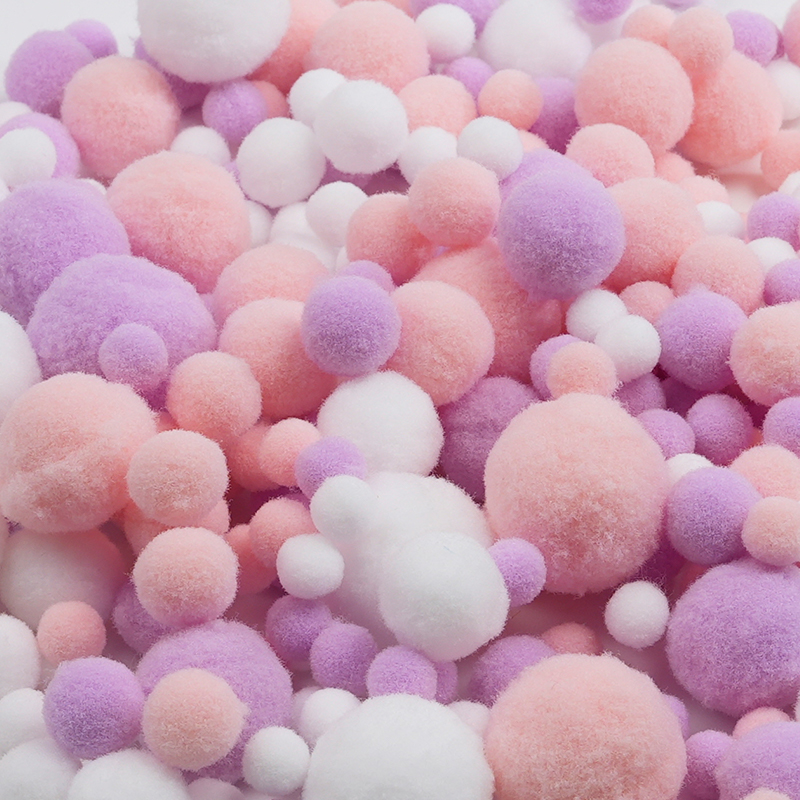
Raffia Decorative Pom Poms
What Are Raffia Decorative Pom Poms?
Raffia decorative pom poms are compact, rounded decorative units formed from soft, flexible fibers. They are generally used as visual accents rather than as structural components. A pom pom may be tied, glued, stitched, threaded, or otherwise attached to a product depending on the intended application. Because it is lightweight and easy to handle, it can be incorporated into projects without adding excessive weight or complexity.
The term “raffia” is commonly associated with decorative fibers, gift packaging materials, paper yarn, ribbon-like craft materials, and natural-looking handmade design. In this product category, the pom poms are manufactured from polyester and acrylic fibers. This fiber combination gives the product a soft touch and fluffy appearance while helping the pom pom maintain its shape during normal handling and decoration.
Unlike flat ribbons or plain cords, pom poms provide a three-dimensional decorative effect. Their rounded volume can make a package appear more generous and festive. A single pom pom can serve as a small focal point, while multiple pom poms can be arranged into borders, patterns, garlands, ornaments, hanging decorations, or colorful craft compositions.
The product is suitable for professional and individual users. Gift packaging companies may use pom poms as finishing details on boxes, bags, baskets, and wrapped products. Event planners may use them in party displays and seasonal decorations. Schools, hobby stores, handmade businesses, and do-it-yourself creators may incorporate them into cards, ornaments, textile accessories, and home décor projects.
Material Composition and Product Performance
Polyester and Acrylic Fiber Construction
The use of polyester and acrylic fibers gives the pom poms a practical material profile for decorative applications. Polyester is widely valued for its durability, dimensional stability, and resistance to ordinary wear. Acrylic fiber is known for its lightweight feel, soft hand, and ability to support a wool-like or fluffy visual effect. When combined in a decorative component, these fibers help create a product that is attractive to touch and easy to use.
The material selection is especially important for products that may be handled repeatedly. Gift packaging components are often touched during assembly, transport, retail display, and unboxing. Craft accessories may be picked up, rearranged, cut from a string, or attached and reattached during design development. A weak or brittle decorative component can lose its appeal quickly, while a resilient pom pom remains more useful throughout the project process.
The polyester and acrylic construction also supports a soft, elastic texture. Elasticity helps the pom pom recover its appearance after light compression during packing or transportation. This is valuable for wholesale buyers because products may be packed in cartons or bags before reaching the final user. Proper packaging and handling remain important, but a resilient fiber structure can reduce the effect of ordinary compression and movement.
Softness and Fluffy Appearance
Softness is one of the first qualities customers notice when they handle a decorative pom pom. A soft product feels more refined and is more comfortable to use in handmade projects. The fluffy surface also creates a sense of fullness, allowing a relatively small component to attract attention on a package or display.
The fluffy appearance can support many design styles. Bright colors create a playful and energetic effect, while mixed colors can create a cheerful, informal, or festive look. Coordinated colors can be used for brand packaging, seasonal collections, school activities, themed parties, and retail displays. The same basic product can therefore serve different markets through color planning and creative arrangement.
Elasticity and Shape Retention
Elasticity contributes to the practical value of a pom pom. During manufacturing, packaging, shipping, and assembly, decorative items may be pressed or moved. A product with a flexible fiber structure is better able to maintain a rounded, full appearance after normal handling. This does not eliminate the need for appropriate storage, but it supports a more reliable presentation at the time of use.
Shape retention is particularly important for commercial customers. A retailer preparing hundreds or thousands of gift packages needs decorative components that look reasonably consistent from one package to the next. Even shape, stable fullness, and controlled fiber distribution help the final packaging appear more professional and organized.
Color Brightness and Consistency
Color is central to decorative products. Bright, even color can make a gift package more visible and can help a craft project communicate a particular theme. The available product range includes various bright colors, with mixed-color options for customers seeking a more playful or varied appearance.
Color consistency across a production batch is also important. If pom poms from the same order show substantial differences in shade, customers may experience difficulty when assembling coordinated products. A professional production system should therefore pay attention to material preparation, color grouping, production records, and inspection procedures. Consistent processing improves the likelihood that products packed together will present a uniform appearance.
Key Advantages Over Ordinary Decorative Alternatives
More Visual Volume Than Flat Decorations
Flat paper pieces, printed stickers, and simple strips can provide color, but they do not always create the same tactile and three-dimensional effect as a pom pom. The rounded form adds depth to gift packaging and craft projects. It can make an otherwise plain surface look more layered and carefully designed.
For packaging buyers, this visual volume can help products stand out on retail shelves, gift tables, online product photography, and event displays. For craft users, it can make projects appear more expressive without requiring complicated construction techniques. A pom pom can often deliver a noticeable decorative result with only a small amount of labor.
Soft Texture for a More Inviting Presentation
Some decorative accessories are attractive visually but feel rough, stiff, or uncomfortable during handling. The soft texture of polyester and acrylic pom poms provides a more pleasant user experience. This is beneficial when the finished item is designed to be touched, opened, carried, or given as a personal gift.
The soft surface also complements materials such as paper, cardboard, fabric, wood, glass, and woven packaging. It can soften the appearance of rigid boxes or add warmth to simple paper bags. In handmade products, the tactile quality can reinforce the impression that the item has been thoughtfully assembled.
Lightweight and Easy to Apply
Decorative accessories should enhance a package without making it difficult to transport. Lightweight pom poms can be added to gift bags, boxes, cards, tags, baskets, and party decorations without significantly increasing the overall weight of the finished item. They are also easy for workers and hobbyists to sort, position, and attach.
The application method can be adapted to the project. Depending on the surface and required durability, users may use craft adhesive, hot glue, thread, wire, ribbon, cord, or direct tying. This flexibility makes the product appropriate for fast commercial assembly as well as slower, detail-oriented handmade work.
Color Flexibility for Different Markets
A wide color selection increases the number of possible applications. Bright single colors may be useful for children’s crafts, birthday parties, promotional packaging, and energetic seasonal themes. Mixed colors can support rainbow designs, festival decorations, and informal handmade products. More coordinated color combinations can be selected for retail collections or private-label packaging programs.
Color flexibility is also useful for distributors. A distributor can serve several customer groups with one product category by offering different color assortments. This can simplify product planning and allow the same manufacturing platform to support gift packaging, craft retail, party supplies, and decorative accessories.
Reduced Concern About Fiber Shedding
Fiber shedding can reduce the appearance and usability of a decorative product. Loose fibers may collect on packaging surfaces, affect assembly areas, or make a finished product look untidy. The pom poms described here are designed not to shed easily, supporting a cleaner appearance during handling and use.
No textile or fiber product should be treated as completely free from loose particles under every condition. However, controlled material selection, processing, shaping, and quality inspection can reduce unnecessary shedding and improve overall product performance. This is especially valuable for commercial packaging operations where clean presentation and efficient work are important.
| Product Attribute | Value for Users | Typical Application Benefit |
|---|---|---|
| Polyester and acrylic fiber construction | Soft, flexible, and durable material profile | Suitable for repeated handling and decorative assembly |
| Fluffy surface | Full and attractive three-dimensional appearance | Adds volume to gifts, crafts, and displays |
| Elastic texture | Better recovery after ordinary compression | Supports packaging, storage, and transportation |
| Bright and even color | Strong visual impact and coordinated presentation | Useful for themed packaging and seasonal designs |
| Low-shedding design | Cleaner handling and more polished results | Benefits assembly lines, retailers, and hobby users |
| Mixed-color options | Greater creative flexibility | Supports party, festival, and playful craft projects |
| Lightweight format | Easy to transport and attach | Suitable for gift bags, cards, boxes, and ornaments |
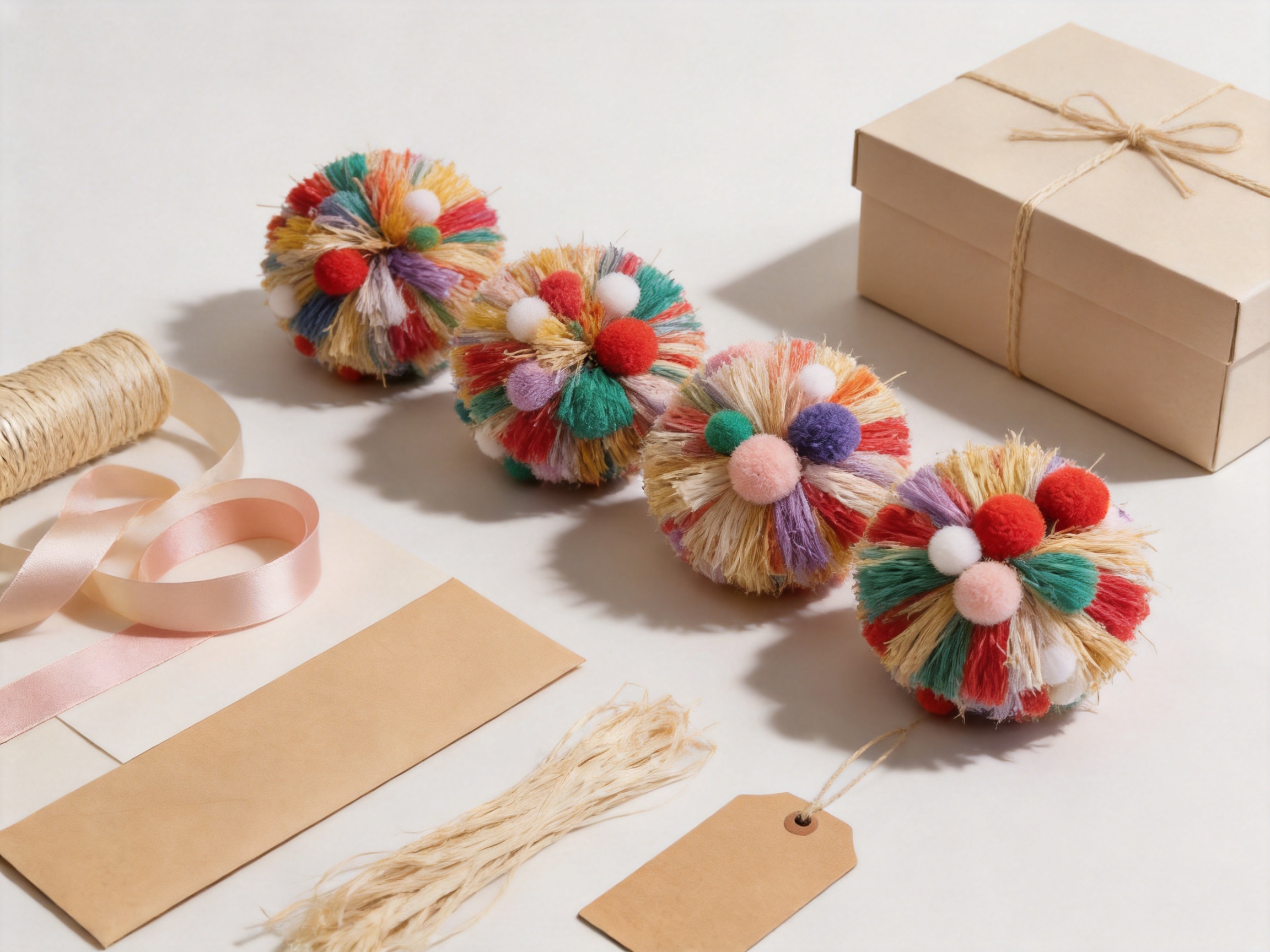
Manufacturing Expertise Behind Consistent Decorative Accessories
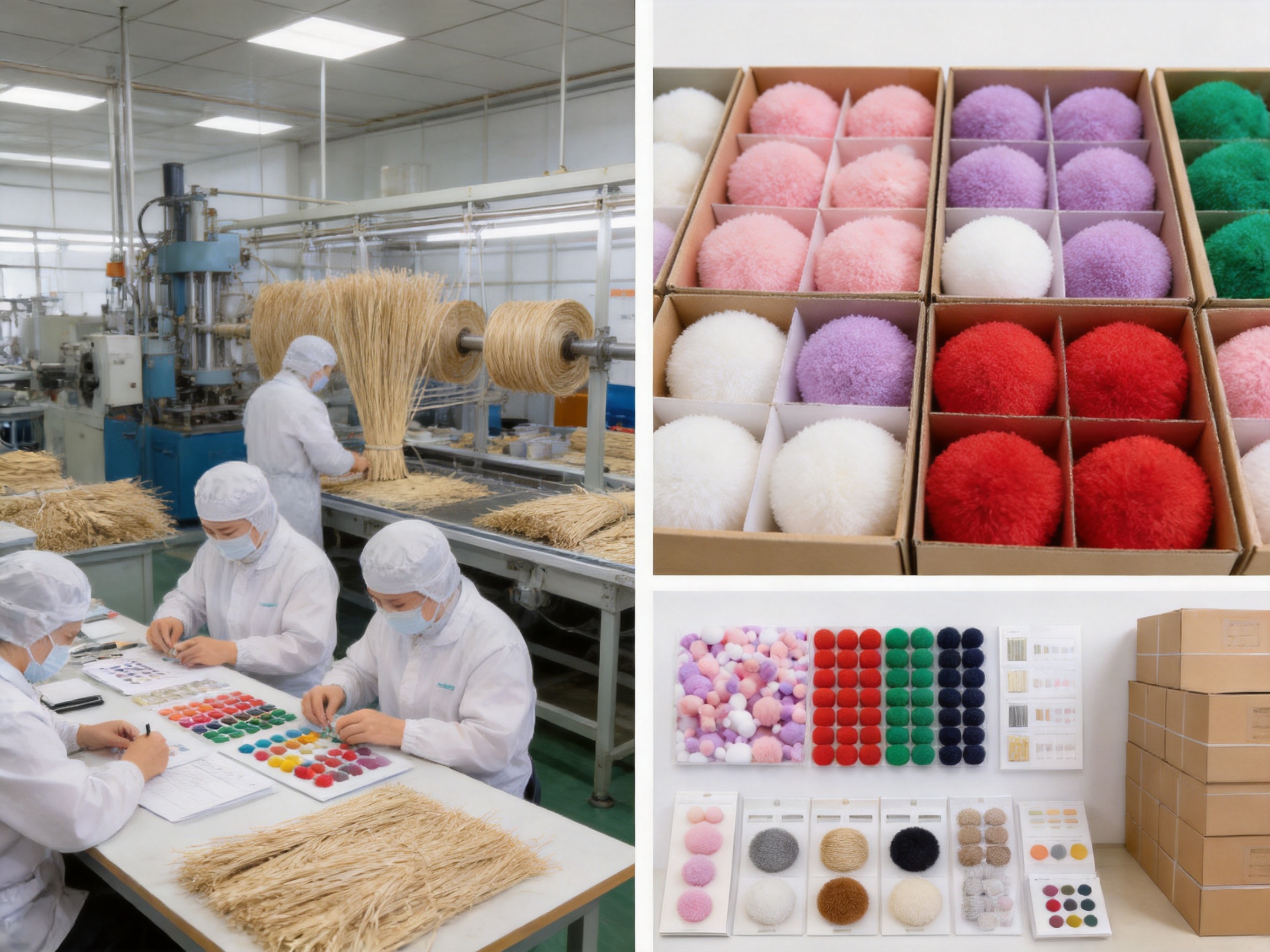
The quality of a decorative pom pom is influenced by more than the final appearance. It depends on the complete manufacturing process, from raw material preparation through finished-goods packaging. Zhejiang Raffia Paper Products Co., Ltd. has developed from a craft materials business unit established in 2010 into an integrated manufacturer founded as a company in 2014. Its experience includes raffia paper, paper yarn, fancy yarns, gift packaging materials, and related decorative products.
This background is relevant because decorative pom poms are part of a broader craft and packaging materials ecosystem. A manufacturer familiar with yarns, raffia materials, winding, slitting, packaging, and decorative applications is better positioned to understand how an accessory will be used in real commercial projects. It can evaluate not only the individual component but also its relationship with paper packaging, cords, ribbons, tags, and other finishing materials.
Integrated Production Structure
The company operates a modern production base of approximately 20,000 square meters in Dongyang, Zhejiang Province, with more than 200 professional employees. Its operations encompass raw material processing, mass production, quality testing, and finished-goods packaging and shipment. This integrated structure reduces dependence on disconnected external processes and supports better coordination between production stages.
For international buyers, integrated production can offer several advantages. Production schedules are easier to coordinate when material preparation, manufacturing, inspection, and packing are managed within one organized system. Communication can also be more direct because the supplier has greater visibility into the status of an order. If a customer requests a specification review or packaging adjustment, an integrated manufacturer may be able to respond more efficiently than a trading intermediary with limited control over production.
Standardized Operating Procedures
Decorative accessories require repeatability. A customer purchasing a small trial order may focus on appearance, while a customer placing a large recurring order must also consider batch-to-batch consistency. Standardized operating procedures help define how materials are handled, how production equipment is used, how products are checked, and how goods are prepared for shipment.
A standardized process can include documented material requirements, production parameters, inspection points, packing instructions, and handling procedures. By repeating these controls across orders, a manufacturer can make product quality more predictable. This is particularly important for retailers, packaging factories, party-supply distributors, and brands that need to maintain a recognizable product standard over time.
Equipment and Process Development
The company continues to upgrade its core technologies and production equipment for slitting, twisting, winding, and compression packaging. These capabilities are primarily associated with its wider raffia and fancy-yarn manufacturing operations, but they also demonstrate an investment in controlled material processing and efficient product handling.
Slitting and related preparation technologies help create material formats with more controlled width and structure. Twisting and winding processes support the production of yarns, cords, and other continuous materials. Compression packaging helps organize products for storage and transportation. Together, these capabilities reflect a manufacturing environment designed to handle decorative materials at commercial volume rather than only through manual workshop production.
For pom poms and similar accessories, controlled production is valuable because the final product depends on the organization of fibers. The material must be sufficiently full, visually even, and stable during handling. Production experience with fiber-based decorative goods helps the manufacturer identify problems such as uneven fullness, inconsistent shaping, excessive loose fibers, or irregular color distribution.
Quality Testing and Batch Control
Quality control should be present at multiple stages rather than limited to a final visual check. Incoming materials can be reviewed for suitability, production can be monitored for consistency, and finished goods can be inspected before packing. A strict and replicable quality control system gives customers greater confidence that orders will meet the agreed requirements.
For decorative pom poms, relevant inspection considerations may include fiber appearance, softness, elasticity, color uniformity, fullness, shape, attachment integrity where applicable, and visible shedding. Packaging quality is also important because compressed, poorly arranged, or inadequately protected goods may arrive in less attractive condition.
A reliable supplier should be able to discuss product specifications clearly and identify which characteristics are controlled during production. This transparency helps buyers establish practical acceptance criteria before placing a bulk order. It also reduces the likelihood of misunderstandings between the buyer’s design team, purchasing department, and production supplier.
Large-Scale Capacity and Supply Reliability
The company reports an annual production capacity of more than 200 million pieces across its product operations. Large capacity does not automatically guarantee quality, but when supported by standardized procedures and testing, it can provide important benefits for wholesale customers. A supplier with substantial capacity is more likely to support repeated orders, seasonal demand, promotional programs, and large retail launches.
Capacity planning is particularly important for decorative products because demand can increase quickly before holidays, festivals, wedding seasons, school events, and major retail campaigns. Customers who wait until the last moment may face limited production slots or shipping pressure. Working with an experienced factory and planning orders in advance can improve the likelihood of timely delivery.
Production capacity also supports product assortment. A buyer may require several colors, mixed-color packages, different packing quantities, or multiple related raffia products. An integrated factory can coordinate these requirements more effectively when the products are manufactured within a connected supply system.
The company serves customers throughout China and exports to Europe, North America, South America, Asia, and other regions. Experience with international supply chains can help the manufacturer understand the importance of export packing, documentation coordination, shipment scheduling, and communication across time zones. These factors are often as important to wholesale buyers as the product itself.
Applications in Gift Packaging
Gift Bags and Gift Boxes
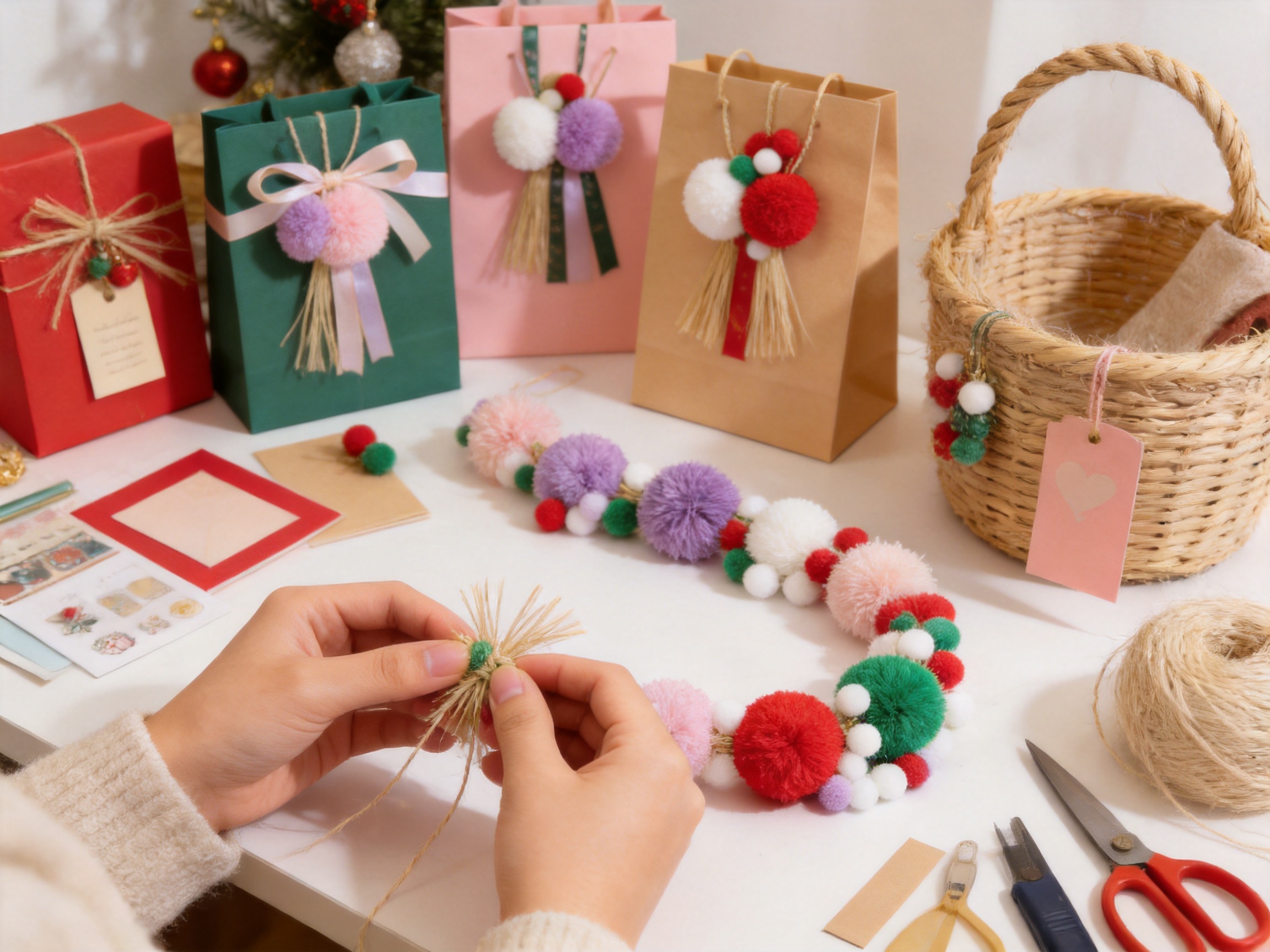
Pom poms can be attached to gift bags and gift boxes as a finishing accent. A single pom pom may be placed near a handle, ribbon, or gift tag. Several pieces can be arranged to create a border or repeating pattern. Because the product is lightweight, it can add decorative impact without making the package cumbersome.
For premium packaging, pom poms can be combined with paper raffia yarn, paper tape, cords, tissue paper, and printed labels. The contrast between a soft, fluffy accessory and a structured paper box can create a more layered presentation. For casual packaging, mixed-color pom poms can provide a cheerful and handmade character.
Seasonal and Holiday Packaging
Seasonal packaging often depends on color and texture. Bright colors can support spring, summer, birthday, festival, and children’s themes. Coordinated colors can be used for winter holidays, wedding favors, baby celebrations, and corporate events. A mixed-color assortment can give customers flexibility when the final packaging design is varied.
Since pom poms are small and easy to attach, they can be used for limited-edition packaging without requiring a complete redesign of the base package. A basic gift bag can become a seasonal product through the addition of selected decorative accents. This can help retailers refresh existing packaging lines while controlling tooling and design costs.
Basket and Hamper Decoration
Gift baskets and hampers often contain multiple products and need a finishing element that unifies the overall presentation. Pom poms can be attached to basket handles, wrapping material, bows, tags, or protective packaging. Their fluffy shape can soften the appearance of woven or rigid basket structures.
For food and personal-care gift sets, users should ensure that decorative components are positioned appropriately and do not create unwanted contact with the product contents. The pom poms are intended for decoration, so correct placement and packaging design remain the responsibility of the final user.
Applications in Crafts and Handmade Products
Greeting Cards and Scrapbooking
Craft creators can use small pom poms as focal points on greeting cards, scrapbook pages, memory books, and paper art. Their dimensional form can turn a flat card into a tactile design. They may represent flowers, balloons, animal features, clouds, ornaments, or abstract patterns depending on the project.
Because the product is available in bright and mixed colors, creators can select combinations that match printed paper, photographs, stickers, and other embellishments. Soft colors may support gentle designs, while vivid colors can create a more energetic composition.
Children’s and Classroom Crafts
Pom poms are widely useful for supervised classroom activities, holiday workshops, and children’s craft projects. They can be used to decorate paper figures, masks, seasonal ornaments, gift cards, and simple models. Their rounded shape makes them easy to recognize and incorporate into basic creative exercises.
Although the material is described as non-toxic, non-allergenic, and safe for decorative use, adult supervision remains appropriate for young children. Small decorative pieces should not be treated as food, and they should be kept away from children who may place craft components in their mouths. Safe storage and responsible use are important for every small craft accessory.
Home Décor and Party Supplies
Pom poms can be used in garlands, hanging ornaments, table decorations, photo backdrops, party signs, and centerpiece details. Multiple colors can be arranged into patterns, while a single color can create a more coordinated decorative theme.
For parties and events, lightweight accessories are practical because they can be installed quickly and removed after the event. They can be tied to strings, attached to paper banners, or combined with other craft materials. Event designers can also use them to add small accents to chairs, favor bags, dessert tables, and guest gifts.
Textile and Handmade Accessories
Experienced makers may attach pom poms to fabric items, handmade bags, scarves, hats, baskets, or decorative textile pieces. The soft texture can complement knitted and woven surfaces. Before applying the product to a textile item that will be washed or exposed to friction, the maker should test the attachment method and assess the expected service conditions.
For products intended for sale, the maker should also consider whether the attachment is secure enough for the intended use. Adhesive, stitching, and tying methods may perform differently depending on the surface and handling requirements. The pom pom itself can be attractive, but the finished product depends on the quality of the complete assembly.
Customization and OEM/ODM Support
Different buyers require different formats, colors, assortments, and packaging methods. A craft retailer may prefer small packs with mixed colors. A gift packaging factory may need bulk cartons of coordinated colors. A brand may require exclusive packaging, private labeling, or a specific assortment designed for a seasonal campaign.
The company provides flexible OEM and ODM services, including exclusive brand customization, custom size development, and long-term bulk order supply. These services allow buyers to move beyond standard catalog products when their market requires a more specialized solution.
Color and Assortment Planning
Color planning should begin with the customer’s application. A buyer may request bright individual colors, coordinated sets, or mixed-color assortments. Mixed colors can be packed randomly or organized according to an agreed ratio, depending on production feasibility and packaging requirements.
For a branded packaging program, color selection may be connected to brand identity, seasonal campaigns, or product categories. For craft retail, a broad assortment may be more attractive because it gives consumers more creative options. Clear communication about color expectations is essential, especially when customers need close visual coordination with other packaging materials.
Size Development
Custom size development can help buyers match the decorative accessory to a specific product. Small pom poms may be appropriate for greeting cards, jewelry packaging, gift tags, and miniature craft projects. Larger versions may be more suitable for gift baskets, party displays, ornaments, and visual merchandising.
When discussing a custom size, buyers should provide the intended application, target dimensions, preferred fullness, color requirements, packing quantity, and acceptable tolerances. A sample approval process can help both parties confirm the appearance before mass production.
Packaging and Private Label Requirements
Packaging influences how the product is displayed, stored, and sold. Retail packs may require printed labels, barcodes, instructions, color information, and specific hanging or shelf-ready formats. Wholesale cartons may prioritize efficient packing, protection, and easy counting.
Private-label customers may also require customized outer cartons, inner bags, product cards, or brand-specific presentation. An experienced manufacturer can coordinate these requirements with production and shipment planning. The buyer should provide artwork, packing instructions, carton information, and approval deadlines in a timely manner to avoid delays.
Purchasing Considerations for Wholesale Buyers
Define the Intended Use
Before requesting a quotation, buyers should identify where and how the pom poms will be used. Gift packaging, party supplies, retail craft kits, textile accessories, and home décor may require different expectations for size, attachment, packing, and durability. A clear application description helps the manufacturer recommend a suitable specification.
Confirm Material and Appearance
Buyers should confirm that the product is made from the expected polyester and acrylic fiber composition and that the desired texture is fluffy, soft, and elastic. Color samples should be reviewed where precise matching is important. Buyers should also discuss acceptable variation in fullness, shape, and color between production batches.
Request Samples Before Mass Production
Samples allow customers to assess the product directly. A sample review can cover softness, color, size, shape, fullness, shedding, packaging, and compatibility with the intended attachment method. For customized orders, the approved sample should become a reference for mass production.
Samples are especially helpful when the pom poms will be combined with other materials. A buyer can test whether the colors work with paper raffia, boxes, ribbons, printed graphics, fabric, or other decorative components. Testing the complete package can reveal issues that are not visible when the pom pom is viewed alone.
Discuss Order Quantity and Production Timing
Order quantity affects production planning, packaging, and shipping. Small trial orders may be used for market testing, while larger orders may support retail distribution or a seasonal campaign. Buyers should discuss minimum order quantities, production lead times, packing quantities, and estimated shipment schedules before confirming the order.
For seasonal projects, early planning is recommended. Holiday demand can place pressure on manufacturing capacity and international transport. A realistic schedule should include sample approval, production, inspection, packing, shipment, customs processing, and local delivery.
Evaluate the Supplier’s Quality System
A supplier should be evaluated not only by price but also by production control, communication, capacity, quality management, and service reliability. Buyers should ask how materials are inspected, how color and appearance are controlled, how finished goods are packed, and how nonconforming products are handled.
An integrated factory with standardized procedures and internal quality testing may offer stronger long-term value than a low-cost source with inconsistent production. For decorative products, an apparently small quality difference can affect the appearance of thousands of finished packages. A dependable supplier can help reduce rework, complaints, and missed delivery opportunities.
Sustainability and Responsible Supply Chain Considerations
Responsible sourcing is becoming increasingly important in gift packaging and craft materials. Buyers may consider material efficiency, packaging reduction, production waste, shipment efficiency, and the long-term reliability of the supply chain. The company emphasizes eco-friendly concepts and sustainable green supply chains as part of its broader business approach.
Because the pom poms are made from polyester and acrylic fibers, customers should communicate clearly about their material requirements and sustainability policies. If a buyer has specific expectations regarding recycled content, packaging materials, certifications, or end-of-life handling, those requirements should be confirmed directly before an order is placed.
Manufacturing efficiency can also support responsible purchasing. Stable production reduces waste caused by rejected batches, incorrect colors, or inconsistent sizing. Efficient compression packaging and organized shipment planning may help make better use of transport space. These measures do not replace formal environmental standards, but they can contribute to more controlled resource use.
Buyers can further support responsible use by ordering appropriate quantities, selecting packaging suited to the market, and avoiding unnecessary overpacking. Clear specifications and accurate forecasting help reduce excess production and prevent avoidable rework.
Why an Experienced Manufacturer Matters
A decorative accessory may appear simple, but commercial supply involves many details. Material quality, shape, softness, color, quantity, packing, timing, and communication all influence the final result. An experienced manufacturer understands that a product is not successful merely because it looks acceptable in a single sample. It must remain consistent through production, inspection, packaging, shipment, and repeated ordering.
Zhejiang Raffia Paper Products Co., Ltd. brings more than ten years of industry development experience, beginning with its craft materials business origins in 2010 and continuing through its manufacturing operations established in 2014. Its modern production base, professional workforce, integrated processes, and broad product knowledge support customers seeking reliable raffia and decorative material supply.
The company’s reported customer and market experience includes domestic and international supply, with products used by brands and organizations such as Costco, IKEA, LOKLIK, Disney, Lancôme, Chanel, Dior, and Primark. Such experience reflects familiarity with demanding commercial environments, although every order still requires its own specification confirmation and quality agreement.
Its manufacturing chain covers raw material processing, mass production, quality testing, finished-goods packaging, and shipment. This combination allows the company to support both standard products and customized OEM or ODM programs. For buyers seeking long-term cooperation, the ability to coordinate multiple parts of the supply chain can be a significant advantage.
Recommended Product Handling and Storage
To preserve the appearance of decorative pom poms, users should store them in a clean, dry environment away from excessive moisture, direct heat, sharp objects, and unnecessary compression. Products should remain in suitable packaging until they are ready for use. If compression occurs during transportation, gentle handling and natural recovery may help restore the fluffy appearance.
When attaching the pom poms, users should select an adhesive or fastening method suitable for the surface. Glue should be tested on a sample before large-scale assembly, particularly when the package is made from coated paper, plastic, glass, or a heat-sensitive material. If the finished item will be exposed to outdoor conditions, water, friction, or high temperatures, additional performance testing is recommended.
For commercial production, workstations should be clean and organized. Color groups should be stored separately to prevent mixing, and staff should follow the approved assembly instructions. These simple practices help maintain consistent finished products and reduce avoidable errors.
Q&A: Common Questions About Raffia Decorative Pom Poms
Q1: What materials are used to make these decorative pom poms?
The pom poms are made from polyester and acrylic fibers. This combination supports a fluffy, soft, elastic, and durable decorative product suitable for gift packaging, crafts, party supplies, and related applications.
Q2: Are the pom poms available in different colors?
Yes. Various bright colors are available, and mixed-color options can also be selected. Buyers should confirm the available color range, assortment method, and color requirements when requesting a quotation or customized order.
Q3: Do the pom poms shed easily?
The product is designed not to shed easily. Controlled material selection and production help support a cleaner appearance. As with all fiber-based decorative products, appropriate handling and storage are recommended.
Q4: Are the pom poms soft and elastic?
Yes. The product is described as fluffy, soft, and elastic. These characteristics improve tactile appeal and help the pom poms remain attractive during ordinary handling, packing, and decorative assembly.
Q5: What can the pom poms be used for?
They can be used for gift decoration, handicrafts, party supplies, greeting cards, scrapbooking, ornaments, baskets, gift bags, gift boxes, seasonal displays, home décor, and other creative projects.
Q6: Can the product be used for children’s crafts?
The product is described as non-toxic, non-allergenic, and safe for decorative use. However, adult supervision is recommended for young children because small craft components may present a choking risk if misused or placed in the mouth.
Q7: Can custom sizes be developed?
Custom size development is available through OEM and ODM services. Buyers should provide the intended application, target dimensions, preferred appearance, quantity, packaging requirements, and any acceptable tolerances.
Q8: Can the pom poms be supplied under a private label?
Exclusive brand customization and private-label support are available as part of flexible OEM and ODM services. Packaging artwork, labeling specifications, packing quantities, and approval requirements should be confirmed before production.
Q9: Why should a buyer choose an integrated manufacturer?
An integrated manufacturer can coordinate material processing, production, quality testing, packaging, and shipment within one organized system. This may improve communication, consistency, production planning, and long-term supply reliability compared with a supplier that has limited control over external processes.
Q10: How should buyers evaluate a sample?
Buyers should examine the sample’s material feel, softness, elasticity, fullness, shape, color, visible shedding, attachment compatibility, and packaging. If the product will be used in a commercial package, it is advisable to test the complete assembled package before approving mass production.
Q11: Are mixed-color assortments suitable for retail craft packs?
Yes. Mixed-color assortments can provide creative variety for hobby users, children’s crafts, party projects, and seasonal decorations. The desired color ratio and packing method should be discussed with the manufacturer.
Q12: Can the manufacturer support large recurring orders?
The company operates a large production base and reports annual capacity of more than 200 million pieces across its operations. It provides long-term bulk order supply and can discuss production planning based on the customer’s quantity, specification, and delivery schedule.
Conclusion
Raffia decorative pom poms provide a simple but highly effective way to improve the appearance and tactile quality of gift packaging, handicrafts, party supplies, and decorative displays. Their polyester and acrylic fiber construction gives them a soft, fluffy, elastic, and durable character. Bright and even colors create strong visual impact, while mixed-color options allow users to develop playful, festive, or customized designs.
Compared with flat or less tactile decorative alternatives, pom poms add three-dimensional volume, warmth, and creative flexibility. They are lightweight, easy to attach, suitable for many surfaces, and practical for both commercial assembly and personal craft work. Their low-shedding design and resilient texture further support a cleaner and more dependable presentation.
For wholesale buyers, product performance is closely connected to manufacturing capability. A supplier with integrated raw material processing, mass production, quality testing, packaging, and shipment can provide better coordination and more reliable batch consistency. Standardized procedures, upgraded equipment, large production capacity, international supply experience, and OEM/ODM flexibility are valuable advantages for customers planning retail, seasonal, promotional, or long-term packaging programs.
With its manufacturing base in Dongyang, Zhejiang Province, professional workforce, extensive raffia and craft-material experience, and commitment to quality and sustainable supply-chain development, Zhejiang Raffia Paper Products Co., Ltd. is positioned to support customers seeking decorative pom poms and related raffia products. By combining attractive product design with controlled manufacturing and flexible customization, the company helps buyers create gift packaging and craft products that are colorful, distinctive, safe for intended decorative use, and suitable for global markets.
References
1. Product material and application information supplied for Raffia Decorative Pom Poms.
2. Company profile and manufacturing information supplied for Zhejiang Raffia Paper Products Co., Ltd.
3. General principles of textile fiber selection, decorative accessory design, and packaging quality control.
4. General practices for craft-material storage, sample approval, production inspection, and wholesale supply planning.
5. General considerations for OEM and ODM development of gift packaging and decorative craft materials.
Product: Raffia Decorative Pom Poms

 +86 15355323399
 kevin@raffia-paper.com
 No. 151 Guanshan North Road, Dongyang City, Zhejiang Province, China

Copyright © Zhejiang Raffia Paper Products Co., Ltd. All Rights Reserved.

Paper Raffia Yarn & Gift Packaging Factory