
 +86 15355323399
 En
 中文简体
 日本語
 Français
 Español
 Deutsch
 Türk
 عربى
 italiano
 русский
Shredded paper filler is cut paper used to fill, cushion and finish the inside of a gift box, hamper or e-commerce parcel. Buyers usually shortlist three suppliers, receive three prices that differ by 30–40%, and discover after the first container that the quotes were never comparable. This guide covers the eight fields that decide whether two quotes mean the same thing, the four material families, and the quality points that prevent batch-to-batch drift.
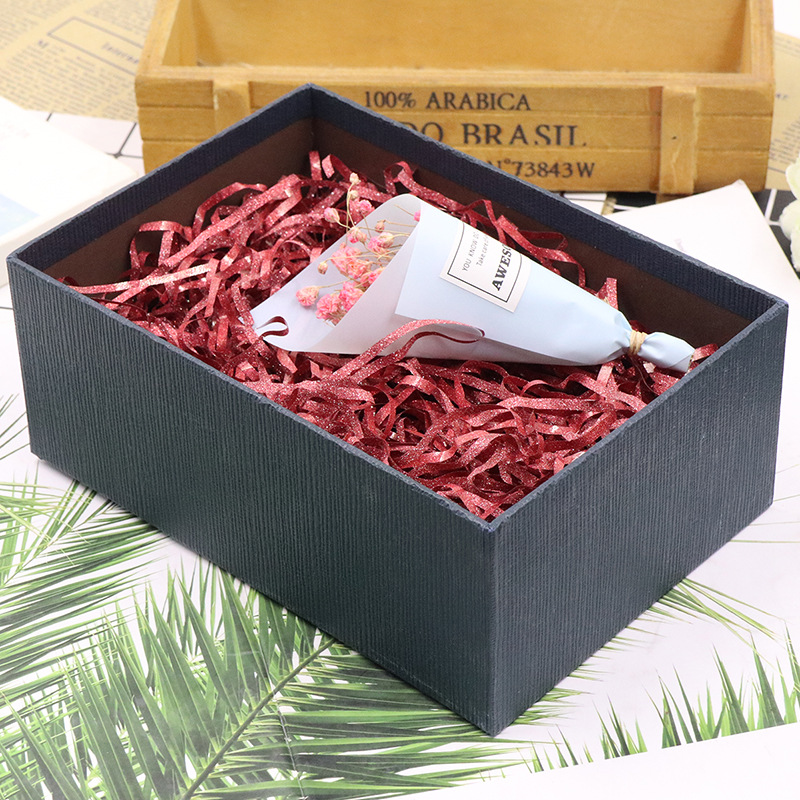
1. What shredded paper filler is — and what it is not
Paper filler is a paper product: it is cut from paper, it is specified by paper grade and cut width, and it is priced by weight and by packed volume. Three materials are often sold next to it but behave differently:
Wood wool / excelsior
●— long, coarse wood strands; strong cushioning, rougher surface, not printable.
Honeycomb or tissue wrap
●— an outer wrapping material, not a loose filler.
Metallized film / PET decorative shreds
●— plastic film shreds with a metallic or holographic finish. They look like filler and are specified like filler, but they are not paper and cannot carry a paper certification claim.
That last point matters more than it used to. If your packaging brief says "paper-based filler" and the sample you approved turns out to be PET film, the claim fails at the audit stage, not at the sample stage.
2. The four families, and when each one wins
| Family | What it is | Wins when | Watch out for |
| Standard paper shreds | Cut and often crinkle-cut paper, dyed or printed | Colour range and brand matching matter; volume is high | Colour drift between dye lots; dust if cut too dry |
| Fine paper / wood pulp shreds | Lighter paper cut into fine strands | Softness and bulk inside premium boxes | Compresses under load; needs correct pack density |
| Natural plant fibre | Raffia, sisal, jute, hemp, wood fibre — unbleached, textured | Natural look, compostable story, tactile retail | Shade varies by harvest; absorb moisture |
| Metallized PET film shreds | Plastic film, metallic or holographic | High-shine decorative effect | Not paper; not recyclable in paper streams |
Most gift programmes end up using two of these in the same box — a paper base for volume and a film or fibre accent for look. That is also where most colour mismatches happen: the base and the accent come from different suppliers with different colour references.
3. The eight fields that make quotes comparable
Ask every supplier to confirm these in writing before you compare prices.
| # | Field | Why it decides the price | What to put in the RFQ |
| 1 | Cut width | Narrower cuts cost more per kg and fill differently | Width in mm, with tolerance |
| 2 | Paper grade and grammage | Drives softness, bulk and cost | Grade name + gsm |
| 3 | Colour reference | Dye lot matching is the main re-order risk | Physical chip or Pantone, plus "match to approved sample" |
| 4 | Bulk / recovery | Two fillers at the same weight fill different volumes | Fill volume per gram, or a fill test in your box |
| 5 | Pack form | Compression changes freight and warehouse space | Bag weight, compressed or loose |
| 6 | Carton and pallet data | Half of a landed cost hides here | Units per carton, CBM, gross weight, pallet pattern |
| 7 | MOQ and replenishment | Re-order speed matters more than first price | MOQ, re-order MOQ, standard lead time |
| 8 | Documentation | FSC claim, test reports, compliance statements | Which document, in whose name, valid until when |
A quote without fields 4–6 is not a price — it is a starting position.
4. Why the cheapest quote rarely lands cheapest
Filler is a volume product sold by weight. Two suppliers can quote the same price per kg and deliver very different costs per filled box, because:
●a lighter, bulkier paper needs fewer grams to fill the same space;
●vacuum compression cuts freight volume, but changes how the material recovers on unpacking;
●a narrower cut looks fuller with less material, but slows down packing lines.
So compare cost per filled box, not price per kg. Ask each supplier for the gram weight needed to fill your actual box to your actual fill height, then multiply by their price. That single change explains most of the "we switched suppliers and our cost went up" stories.
5. Four failure modes, and how each is controlled
Colour drift
1. — the approved chip and the bulk order diverge. Control: dye lot retention, a retained reference sample per order, and colour check at the finished-goods gate, not at packing.
Softness drift
2. — one carton feels crisp, the next feels limp. Control: incoming paper grade verification and fixed production parameters per SKU.
Dust and fibre shedding
3. — shows up as complaints from the packing line, not from the buyer. Control: cut condition maintenance and a dust check before compression packing.
Moisture and smell
4. — natural fibres and paper both absorb humidity in transit. Control: moisture check at pre-shipment, and compression packing with the right liner.
None of these can be inspected in at the loading dock. They have to be designed into the process, which is why we run four gates: incoming material, in-process production, finished goods and pre-shipment.
6. A ten-day sample test you can run yourself
- Send the
same physical colour chip
and the
same fill height
to all three suppliers. - Ask for the gram weight required to fill your box — not a sample photo.
- Store each sample seven days in a humid room, then compare colour and softness again.
- Fill ten boxes per sample on your own line and time the packing step.
- Compare cost per filled box, carton CBM and re-order lead time.
Suppliers who resist step 2 usually cannot hold consistency past the first batch.
7. How we supply it
We produce paper shreds and filler as one of four product lines at our 20,000 m² facility in Dongyang, Zhejiang, with close to 200 people and a capacity of around 800 tonnes per month. Core processes — slitting, twisting, winding and compression packaging — run in-house, which is what makes a fixed cut width and a retained colour reference enforceable rather than aspirational.
Standard items ship in 48–72 hours; custom colours and cut widths run in 3–7 days. FOB Ningbo, with Shenzhen available on request. FSC certified paper is available on request, our BSCI audit is completed, and ISO 9001 is in progress.
FAQ
Is shredded paper filler recyclable?
Paper-based shreds go into the paper stream if they are not laminated or metallized. Metallized PET film shreds do not — they must be specified as plastic. Ask your supplier which family each SKU belongs to before you print a recyclability claim on the box.
What cut width should I specify?
Width is a function of box size, fill height and packing speed — not of taste. Tell the supplier the box dimensions, the target fill height and how the filler is applied (by hand or by dispenser) and let them propose a width, then verify it in a fill test.
Can you match our brand colour?
Colour is matched to an approved physical chip, and the approved chip is retained per order. Matching to a screen image is not a colour reference.
What is the difference between paper shreds and wood wool?
Paper shreds are cut paper, printable and consistent in colour; wood wool is coarse wood strand with stronger cushioning and a rougher surface. They are not interchangeable in a premium gift box.
Do you supply FSC certified filler?
FSC certified paper is available on request; the claim applies to the paper component, not to film or synthetic shreds. We will state the scope in writing on the quotation.
→ See our raffia filler range | → Send your spec for a quote
 +86 15355323399
 kevin@raffia-paper.com
 No. 151 Guanshan North Road, Dongyang City, Zhejiang Province, China

