
 +86 15355323399
 En
 中文简体
 日本語
 Français
 Español
 Deutsch
 Türk
 عربى
 italiano
 русский
Crinkled Metallic Raffia Shreds: A High-Impact Decorative Filler for Modern Packaging
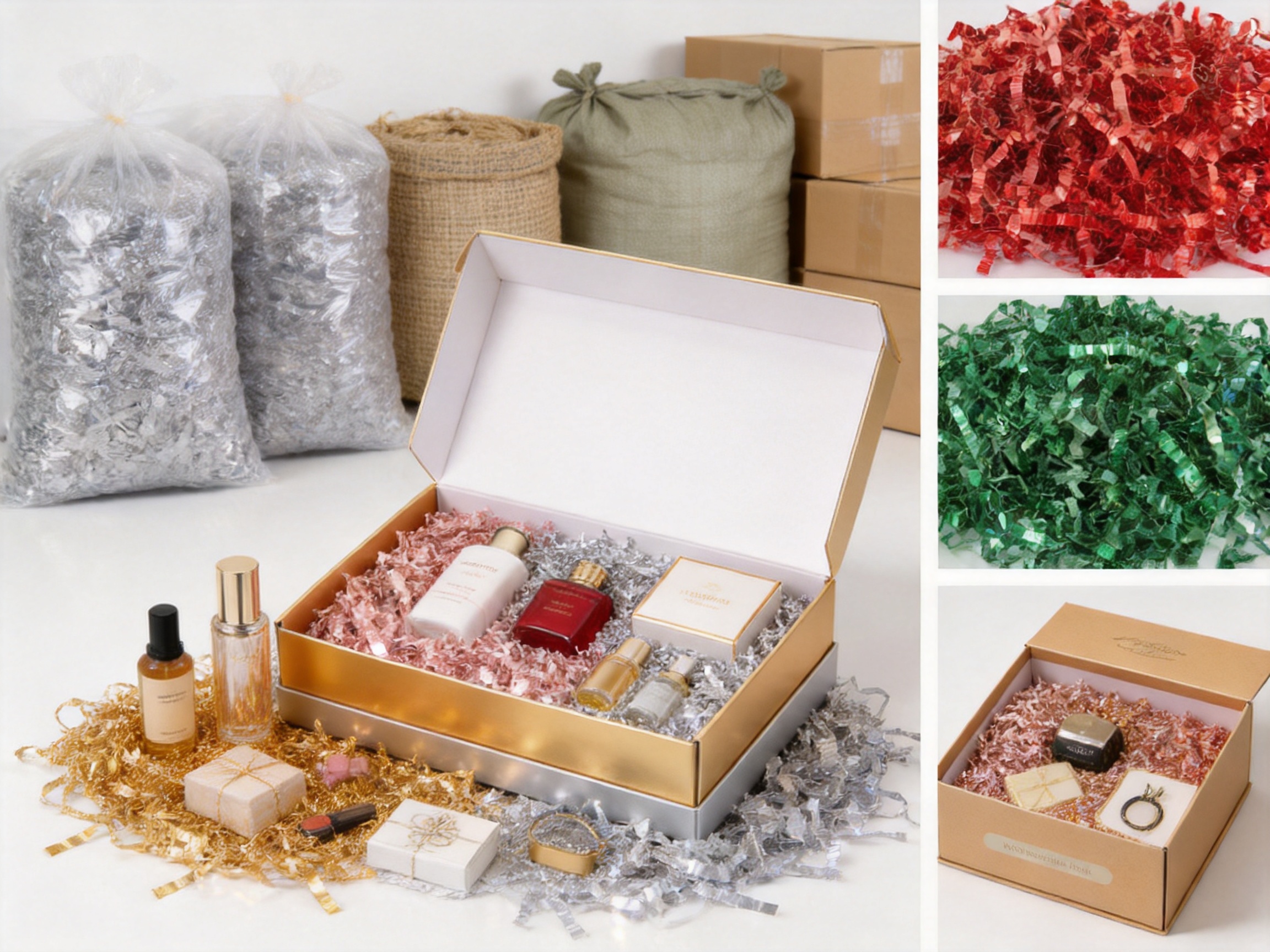
Crinkled Metallic Raffia Shreds are decorative packaging fillers made from crinkled PET-based metallic film fibers. By combining a reflective metallic surface with a curled and irregular shred structure, this material provides volume, texture, movement, and visual brightness inside packaging. It is designed for gift boxes, seasonal packaging, retail presentation, promotional products, cosmetic packaging, and e-commerce unboxing applications.
Unlike flat metallic strips, crinkled metallic raffia shreds do not remain in a simple two-dimensional layer. Their wrinkles, curls, and irregular folds scatter light in multiple directions, creating a fuller and more dynamic appearance. This structure allows a relatively light quantity of material to create a high-volume decorative effect, helping packaging manufacturers achieve visual impact while maintaining control over material consumption, shipping volume, and production costs.
For commercial packaging producers, the value of this product extends beyond appearance. The material is compatible with large-scale processing, flexible color development, multiple width options, customized densities, and several packaging formats. It can be supplied for sampling, factory use, OEM programs, and long-term bulk procurement.
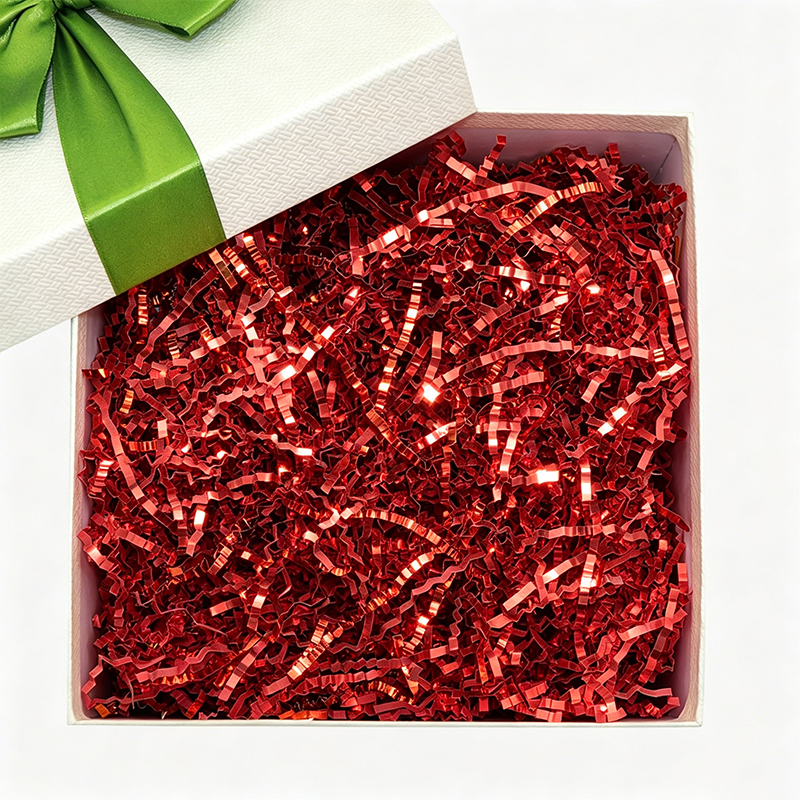
Crinkled Metallic Raffia Shreds
1. Understanding Crinkled Metallic Raffia Shreds
Crinkled Metallic Raffia Shreds are produced from PET metallic film that is mechanically crinkled and then cut into narrow decorative strips. The result is a lightweight filling material with a reflective surface and a soft, curled form. Depending on the selected width, crinkle level, density, and color, the product can create effects ranging from delicate shimmer to dense, high-gloss presentation.
The word “raffia” in this product category refers to the visual and functional role of the material as a decorative shred or filling fiber. It is intended to provide a similar packaging function to paper raffia, decorative paper shreds, and other box fillers, while delivering a distinctly metallic appearance. It is especially suitable when a brand wants packaging to look festive, luxurious, playful, or highly visible on a retail shelf.
The material may be supplied in single colors such as gold, silver, rose gold, red, green, black, or blue. Mixed-color combinations and iridescent effects can also be developed for specific packaging themes. Pantone matching and custom visual development are available for buyers requiring closer coordination with a brand identity, seasonal campaign, or product collection.
1.1 The Role of Decorative Fillers in Packaging
Packaging fillers serve several practical and visual purposes. They help occupy empty space inside a box, improve the presentation of the packaged item, provide a layered unboxing experience, and create a more complete appearance when the package is opened. A well-selected filler can make a small product appear better positioned and can add color or texture without requiring a complex structural insert.
Crinkled metallic raffia shreds are particularly effective when the package needs an immediate visual effect. The reflective fibers catch ambient light as the box is moved or opened. Their irregular shape produces depth, while their loose structure allows the product to be arranged around bottles, gift items, accessories, cosmetics, stationery, and promotional products.
In e-commerce packaging, the material contributes to the customer’s unboxing experience. In gift packaging, it supports a festive or premium presentation. In retail packaging, it can help coordinate the internal appearance of the package with exterior graphics, ribbons, labels, and decorative accessories.
1.2 Product Structure
The product consists of three important structural elements: the PET film base, the metallic coating or reflective finish, and the crinkled shredded form. Each element influences performance and appearance.
The PET film base provides a stable and lightweight substrate. It supports the metallic visual effect while allowing the film to be slit and processed into narrow strips. The metallic surface contributes brightness and color. The crinkling process gives the strip its three-dimensional form, increasing the apparent volume and creating more angles for light reflection.
Because the strips are not flat, they can retain a loose and expanded structure after being placed into a box. This helps produce a fuller appearance compared with an equal weight of flat strips. The actual visual effect depends on strip width, crinkle intensity, packing density, color, and the shape of the box.
2. Main Advantages Over Conventional Decorative Fillers
Packaging buyers generally compare decorative fillers according to appearance, cost, filling efficiency, supply stability, customization, and ease of logistics. Crinkled metallic raffia shreds provide a combination of characteristics that makes them competitive with flat metallic strips, solid foil fillers, paper shreds, and other decorative materials.
2.1 Multi-Angle Light Reflection
The most visible advantage is the crinkled structure. Flat metallic strips reflect light primarily from their surface plane. When several flat strips overlap, they can form relatively uniform layers with limited visual movement. Crinkled strips have multiple folds and irregular angles, so they reflect light in different directions.
This creates a more animated appearance when the box is moved, opened, or viewed from different positions. Gold and silver versions can produce a strong bright effect, while rose gold, red, green, blue, and multicolor versions can create a softer or more decorative result.
2.2 Higher Apparent Volume
The curled form allows the shreds to occupy more visible space than a flat strip of the same weight. This is important for packaging manufacturers seeking a substantial presentation without filling the entire box with heavy material. The material expands visually when loosened, creating a cushion-like decorative layer.
High apparent volume can support cost control because the packaging producer may be able to achieve the desired visual coverage with a controlled quantity of product. Actual usage should always be confirmed through sample testing, since the required amount depends on box dimensions, product weight, presentation standards, and the preferred level of fullness.
2.3 Lightweight Handling
PET metallic film is lightweight compared with many solid decorative materials. This supports easier handling during filling, packing, sampling, and order preparation. Lower material weight can also be useful in e-commerce packaging, where shipping expenses and parcel weight are important considerations.
The product is suitable for manual filling and can also be integrated into standardized packaging workflows. It can be supplied in loose form, compressed bulk packs, or customized OEM packaging depending on the customer’s operation.
2.4 Controlled Decorative Cost
Solid metallic foil fillers can provide strong visual impact, but they may be more material-intensive and less efficient when the required result is a loose, high-volume internal filling. Crinkled metallic raffia shreds are designed to create a premium visual effect through surface reflection and structural volume rather than through heavy solid construction.
This makes them suitable for scalable commercial packaging programs that need an attractive appearance at a controlled cost. Buyers can select different widths and densities according to the product category. A fine, lower-density version may be suitable for small cosmetic boxes, while a wider and denser version may be more appropriate for seasonal gift packaging.
2.5 Flexible Color and Visual Development
The product can be developed in standard metallic colors, mixed-color combinations, and custom visual effects. This gives packaging designers more flexibility than a single standard filler color. The material can be coordinated with holiday themes, corporate colors, product launches, luxury collections, or retail campaign graphics.
Color development may include single-color metallic crinkle, blended color combinations, high-gloss intensive effects, soft-light low-density effects, and brand-specific visual concepts. This range allows buyers to choose whether the filler should be the dominant feature inside the box or a supporting accent around the packaged product.
2.6 Compatibility with Commercial Supply Chains
A decorative filler is only useful for large-scale packaging if it can be supplied consistently. Crinkled metallic raffia shreds are designed for industrial production, export packing, sampling, and repeat orders. Supply can be arranged in small sample quantities, standard bulk weights, or customized packaging formats.
This flexibility is valuable for companies that need to test a product before committing to a larger purchase. It also supports buyers that operate multiple packaging lines or serve several customers with different color and size requirements.
| Comparison Factor | Crinkled Metallic Raffia Shreds | Flat Metallic Strips | Paper Shreds |
| Surface appearance | Reflective and dimensional | Reflective but relatively flat | Matte or printed paper appearance |
| Light reflection | Multi-angle reflection from crinkled folds | Strong reflection mainly from flat surfaces | Limited reflection unless specially coated |
| Visual volume | High apparent volume when loosened | Moderate volume | Moderate to high depending on cut and curl |
| Color range | Metallic, mixed, iridescent, and custom options | Common metallic colors | Broad paper color range |
| Typical positioning | Premium, festive, promotional, and retail packaging | Decorative packaging with a simpler effect | Natural, kraft, sustainable-look, and general gift packaging |
| Customization | Width, density, color, and packaging format | Usually color and width focused | Paper type, color, cut, and printing options |
3. Material and Manufacturing Process
Consistent quality in decorative shreds depends on more than the appearance of the final material. The raw film, slitting accuracy, crinkle control, cutting process, color management, compression method, and inspection procedures all influence the finished product.
3.1 PET Metallic Film Selection
The manufacturing process begins with PET metallic film. PET is selected as the base because it provides a stable film structure that can be processed through slitting, crinkling, and cutting equipment. The metallic finish gives the final shreds their reflective character and helps the product maintain a bright appearance under normal packaging conditions.
Material selection must consider film thickness, surface consistency, reflective performance, color uniformity, and processing behavior. If the film is not stable during crinkling or cutting, the final strips may have inconsistent width, uneven curls, or an irregular visual effect that does not meet the buyer’s requirements.
3.2 Slitting and Width Control
After the film is prepared, it is slit into narrow strips. Standard width options include approximately 1 millimeter and 3 millimeters, with custom sizes available for packaging development. Width influences the appearance, softness, density, and handling characteristics of the finished product.
Fine 1-millimeter crinkle is generally associated with a softer and lighter visual effect. It can be suitable for small gift boxes, cosmetic packaging, delicate retail presentation, and packages where the filler should not overpower the main product.
The 3-millimeter standard crinkle creates stronger volume and a more visible shine. It is suitable for general gift packaging, holiday packaging, larger presentation boxes, and applications where a bold internal decorative effect is desired.
Custom widths can be developed when a buyer requires a particular visual balance, filling behavior, or relationship between the decorative filler and the packaged product. Width selection should be confirmed through physical samples rather than relying only on numerical specifications.
3.3 Controlled Crinkling
The film is mechanically crinkled before or during the shredding process. This step creates irregular folds and curled strip structures. The goal is to produce sufficient texture and volume while retaining a stable and visually attractive form.
Crinkling must be controlled carefully. If the material is too lightly crinkled, it may behave like a flat strip and fail to provide the intended volume. If it is too heavily crinkled, the strips may become excessively compact, tangled, or difficult to distribute evenly inside a package.
Controlled processing allows the manufacturer to offer different effect densities. A low-density version can create a softer, more open appearance. A medium-density version offers a balance between volume and shine. A high-density version is intended for a more intensive decorative effect with stronger visual coverage.
3.4 Cutting into Shreds
Once the film has been crinkled, it is cut into shredded or curled strips. The cut length and strip width affect how the material spreads inside a box. Shorter shreds may be easier to distribute in small packages, while longer shreds can create a more dramatic layered effect in larger boxes.
Uniform processing does not mean that every shred must be perfectly identical. The product is intentionally decorative and irregular. However, the overall batch should maintain a controlled range so that customers receive a predictable visual result and consistent filling behavior from one production lot to another.
3.5 Density Adjustment
Density refers to the degree of crinkle, the amount of material per package, or the visual intensity of the final filling effect, depending on the customer’s specification. Density can be adjusted to match the packaging format and the desired presentation.
Low-density material is useful when the box contains a delicate product or when the filler serves mainly as a light decorative accent. Medium density is a practical general-purpose option. High density can be selected for gift boxes, promotional packaging, and seasonal displays where a strong first impression is important.
3.6 Inspection and Batch Consistency
Quality control should cover the incoming PET metallic film, color consistency, strip width, crinkle structure, cleanliness, packaging weight, and finished appearance. A repeat customer normally expects the new shipment to match previously approved samples as closely as possible.
Consistent batch production is particularly important when the product is used in a retail campaign or a large gift packaging program. Differences in color or density can become visible when packages are displayed together. Standardized procedures and repeatable processing help reduce these variations.
4. Manufacturing Strengths of the Supplier
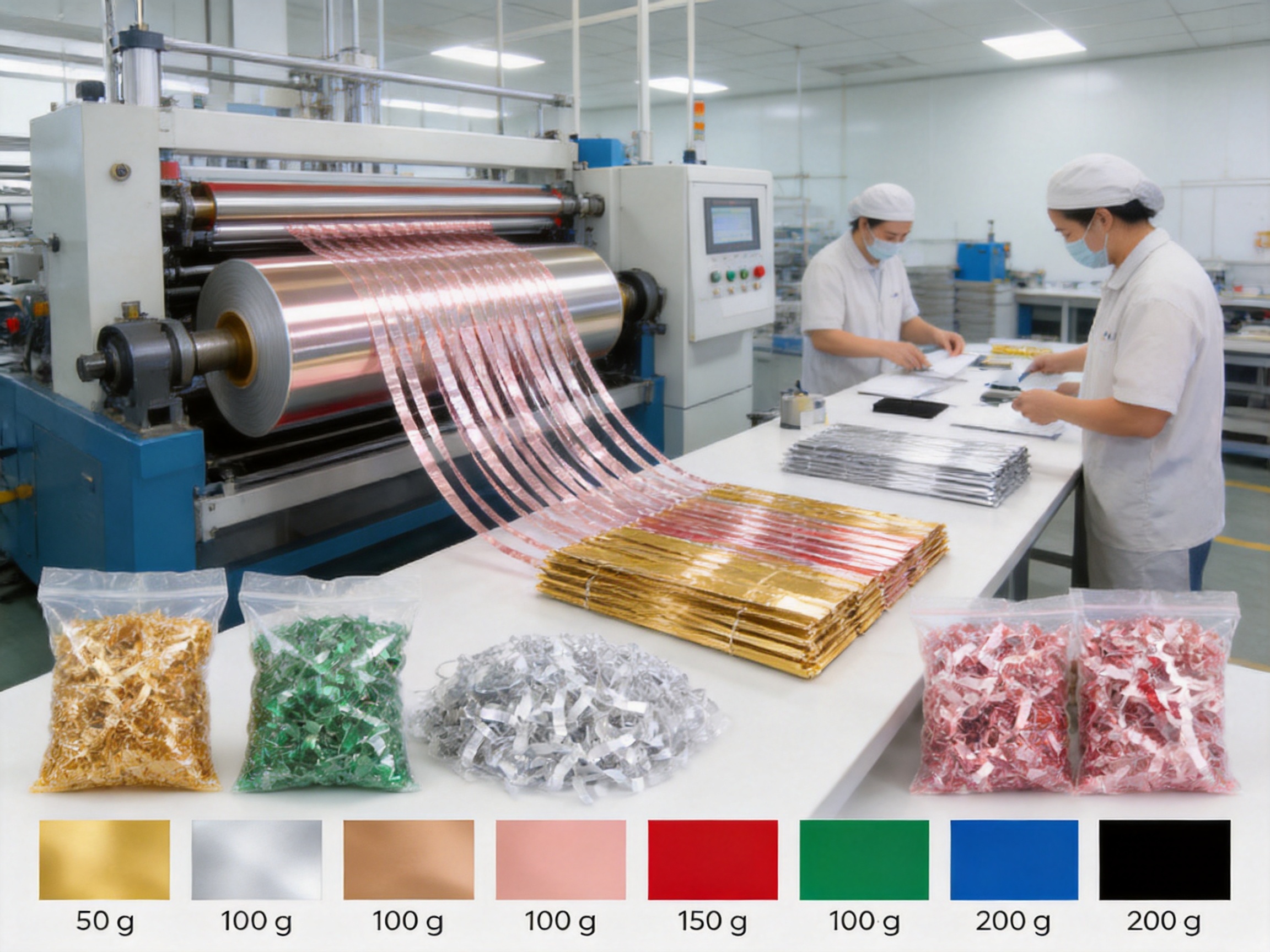
Zhejiang Raffia Paper Products Co., Ltd. has developed from a craft materials business unit established in 2010 into an integrated manufacturer serving decorative packaging and related material markets. The company was formally founded in 2014 and has more than ten years of industry experience.
Its production base is located in Dongyang, Zhejiang Province, China. The facility covers approximately 20,000 square meters and is supported by more than 200 professional employees. The company operates an integrated manufacturing chain that includes raw material processing, mass production, quality testing, finished-goods packaging, and shipment preparation.
4.1 Integrated Production Structure
An integrated production structure can help reduce unnecessary separation between material preparation, converting, inspection, and packing. For buyers, this may simplify communication because technical requirements can be evaluated within the same supply organization that manages production and final shipment.
The company’s equipment and procedures support slitting, twisting, winding, and compression packaging. These capabilities are relevant to the broader product range of paper raffia yarns, fancy yarns, decorative packaging materials, and related craft products. For crinkled metallic raffia shreds, the same manufacturing philosophy supports controlled converting, packaging flexibility, and bulk supply.
4.2 Production Capacity
The company reports an annual production capacity of more than 200 million pieces across its product categories. This scale is important for buyers that require stable supply during seasonal peaks, retail campaigns, promotional events, and recurring e-commerce packaging programs.
Large capacity does not replace quality control, but it can support better production planning and more reliable delivery when orders are scheduled in advance. It also allows the supplier to serve both development-stage buyers and established customers with continuing bulk demand.
4.3 Quality Management
A strict and replicable quality control system is essential for decorative materials because visual differences can affect the perceived quality of the finished package. The company emphasizes standardized production procedures and consistent batch quality.
For crinkled metallic raffia shreds, quality management may involve confirming raw material appearance, checking color and gloss, inspecting width and crinkle condition, verifying package weight, and reviewing the condition of compressed or bulk-packed goods before shipment.
Buyers requiring a specific technical standard should provide approved samples, target colors, preferred strip widths, density expectations, packaging requirements, and inspection criteria at the beginning of the project. Clear specifications make it easier to evaluate production consistency.
4.4 Export-Oriented Packaging
The supplier provides packaging formats designed for different procurement requirements. Vacuum compression packaging uses moisture-proof PE bags and reduces shipping volume. This can be useful for export shipments in which the buyer wants to optimize container space.
Bulk industrial packaging is available in 5-kilogram, 10-kilogram, and customized weight options. This format is suitable for packaging factories that use the material directly in production. Woven bag export packaging provides a heavier-duty solution for large-volume orders and container shipment.
Small sample packaging in 50-gram, 100-gram, and 200-gram OPP bags supports product evaluation, color approval, packaging trials, and customer demonstrations. OEM branding can be incorporated when the project requires customer-specific presentation.
5. Product Options and Customization
Crinkled metallic raffia shreds can be configured according to the buyer’s visual and operational requirements. Customization is not limited to color. It can also include width, density, product form, packing method, labeling, and brand presentation.
5.1 Single-Color Metallic Crinkle
Single-color metallic crinkle is the most straightforward option. Gold and silver are widely used for luxury, holiday, anniversary, and premium gift packaging. Rose gold is frequently selected for beauty, fashion, wedding, and lifestyle presentations. Red and green can support Christmas and other seasonal themes, while black can create a modern or dramatic appearance.
Single-color material is useful when the filler needs to coordinate with a clear packaging color system. It is also easier to standardize across a high-volume packaging line.
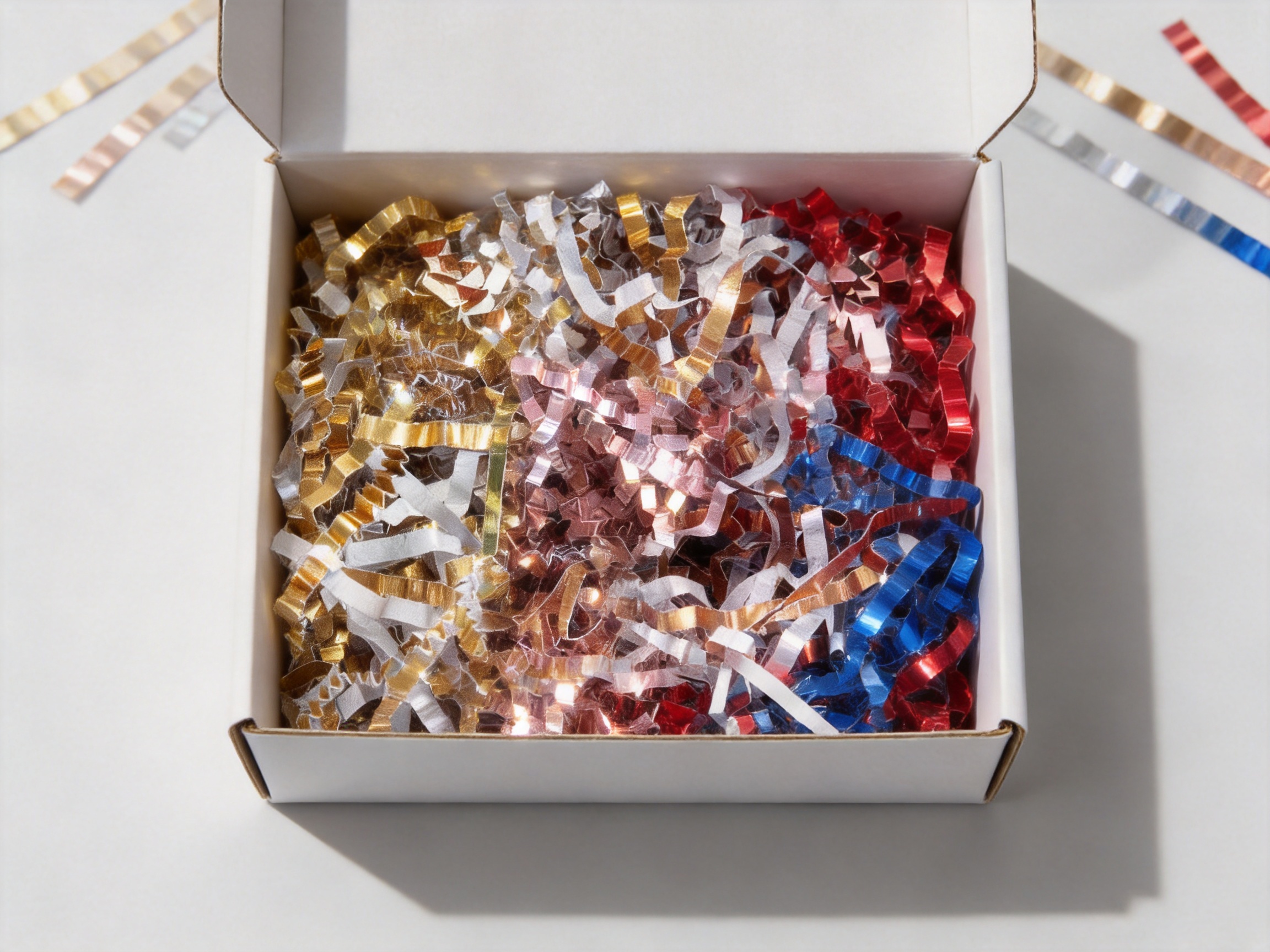
5.2 Mixed-Color Decorative Blends
Mixed-color blends combine two or more colors to create a more playful or customized appearance. They can match brand palettes, event themes, sports colors, holiday concepts, or product collections.
Color blending should be evaluated in the actual packaging environment. A combination that looks balanced in a sample bag may appear different when spread inside a large box. Buyers should assess the blend under retail lighting and alongside the primary product and package graphics.
5.3 High-Gloss Intensive Effect
The high-gloss intensive effect version is designed for packaging that requires strong shine and immediate visual attention. It may be suitable for promotional gift sets, festive displays, premium cosmetics, and retail presentation boxes.
This type of effect should be balanced with the product inside the box. If the package already includes highly reflective labels, foil printing, metallic ribbons, or glossy inserts, a dense filler may create too much visual competition. Sample testing helps determine the right intensity.
5.4 Soft-Light Low-Density Version
The soft-light low-density version provides a more restrained decorative appearance. It can be used when the buyer wants a touch of shimmer without making the filler the main visual feature. This option may be appropriate for small boxes, boutique products, personal care items, and minimalist presentations.
5.5 OEM and ODM Development
OEM and ODM services can include custom colors, widths, densities, packaging weights, labels, and visual combinations. A buyer may submit a reference sample, color standard, brand guide, or packaging photograph for development.
The development process generally begins with a requirement review, followed by sample preparation and visual evaluation. After the buyer confirms the sample, production specifications can be recorded for repeat orders. This helps create a more stable basis for long-term cooperation.
| Customization Item | Available Direction | Typical Buyer Objective |
| Color | Gold, silver, rose gold, red, green, blue, black, multicolor, custom | Match brand identity or seasonal theme |
| Width | 1 mm, 3 mm, or custom size | Control softness, volume, and visual scale |
| Density | Low, medium, or high | Adjust filling intensity and appearance |
| Product form | Loose, roll, or customized presentation | Match factory handling and filling process |
| Package weight | Sample, bulk, or customized weight | Support testing, production, or distribution |
| Branding | OEM bags, labels, and presentation | Build customer-specific product identity |
6. Application Scenarios
6.1 Gift Box Filling
Gift boxes often require an internal material that protects the visual presentation of the product while adding decorative value. Crinkled metallic raffia shreds can be arranged underneath and around the item to fill unused space and create a more complete appearance.
The reflective effect is especially suitable for gifts associated with celebrations, anniversaries, holidays, weddings, and milestone events. Gold, silver, rose gold, and mixed-color versions can be selected according to the theme.
6.2 Seasonal Packaging
Seasonal packaging depends strongly on color and visual atmosphere. Red and green can support Christmas designs, while gold and silver can be used for New Year, anniversary, and premium holiday campaigns. Multicolor blends can create a playful effect for promotional seasons and special events.
Because the product can be supplied in different densities and widths, the same packaging program may use a lighter version for smaller units and a fuller version for larger gift boxes.
6.3 Cosmetic and Beauty Packaging
Cosmetic packaging often emphasizes color coordination, surface finish, and unboxing presentation. Rose gold, silver, soft metallic colors, and carefully controlled mixed-color versions can complement cosmetic gift sets, skincare collections, fragrance products, and beauty accessories.
For smaller cosmetic boxes, 1-millimeter fine crinkle can provide a refined accent without overwhelming the product. For larger gift sets, 3-millimeter standard crinkle can offer more volume and stronger visual shine.
6.4 E-Commerce Unboxing
Online buyers do not see the package in a physical store before purchase, so the unboxing moment can influence their perception of the product and brand. Decorative filler can make the opening experience more memorable and can help create visual content for customer photographs and social media posts.
Crinkled metallic raffia shreds are lightweight and can be used in subscription boxes, promotional mailers, seasonal online campaigns, influencer packages, and direct-to-consumer gift sets. The selected density should be appropriate for parcel handling so that the filler remains attractive after transport.
6.5 Promotional Packaging
Promotional packaging often needs to communicate attention and energy at a controlled cost. A reflective filler can increase the perceived value of a promotional box without requiring an expensive internal structure. Mixed colors can coordinate with campaign graphics, while a single metallic color can provide a cleaner corporate appearance.
6.6 Retail Display Boxes
Retail display packaging must look attractive under store lighting and from different viewing angles. The crinkled structure supports this requirement by producing changing reflections as customers move around the display.
The material can be used in product presentation boxes, seasonal retail displays, sample boxes, and promotional counter units. It is particularly useful when the box is opened or partially open so that the filler remains visible.
7. Packaging and Logistics Options
Packaging format affects shipping efficiency, warehouse handling, sample distribution, and production convenience. The supplier provides several formats to support different order sizes and operating models.
7.1 Vacuum Compression Packaging
Vacuum compression packaging reduces the volume of the loose material during shipment. Moisture-proof PE bags provide an additional barrier for ordinary storage and transport conditions. After opening, the material can be loosened and distributed according to the packaging application.
This format is suitable for export shipments where container space and freight efficiency are important. Buyers should store compressed packages in a clean, dry area and follow practical handling procedures to maintain the appearance of the material.
7.2 Bulk Industrial Packaging
Five-kilogram and ten-kilogram packaging options are designed for factory-direct use. Customized weights can be arranged according to the customer’s filling equipment, warehouse system, or purchase schedule.
Bulk packaging can reduce the frequency of replenishment for high-volume users. It is suitable for gift box manufacturers, packaging factories, seasonal suppliers, and distributors that require a continuing material supply.
7.3 Small Sample Packaging
Small sample packs of 50 grams, 100 grams, or 200 grams are useful for color approval, product development, customer presentations, and packaging trials. Sample packs allow buyers to evaluate the actual reflective effect, crinkle level, filling volume, and compatibility with the target box.
Sample packaging can also be used by distributors that need to present several colors or widths to their own customers before placing a bulk order.
7.4 Woven Bag Export Packaging
Heavy-duty waterproof woven bags are suitable for large-volume procurement and container shipments. They provide a robust outer package for logistics handling and can be combined with inner bags or customized labels where required.
8. How to Select the Correct Specification
Choosing the right product specification requires consideration of the box dimensions, product shape, desired visual effect, filling method, color system, order quantity, and shipping conditions.
8.1 Selecting the Width
Choose 1-millimeter fine crinkle when the package is small, the product is delicate, or the filler should create a softer visual effect. Choose 3-millimeter standard crinkle when stronger volume, more visible shine, or a bolder decorative presence is required.
Custom width development may be appropriate when the product has an unusual box size or when the buyer wants a specific balance between softness and visual intensity.
8.2 Selecting the Density
Low density is suitable for light decorative accents. Medium density is appropriate for most general packaging applications. High density is useful when the filler must create strong coverage or a dramatic presentation.
The required amount should be tested in the final box. A product that looks full in a sample pouch may require adjustment when placed around a large or irregularly shaped item.
8.3 Selecting the Color
Color should be assessed with the box, product label, ribbon, tissue paper, and other accessories. Gold and silver offer broad application flexibility. Rose gold is often selected for elegant and lifestyle-oriented packaging. Red, green, blue, and multicolor blends can support seasonal or campaign-specific concepts.
8.4 Evaluating the Finished Package
The most reliable evaluation method is a complete packaging trial. Place the intended product into the final box, add the proposed quantity of shreds, close and reopen the package, and observe the material from several angles.
Important points include whether the product remains visible, whether the filler distributes evenly, whether the color is sufficiently bright, whether the box can be closed easily, and whether the material retains an attractive appearance after transport simulation.
9. Advantages for B2B Buyers
For business customers, product performance is only one part of the purchasing decision. Supply continuity, communication, packaging, customization, and production planning are equally important.
9.1 Support for Small and Large Orders
The availability of small sample packs allows buyers to begin with a controlled evaluation. Once the material is approved, bulk packaging can support regular production. This staged process is useful for new product launches and packaging redesigns.
9.2 Stable Repeat Production
Repeat production depends on recorded specifications and standardized procedures. When color, width, density, packaging weight, and inspection requirements are confirmed, future orders can be produced against the same reference.
This is especially important for brands with seasonal packaging programs, retailers with multiple stores, and e-commerce businesses that reorder packaging materials throughout the year.
9.3 OEM and ODM Cooperation
OEM and ODM services provide flexibility for buyers that require their own product identity or a unique appearance. Custom packaging can help distributors and packaging companies present the material under their own brand. Custom visual development can also help a brand create a distinctive unboxing experience.
9.4 Export and Logistics Support
Export-ready packaging, compression options, bulk bags, and container-oriented packing support international procurement. The supplier serves customers in Europe, North America, South America, Asia, and other regions, giving it experience with cross-border supply requirements.
9.5 Broader Product Expertise
The company’s product range includes paper raffia yarn, raffia paper, DIY cords, fancy yarns, decorative accessories, wrapping materials, and related craft products. This broader expertise can be valuable when a buyer wants to source multiple packaging components from one manufacturing partner.
A coordinated supplier may help simplify purchasing, sample communication, packaging development, and shipment planning for projects that use several types of decorative materials.
10. Sustainability and Responsible Material Selection
Packaging buyers increasingly evaluate the environmental profile of decorative materials. Crinkled metallic raffia shreds are made from PET-based metallic film, so customers should consider the material composition, local recycling conditions, disposal requirements, and the intended use of the finished package.
The supplier emphasizes eco-friendly concepts and sustainable green supply chains as part of its development direction. Buyers should discuss specific sustainability requirements directly, including material documentation, packaging reduction, recycled-content expectations, and end-of-life handling where applicable.
Responsible use also involves selecting the correct quantity. Because the crinkled structure creates high apparent volume, buyers can evaluate whether a controlled amount provides the required presentation. Avoiding unnecessary overfilling can reduce material consumption and shipping weight while maintaining the desired appearance.
11. Quality and Performance Considerations
Crinkled metallic raffia shreds are decorative packaging materials rather than structural protective packaging. They help improve presentation and occupy space, but they should not be treated as a replacement for specialized cushioning when the packaged product requires impact protection.
11.1 Appearance
Appearance should be evaluated for gloss, color uniformity, crinkle consistency, cleanliness, and visual fullness. Small variations may occur between production batches, especially when custom colors or mixed effects are developed. An approved reference sample can help define acceptable limits.
11.2 Handling
The material should be opened and distributed carefully to prevent unnecessary tangling. Compressed packages may require loosening before use. Industrial users can establish simple filling procedures to ensure that each box receives a consistent amount.
11.3 Storage
Store the product in a clean, dry location away from excessive moisture, direct heat, and conditions that may damage the packaging. Keep unused material sealed when possible. Storage practices should follow the buyer’s internal packaging-material management procedures.
11.4 Compatibility
Before full production, test the filler with the actual product, box coating, printed surfaces, ribbons, labels, and inserts. This helps identify possible issues related to color transfer, static behavior, friction, or visual compatibility. The final packaging environment is the best basis for approval.
12. Recommended Purchasing Process
A structured purchasing process helps reduce misunderstandings and supports efficient production.
Step 1: Define the Application
Identify the box type, product dimensions, expected order volume, target market, seasonal timing, and desired visual effect. Explain whether the filler is intended for gift packaging, cosmetics, retail presentation, e-commerce, or promotional use.
Step 2: Select Initial Specifications
Choose a starting color, width, density, and packaging format. If the buyer is uncertain, it is practical to request several sample options for comparison.
Step 3: Conduct a Physical Trial
Place the samples into the intended package and evaluate the complete presentation. Check fullness, color, shine, handling, box closure, and the appearance after simulated transport.
Step 4: Confirm the Production Standard
Once the sample is approved, record the color reference, width, density, packaging weight, bag type, labeling, and inspection requirements. These details should be used as the basis for quotation and production.
Step 5: Plan Delivery
Choose vacuum compression, bulk industrial packing, or woven bag export packaging according to order size and logistics requirements. Confirm the production schedule, shipping method, destination, and documentation needs.
Step 6: Establish Repeat-Order Controls
For long-term cooperation, retain the approved sample and relevant technical information. Review any requested changes before production begins so that a new visual effect is not introduced unintentionally.
13. Frequently Asked Questions
Q1: What are crinkled metallic raffia shreds made from?
They are made from PET metallic film that is mechanically crinkled and cut into narrow shredded or curled strips. The PET base provides a stable lightweight structure, while the metallic surface creates the reflective decorative effect.
Q2: How are they different from flat metallic strips?
Flat metallic strips have a relatively smooth, two-dimensional form. Crinkled metallic raffia shreds have folds and curls that create more volume, texture, and multi-angle light reflection. They generally provide a more dynamic appearance inside a package.
Q3: Which width should be selected for small gift boxes?
A 1-millimeter fine crinkle is a suitable starting point for small gift boxes and cosmetic packaging because it offers a softer, lighter visual effect. The final choice should be confirmed through a sample test.
Q4: Which width is suitable for larger gift packaging?
A 3-millimeter standard crinkle can provide stronger volume and shine for general gift packaging, seasonal boxes, and larger presentation packages. Custom widths may also be developed.
Q5: Are custom colors available?
Yes. Standard options include gold, silver, rose gold, multicolor, and other decorative colors. Custom color development and Pantone matching are available for suitable projects.
Q6: Can different colors be mixed?
Yes. Mixed-color decorative blends can be developed for brand palettes, holiday themes, promotional campaigns, and special visual concepts. A physical sample should be approved before mass production.
Q7: Can the density be customized?
Yes. Low, medium, and high-density effects are available. Density can be selected according to the desired visual intensity, box size, product type, and filling method.
Q8: What packaging formats are available?
Available formats include loose supply, vacuum compression packaging, bulk industrial packaging, small OPP sample bags, woven bag export packaging, and OEM packaging. Weight options can be customized for factory use or distribution.
Q9: Are the shreds suitable for e-commerce packaging?
Yes. They can be used for e-commerce gift boxes, subscription boxes, direct-to-consumer packaging, promotional mailers, and unboxing programs. The selected density and quantity should be tested for the intended parcel and shipping conditions.
Q10: Can the material replace protective cushioning?
It is primarily a decorative filler and space-occupying material. It should not automatically be considered a replacement for specialized protective cushioning when the packaged product requires impact or vibration protection.
Q11: Are samples available?
Small sample packaging is available in formats such as 50 grams, 100 grams, and 200 grams. Samples can be used to evaluate color, width, density, shine, and compatibility with the final packaging design.
Q12: Does the supplier provide OEM and ODM services?
Yes. OEM and ODM support can include custom color, width, density, packaging format, labeling, and brand visual development. Buyers should provide clear specifications or reference materials for efficient development.
Q13: What information should be included in an inquiry?
An inquiry should include the intended application, color preference, strip width, density, estimated order quantity, packaging format, destination market, delivery timing, and any OEM requirements. Photographs or physical samples of the target package can also help.
Q14: Can the same specification be produced for repeat orders?
Repeat production can be organized around an approved sample and recorded technical specifications. Buyers should confirm whether any change in color, width, density, packaging, or visual effect is required before a new order is started.
14. Conclusion
Crinkled metallic raffia shreds provide an effective way to add reflective color, texture, volume, and movement to modern packaging. Their crinkled PET metallic film structure gives them advantages over flat strips by creating multi-angle light reflection and a fuller visual effect. The material is lightweight, adaptable, and suitable for gift boxes, seasonal packages, cosmetic presentations, e-commerce unboxing, promotional packaging, and retail display applications.
The product can be customized by color, width, density, packaging format, and brand presentation. Fine 1-millimeter crinkle offers a softer effect for small packages, while 3-millimeter standard crinkle provides stronger volume and shine for general and larger gift packaging. Mixed colors, high-gloss versions, soft-light versions, and custom developments allow packaging designers to create a more distinctive presentation.
For B2B buyers, the supplier’s integrated manufacturing structure, production experience, standardized quality procedures, flexible packaging options, and OEM and ODM capabilities provide a foundation for both sample development and long-term supply. With proper specification selection and physical testing, crinkled metallic raffia shreds can become a practical and visually powerful component of commercial packaging programs.
References
1. Zhejiang Raffia Paper Products Co., Ltd. Product specification information for Crinkled Metallic Raffia Shreds.
2. Zhejiang Raffia Paper Products Co., Ltd. Company profile and manufacturing capability information.
3. PET Film Processing and Converting Principles, technical reference material.
4. Decorative Packaging Design and Material Selection, industry reference material.
5. General Guidelines for Packaging Product Sampling, Quality Control, and Export Preparation.
Product: Crinkled Metallic Raffia Shreds

 +86 15355323399
 kevin@raffia-paper.com
 No. 151 Guanshan North Road, Dongyang City, Zhejiang Province, China

Copyright © Zhejiang Raffia Paper Products Co., Ltd. All Rights Reserved.

Paper Raffia Yarn & Gift Packaging Factory