
 +86 15355323399
 En
 中文简体
 日本語
 Français
 Español
 Deutsch
 Türk
 عربى
 italiano
 русский
Metallic Glitter PET Raffia Fiber: Advanced Decorative Filling for Premium Packaging
Introduction
Packaging is no longer viewed only as a protective layer around a product. In competitive retail, gifting, cosmetics, promotional merchandise, and e-commerce, packaging has become an important part of the customer experience. The materials placed inside a box can influence perceived value, reinforce a brand identity, protect the contents, and create a memorable unboxing moment. Metallic Glitter PET Raffia Fiber is designed for buyers who require all of these functions in one decorative packaging material.
Made with an eco-friendly PET base, this specialized raffia fiber combines surface brilliance, structural stability, cushioning performance, and flexible customization. Its appearance can be created through metallic glitter coating or holographic film lamination, allowing buyers to select a visual effect that matches the product, season, campaign, or brand positioning. It can be supplied in solid colors, multicolor combinations, holographic blends, paper-fiber mixtures, rolls, loose filling, or customized packaging formats.
Unlike conventional paper shreds, ordinary raffia filling, or low-grade decorative strips, metallic glitter PET raffia fiber is developed for stronger visual impact and more demanding logistics conditions. The material is moisture-resistant, durable, lightweight, and suitable for long-distance shipping and storage. Its surface treatment is engineered to improve glitter adhesion and reduce unwanted shedding, helping the filling remain attractive during handling, transportation, and display.
For bulk buyers, importers, packaging distributors, gift manufacturers, cosmetic brands, and promotional product suppliers, the value of this material extends beyond appearance. A reliable manufacturing system is equally important. Zhejiang Raffia Paper Products Co., Ltd. supports this product with integrated production, standardized processes, quality control, flexible OEM and ODM services, and export-oriented packaging solutions.
This article explains the material structure, production technology, available specifications, practical advantages, packaging options, application scenarios, and supplier capabilities associated with Metallic Glitter PET Raffia Fiber.
Metallic Glitter PET Raffia Fiber
What Is Metallic Glitter PET Raffia Fiber?
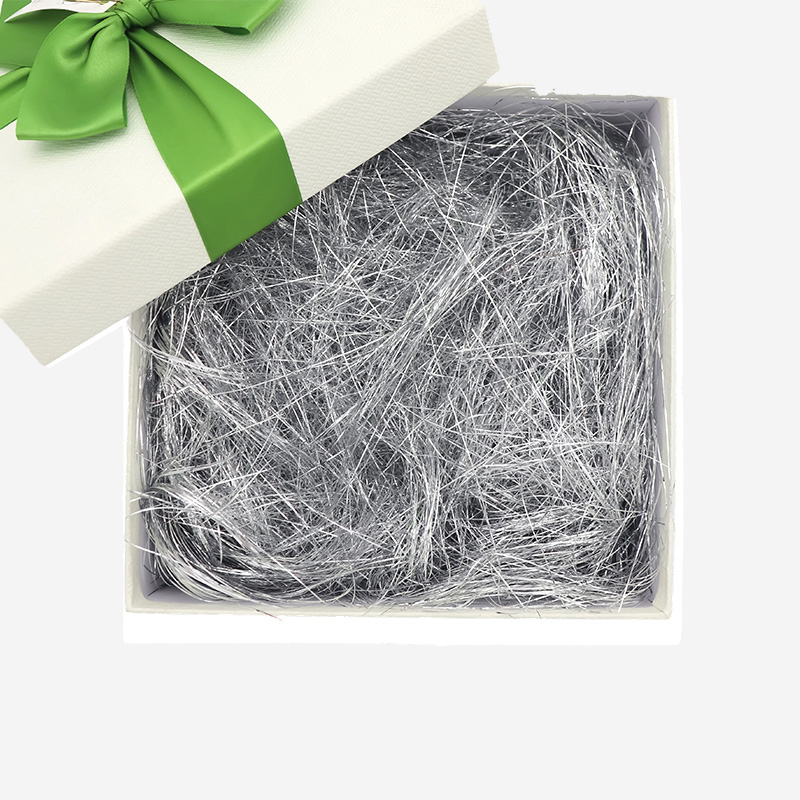
Metallic Glitter PET Raffia Fiber is a decorative packaging filling material manufactured from polyethylene terephthalate, commonly known as PET. PET is selected as the base because it provides a stable, flexible, and durable structure while maintaining a lightweight profile. The material is processed into narrow strips or fiber-like shreds that can be placed inside gift boxes, presentation boxes, shipping cartons, retail packaging, and promotional containers.
The surface can be finished in two primary ways. The first method applies metallic glitter to the PET surface with an environmentally friendly fixing system. The second method laminates holographic laser film onto PET strips. Both methods create a reflective and decorative appearance, but each provides a different visual effect.
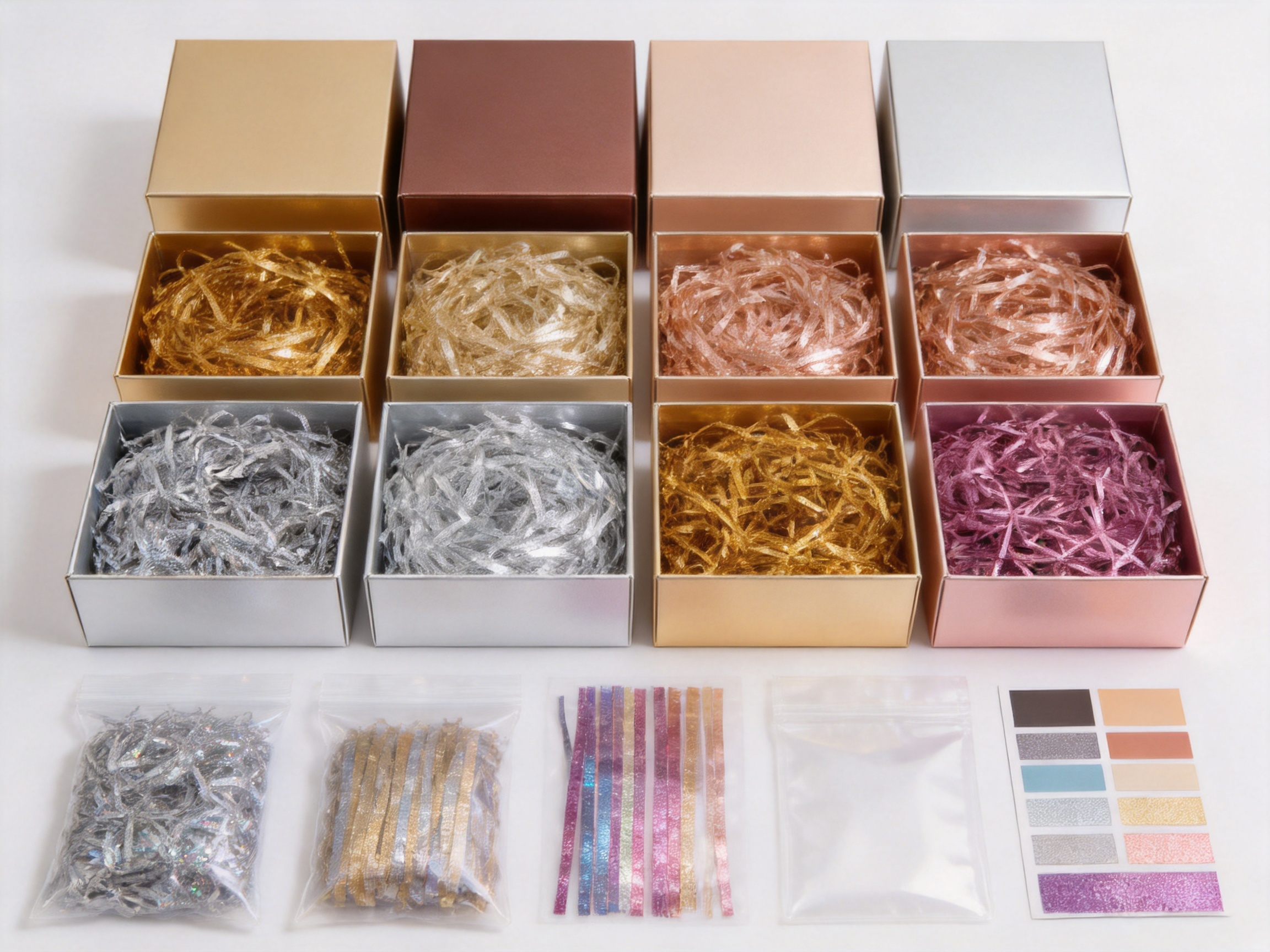
Metallic glitter coating creates a more traditional sparkling surface. It is suitable for gold, silver, rose gold, colored glitter, and multicolor effects. Holographic lamination produces shifting reflections and laser-like visual movement. It is often selected for luxury presentation, seasonal packaging, creative gift boxes, and products that need strong shelf or display appeal.
The material can be used as a loose filler or supplied in a form suitable for further processing. Buyers may select different widths, colors, glitter particle sizes, and mixing ratios according to the intended application. The available standard widths include 1 mm ultra-fine strips and 3 mm standard strips, while customized widths can be developed for special packaging structures or brand requirements.
Because the product is designed specifically for B2B supply chains, it is not limited to small decorative projects. It can be manufactured in stable bulk quantities, packed for international logistics, and adapted to the requirements of large packaging programs. Sampling, pre-production confirmation, custom color matching, and long-term order planning are available as part of a flexible cooperation model.
Core Material Structure and Functional Design
Eco-Friendly PET Base
The PET base provides the foundation for the product’s appearance and performance. Compared with fragile paper strips, PET fibers are less likely to tear during handling and are more resistant to humidity. This makes them suitable for packaging that may be exposed to changing temperatures, warehouse conditions, or long-distance transportation.
The material maintains a stable structure while remaining flexible enough to be distributed throughout a box. It can create volume around a product without adding excessive weight. This balance is important for buyers managing shipping expenses, storage space, and packaging efficiency.
Decorative Surface Treatment
The surface treatment gives the material its distinctive visual quality. Metallic glitter creates a dense sparkle that can be adjusted according to the desired finish. Fine glitter provides a refined and understated appearance, while medium or coarse particles create stronger reflection and a more dramatic presentation.
Holographic lamination offers a different design direction. As the angle of light changes, the laminated surface produces shifting color and reflective effects. This is useful for luxury packaging, holiday collections, event merchandise, wedding favors, and creative cultural products.
Flexible Fiber Dimensions
Fiber width influences both the appearance and the functional behavior of the filling. Ultra-fine 1 mm strips can be distributed evenly and create a delicate texture. They are especially suitable for cosmetic boxes, jewelry packaging, small accessories, and premium products that require a refined interior presentation.
The 3 mm standard option offers a balance between volume, coverage, handling convenience, and cost efficiency. It is suitable for general gift boxes, seasonal promotional packaging, and retail presentation. Customized widths can be developed for structural packaging concepts where the buyer requires a specific density, texture, or visual proportion.
Primary Advantages Over Conventional Filling Materials
Stronger Visual Impact
The most immediate advantage of Metallic Glitter PET Raffia Fiber is its presentation value. Traditional paper shreds may provide basic cushioning, but they often have limited reflectivity and a less distinctive appearance. Metallic and holographic PET fibers create a brighter interior that can make the opening of a box feel more premium.
For gift packaging, appearance is closely connected with perceived product value. A product placed among visually coordinated glitter fibers can appear more carefully designed and more suitable for special occasions. This is particularly important for cosmetics, jewelry, accessories, premium food gifts, corporate gifts, and limited-edition products.
Improved Moisture Resistance
Paper-based fillers can absorb moisture, soften, lose their shape, or become less attractive under humid conditions. PET is naturally more resistant to moisture, and the product can be combined with moisture-proof packaging for improved protection during storage and transportation.
This feature is valuable for export buyers and distributors operating across different climate zones. The product can be packed in sealed PE vacuum bags with desiccant, helping reduce exposure to humidity during sea freight, air freight, warehousing, and cross-border distribution.
Durability During Handling
Decorative packaging materials may pass through several stages before reaching the end customer. They can be handled during filling, sealing, carton packing, transportation, warehouse storage, retail display, and final unboxing. A material that breaks, sheds excessively, or loses its finish during these stages can reduce the quality of the entire package.
Metallic Glitter PET Raffia Fiber is designed for improved durability. Its PET base provides a stable structure, while the coating and lamination processes are developed to strengthen the attachment of decorative elements. This helps the fiber maintain its intended appearance during normal packaging operations.
Reduced Glitter Shedding
Low-quality glitter materials may release excessive particles when touched or moved. This can create an untidy packaging environment, affect the appearance of the product, and increase cleaning requirements during production. It may also lead to customer dissatisfaction after opening.
The metallic glitter surface coating process uses fixing agents and high-temperature curing to improve glitter adhesion. While the actual performance depends on the selected finish, particle size, and production conditions, the process is intended to reduce unnecessary shedding and provide a cleaner decorative effect.
Flexible Color and Design Development
Standard packaging materials may limit a buyer to a small selection of colors. This can make it difficult to create packaging that matches a brand identity or seasonal campaign. Metallic Glitter PET Raffia Fiber offers a broader customization range, including gold, silver, rose gold, multicolor combinations, gradient blends, contrasting combinations, and customized color matching.
Brand-specific color development can support product launches, seasonal collections, promotional events, limited editions, and collaboration packaging. Buyers may also combine glitter fibers with paper raffia or bright color strips to create a specific balance of volume, reflection, and cost.
Efficient Logistics Performance
Packaging materials must be attractive, but they must also be commercially practical. The product can be vacuum-compressed to reduce shipping volume. This is especially useful for international buyers who need to control freight costs or maximize container utilization.
Once opened, the fibers can recover their volume and be distributed inside packaging. Different supply forms, including loose material, rolls, and customized packaging, allow buyers to select the format most suitable for their production process.
Suitability for Repeated Supply
For commercial packaging programs, a buyer needs more than an attractive sample. The material must be supplied consistently across repeated orders. Stable production procedures, standardized raw material processing, and batch quality control are important for maintaining similar color, width, surface appearance, and packing density over time.
A manufacturer with integrated production can coordinate these factors more effectively than a supplier that only purchases and resells finished material. This supports more reliable long-term supply for distributors, brands, and packaging factories.

Advanced Manufacturing Processes
Raw Material Preparation
Manufacturing begins with the preparation and inspection of PET base material. The base must be suitable for slitting, surface treatment, winding, compression, and packing. Consistency in the base material helps reduce variations in strip width, tensile behavior, color presentation, and finished-product handling.
Raw material processing is coordinated with the product’s intended application. A premium gift box may require a finer, smoother, and more reflective material, while a general promotional package may prioritize cost efficiency and higher volume. This means that material selection and processing parameters must be considered together rather than treated as separate steps.
Precision Slitting
Slitting converts wider PET material into narrow strips. This step directly influences the final width, edge quality, distribution behavior, and visual texture of the raffia fiber. For 1 mm ultra-fine material, accurate slitting is particularly important because small dimensional deviations can affect the uniformity of filling.
For standard 3 mm material or customized widths, the slitting process must still maintain stable dimensions across a production batch. Consistent width makes it easier for packaging operators to estimate usage, calculate material requirements, and achieve a repeatable interior appearance.
Glitter Surface Coating
The metallic glitter coating process uses an environmentally friendly fixing system to attach glitter particles to the PET surface. The glitter is distributed across the surface according to the required density and visual effect. Fine, medium, and coarse particles can be selected depending on the product design.
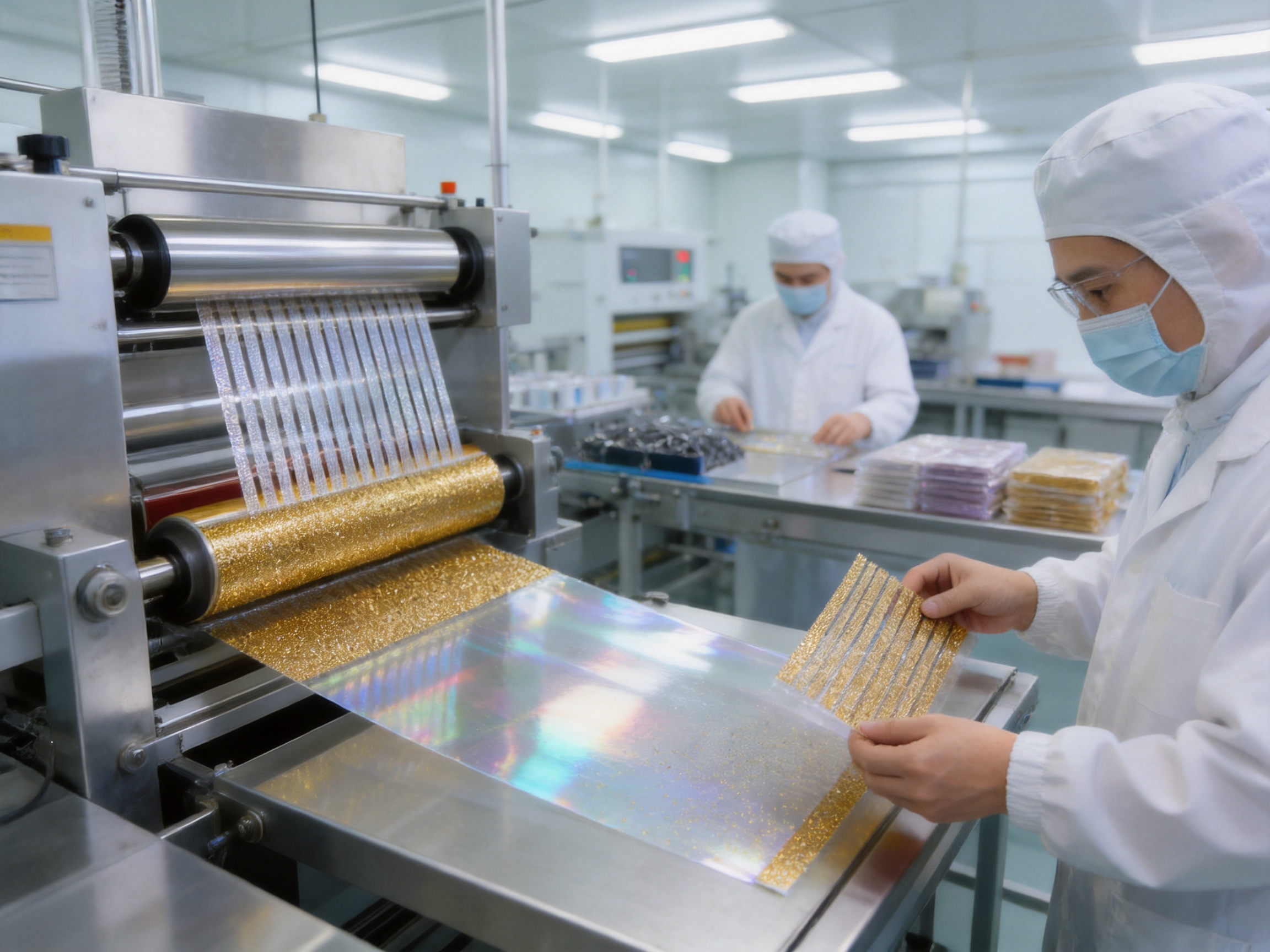
After application, the material passes through a high-temperature curing stage. Curing helps stabilize the fixing system and improves the durability of the decorative surface. The process is carefully managed to support strong adhesion, stable color performance, and a more consistent finish across the production batch.
Glitter density can be adjusted for different market positions. A lighter application may provide a subtle shimmer for elegant cosmetic packaging, while a denser application may be preferred for festive gift boxes, Christmas packaging, event products, and promotional displays.
Holographic Film Lamination
Holographic lamination uses an environmentally friendly adhesive to bond holographic laser film onto PET strips. The goal is to create a stable, reflective surface that produces changing visual effects under different lighting conditions.
Adhesive selection and lamination control are important because weak bonding can lead to peeling, curling, or inconsistent appearance. The production process is designed to strengthen film adhesion and support stable shaping during mass production. The resulting material is suitable for luxury gift box interiors, premium decorative filling, and packaging that requires a more dynamic visual effect.
Compared with loose glitter, holographic lamination creates a continuous decorative surface. This can provide a cleaner appearance and a distinct reflective effect. Buyers can choose between the two surface technologies according to their design goals, target price, packaging environment, and desired level of visual intensity.
Color Matching and Mixing
After the main surface process, colors and combinations can be prepared according to the order requirements. Solid metallic options include gold, silver, and rose gold. Multicolor options can be designed for holiday packaging, children’s products, creative merchandise, and event themes.
Mixing is not limited to random color combinations. A supplier can prepare gradient combinations, contrasting combinations, seasonal blends, and brand color systems. The proportion of each color can be adjusted to create a specific visual balance within the packaging.
Holographic strips can also be combined with bright colors to increase reflective variation. Glitter PET fibers may be mixed with paper fibers to improve fluffiness and volume while reducing the average cost of the filling material. These combinations allow buyers to control both visual performance and commercial efficiency.
Quality Inspection
Quality inspection is necessary at multiple stages. The base material, strip width, surface adhesion, color consistency, moisture-proof packaging, and finished packing condition should all be evaluated. A controlled inspection system helps identify production deviations before the material reaches the customer.
For customized orders, sample approval and pre-production confirmation provide an additional control point. The buyer can review the color, width, glitter density, holographic effect, packing format, and overall appearance before mass production begins.
Compression and Finished-Goods Packaging
Finished fibers may occupy significant volume if packed loosely. Vacuum compression reduces the package size and improves logistics efficiency. Sealed PE vacuum bags can be combined with built-in desiccant to provide additional moisture protection.
For retail or sample supply, the material may be packed in OPP bags at standard weights such as 50 g, 100 g, or 200 g. For premium presentation, customized color boxes with protective paper trays can be developed. For industrial buyers, heavy-duty woven bags with inner moisture-proof film can support bulk supply, ton-bag handling, or pallet shipment.
Manufacturing Strengths of the Supplier
Zhejiang Raffia Paper Products Co., Ltd. has developed from a craft materials business unit into an integrated manufacturer of raffia paper shreds, fancy paper yarns, decorative packaging materials, and related products. The company’s production experience began with a trading enterprise and later expanded into manufacturing, process development, equipment improvement, and standardized quality management.
The company operates a modern production base in Dongyang, Zhejiang Province, covering approximately 20,000 square meters and employing more than 200 professional workers. Its manufacturing chain includes raw material processing, mass production, quality testing, compression, finished-goods packaging, and shipment preparation.
This integrated structure is important for buyers seeking consistent B2B supply. When raw materials, processing, testing, and packing are coordinated within one manufacturing system, production scheduling can be managed more efficiently. It also allows the supplier to respond to changes in width, color, packing format, and order volume.
The company has developed production capabilities for slitting, twisting, winding, and compression packaging. These technologies support not only PET decorative fibers but also paper raffia yarns, fancy yarns, DIY cords, gift packaging materials, and related craft products.
With annual production capacity exceeding 200 million pieces across its product categories, the company is structured to serve both smaller customized orders and larger recurring supply programs. Its customer base extends across China and international markets in Europe, North America, South America, Asia, and other regions.
The company supports OEM and ODM cooperation, including custom sizes, exclusive brand color development, packaging customization, sampling, pre-production confirmation, and long-term bulk order supply. Its stated manufacturing priorities include batch consistency, on-time delivery, sustainable supply practices, and long-term customer cooperation.
Product Specifications and Customization Options
| Item | Available Specification | Commercial Value |
|---|---|---|
| Base material | Eco-friendly PET | Stable structure, lightweight handling, and improved moisture resistance |
| Surface process | Metallic glitter coating or holographic lamination | Supports different visual effects and market positions |
| Width | 1 mm, 3 mm, or customized | Allows matching with product size, box structure, and filling density |
| Color | Gold, silver, rose gold, multicolor, or custom | Supports brand matching, seasonal themes, and promotional design |
| Glitter particle size | Fine, medium, or coarse | Controls the level of sparkle and surface texture |
| Supply form | Roll, loose filling, or custom packaging | Adapts to different production and distribution systems |
| Moisture protection | Moisture-proof treatment and protective packaging | Supports sea freight, air freight, and warehouse storage |
| Packaging | Vacuum bag, OPP bag, color box, woven bag, or palletized supply | Matches sample, retail, premium, and industrial requirements |
Choosing the Correct Width
The 1 mm ultra-fine option is suitable when the buyer wants delicate texture and even distribution. It works well in small or high-value boxes where the filling must look refined rather than bulky. It can also be useful when the packaged product has a small footprint or when the buyer wants the filling to surround the product closely.
The 3 mm standard option is more versatile for general gift packaging. It offers a balanced combination of volume, visible texture, handling convenience, and cost efficiency. It can be used in seasonal gift boxes, promotional packaging, accessory packaging, and general retail presentation.
Customized widths are useful for distinctive packaging designs. For example, a buyer may require wider strips for a more dramatic visual effect or a special width to match a particular product insert. Customized development should normally be confirmed through samples before bulk manufacturing.
Choosing the Correct Surface Finish
Metallic glitter coating is suitable when the desired result is a visible sparkle with adjustable particle size and density. It provides an expressive decorative effect and is available in a broad range of colors. This process is particularly practical for large-scale supply because the appearance can be standardized across repeated production.
Holographic lamination is suitable when the packaging needs a changing reflective effect. It can create a more contemporary, luxurious, or futuristic appearance. The laminated surface is also useful for designs where a clean reflective film is preferred over loose glitter particles.
Choosing Color Combinations
Solid gold and silver are widely applicable and can support traditional luxury, festive, or formal presentation. Rose gold offers a softer and more fashion-oriented appearance, making it suitable for beauty products, wedding favors, lifestyle products, and feminine gift collections.
Multicolor blends can be used for holiday themes, children’s products, creative packaging, and event merchandise. Gradient combinations add visual depth, while contrasting colors can reinforce a particular brand identity or campaign concept.
A mixture of glitter PET fiber and paper raffia can increase volume and fluffiness while helping control the cost of the filling system. This can be useful for larger boxes or high-volume promotional programs where the buyer needs an attractive appearance at a controlled material cost.
Packaging and Logistics Solutions
Vacuum Compression Moisture-Proof Packaging
Vacuum compression is designed for international shipping and bulk logistics. The fibers are placed in sealed PE bags, compressed to reduce volume, and combined with desiccant when required. This approach can lower shipping volume and improve warehouse efficiency.
When the package is opened, the material can recover its general volume and be separated for use. Buyers should conduct application testing to determine the most efficient opening, storage, and fluffing procedures for their own packaging line.
Individual OPP Small Packaging
OPP packaging in 50 g, 100 g, or 200 g formats is suitable for samples, e-commerce sales, craft kits, and small orders. Custom labels and sealing can be added for distributors or retailers who want ready-to-sell units.
This format is convenient for buyers who do not need industrial quantities or who want to test several colors and surface finishes before placing a larger order. It can also support online retail listings and seasonal craft collections.
Customized Color Box Packaging
Color box packaging is designed for premium presentation. A customized box structure and built-in protective paper tray can make the product itself more suitable for retail display or premium brand supply. The box can be developed according to the required quantity, color combination, and market positioning.
Bulk Industrial Packaging
Industrial buyers may select heavy-duty woven bags with an inner moisture-proof film. This format is suitable for factory-level procurement, large packaging operations, distributors, ton-bag supply, and palletized shipment.
Bulk packaging reduces the amount of secondary packaging and makes material handling more efficient. The correct format depends on order volume, warehouse equipment, shipping method, and the buyer’s internal repacking process.
Application Scenarios
Cosmetic Gift Boxes
Cosmetic packaging often depends on visual refinement and color coordination. Metallic glitter or holographic PET fibers can support the premium appearance of skincare sets, fragrance boxes, makeup collections, and beauty gift packages. Gold, silver, rose gold, and fine holographic effects can be matched with metallic printing, foil details, rigid boxes, and molded inserts.
Luxury Accessories Packaging
Accessories such as jewelry, watches, wallets, scarves, hair accessories, and small leather goods can benefit from a decorative interior that increases perceived value. The 1 mm ultra-fine option can create a delicate surrounding layer without overwhelming a small product.
Seasonal Promotional Packaging
Holiday campaigns require materials that communicate a clear seasonal atmosphere. Multicolor mixes, bright metallic tones, and holographic effects can be developed for Christmas, New Year, Valentine’s Day, wedding season, anniversaries, and other promotional periods.
Wedding Favor Packaging
Wedding favors often require soft, elegant, and coordinated packaging. Rose gold, silver, light metallic tones, and customized blends can complement wedding color palettes. The material can be used in favor boxes, gift bags, small presentation boxes, and event table packaging.
Creative Cultural Products
Creative cultural products and handmade merchandise often rely on packaging to express a story or artistic theme. Customized color combinations, holographic effects, and mixed fibers can help create an interior presentation that complements the product’s design language.
Exhibition and Brand Event Packaging
At exhibitions and corporate events, packaging must attract attention while remaining practical for distribution. Decorative PET raffia fiber can be used in event gift boxes, promotional kits, sample packages, launch merchandise, and VIP presentation sets.
E-Commerce Gift Presentation
Online customers cannot physically examine a product before purchase, so the unboxing experience becomes an important point of contact. Decorative filling can improve the first impression when the parcel is opened. Moisture resistance and durability are also valuable because e-commerce shipments may pass through multiple distribution centers.
Why Manufacturing Control Matters to B2B Buyers
For a small craft project, a slight difference in color or width may be acceptable. For a large retail packaging program, the same difference can create visible inconsistencies across thousands of units. Manufacturing control therefore affects both appearance and operating cost.
Consistent strip width makes the filling easier to portion. Stable color reduces the need for manual sorting. Reliable surface adhesion helps reduce cleanup and customer complaints. Correct compression supports predictable freight planning. Accurate labeling and packing reduce receiving errors at the buyer’s warehouse.
An integrated manufacturer can also help buyers solve technical problems before mass production. For example, the supplier may recommend a different width for a small box, adjust glitter particle size to improve appearance, change the mixing ratio for better volume, or select a different packing method for humid shipping conditions.
Pre-production samples are especially valuable for customized projects. Buyers can evaluate how the material interacts with the product, whether the visual density is sufficient, whether the glitter effect is too strong or too subtle, and whether the selected packaging format is practical for their own operations.
Quality and Purchasing Considerations
Confirm the Intended Use
Before ordering, buyers should define whether the material is intended for premium retail packaging, general gift boxes, industrial filling, event merchandise, or online sales. The use case determines the most appropriate width, color, surface finish, packaging format, and order quantity.
Evaluate Surface Adhesion
The buyer should examine whether the glitter or holographic film remains stable during normal handling. A sample can be lightly moved, compressed, separated, and placed inside a box to observe surface performance. The test should reflect the actual packaging process as closely as possible.
Test Humidity and Transportation Conditions
For export supply, the buyer should consider warehouse humidity, shipping duration, container conditions, and final-market climate. Moisture-proof packaging can improve protection, but storage procedures should also be reviewed. The product should be stored in a dry environment and kept sealed until use whenever possible.
Check Color Under Different Lighting
Metallic and holographic surfaces can look different under daylight, warm indoor lighting, LED lighting, and photography. Buyers should evaluate samples under the lighting conditions used in their stores, product photographs, exhibitions, or packaging facilities.
Review Packaging Efficiency
Buyers should compare loose, vacuum-compressed, retail, and bulk packaging according to freight cost, handling equipment, warehouse space, and intended sales format. A lower unit price may not represent the lowest total cost if the package occupies excessive shipping volume or requires additional repacking.
Confirm Customization Details
Customized projects should specify the material, width, surface finish, color, particle size, mixing ratio, quantity per package, label requirements, carton information, and shipping method. Written confirmation reduces the risk of misunderstanding between sample approval and mass production.
OEM and ODM Cooperation
OEM cooperation allows buyers to order the material according to their own specifications and packaging requirements. This may include custom colors, widths, surface treatments, private labels, retail packaging, and carton markings.
ODM cooperation is suitable for buyers who need assistance in developing a complete decorative filling solution. The manufacturer can support the selection of material type, color combinations, glitter density, holographic effects, paper-fiber blends, and packaging format.
Brand color matching can be developed according to a corporate identity system. Seasonal limited editions can be produced for specific retail periods. IP collaboration packaging can use distinctive color and reflective combinations to support a licensed or co-branded product line.
Optional hot stamping and printing integration may also be considered for customized packaging projects. The exact feasibility depends on the packaging structure, material surface, order volume, and production requirements.
How the Product Supports Sustainable Packaging Goals
Metallic Glitter PET Raffia Fiber is manufactured with an eco-friendly PET base and can help buyers reduce reliance on less durable filling materials in certain applications. Its resistance to moisture and handling damage may reduce material loss during transportation and storage.
Sustainability decisions should consider the complete packaging system, including material selection, product lifespan, shipping volume, packaging quantity, and end-of-life handling. Vacuum compression can reduce transport volume, while blended filling solutions can help optimize material usage.
Buyers seeking sustainability documentation, test reports, or additional production information can request the relevant materials from the supplier. Product suitability should always be evaluated in relation to the buyer’s own regulatory requirements, market standards, and packaging policies.
Q&A
What is Metallic Glitter PET Raffia Fiber used for?
It is used as decorative filling in gift boxes, cosmetic packaging, luxury accessory boxes, seasonal promotional packaging, wedding favors, cultural products, exhibition gifts, and brand event packages. It provides visual enhancement while helping fill empty space around the packaged product.
What is the difference between glitter coating and holographic lamination?
Glitter coating attaches metallic or colored glitter particles to the PET surface, creating a sparkling texture. Holographic lamination bonds a reflective laser film to the PET strip, creating changing rainbow-like or shifting reflections. The correct choice depends on the desired appearance and packaging concept.
Is the material suitable for international shipping?
Yes. The PET structure provides good moisture resistance, and the material can be packed in sealed vacuum bags with desiccant or other protective packaging. Buyers should select packaging according to shipping duration, climate, warehouse conditions, and transportation method.
What widths are available?
Common options include 1 mm ultra-fine strips and 3 mm standard strips. Customized widths can also be developed for specific packaging structures, visual effects, or filling requirements.
Can the colors be customized?
Yes. Standard options include gold, silver, rose gold, and multicolor. Buyers can also request gradient combinations, contrasting colors, seasonal blends, brand color matching, and other customized combinations.
Can paper fiber be mixed with PET glitter fiber?
Yes. Glitter PET fiber can be blended with paper fiber to increase fluffiness and volume while helping reduce the overall material cost. The mixing ratio should be confirmed according to the intended appearance and application.
What glitter particle sizes are available?
Fine, medium, and coarse particle sizes are available. Fine particles create a more delicate appearance, while medium and coarse particles provide stronger sparkle and more visible surface texture.
Is the product suitable for luxury packaging?
Yes. Fine-width fibers, holographic lamination, high-gloss metallic finishes, customized color matching, and premium color box packaging can all support luxury packaging applications.
Can samples be provided before bulk production?
Sampling and pre-production confirmation are supported. Buyers should use samples to evaluate color, width, surface effect, glitter adhesion, volume, packing format, and compatibility with their own packaging process.
What packaging formats are available?
Available formats include vacuum-compressed PE bags, individual OPP bags, customized color boxes, heavy-duty woven bags with inner moisture-proof film, rolls, loose filling, ton bags, and palletized supply.
Can the product be supplied under a private label?
OEM and ODM services are supported. Private labels, custom packaging, exclusive color development, and customized size solutions can be discussed according to project requirements and order volume.
What should buyers provide when requesting a quotation?
Buyers should provide the desired material, width, color, surface process, glitter particle size, estimated quantity, packaging format, label requirements, destination market, and delivery schedule. Product samples or reference images may also help clarify the desired result.
Conclusion
Metallic Glitter PET Raffia Fiber is a versatile decorative packaging material for buyers who need more than basic box filling. Its PET base provides durability and moisture resistance, while metallic glitter coating and holographic lamination create strong visual presentation. Width, color, particle size, mixing ratio, and packaging format can all be adapted to different applications.
Compared with conventional paper shreds and standard fillers, the material offers a combination of stronger decorative impact, improved logistics adaptability, flexible customization, and more stable performance during handling. It is suitable for cosmetics, accessories, seasonal gifts, wedding favors, promotional packages, cultural products, exhibitions, and e-commerce presentation.
The product’s commercial value is supported by an integrated manufacturing system. Zhejiang Raffia Paper Products Co., Ltd. combines raw material processing, precision slitting, surface treatment, holographic lamination, glitter curing, color mixing, quality inspection, compression packaging, and export preparation. Its production base, experienced workforce, OEM and ODM capabilities, and flexible cooperation model provide a foundation for both customized projects and recurring bulk supply.
For buyers planning a premium packaging program, the most effective approach is to define the application clearly, test representative samples, confirm the required surface finish and color, evaluate packaging efficiency, and establish specifications before mass production. With the right configuration, Metallic Glitter PET Raffia Fiber can help transform ordinary packaging interiors into a more polished, memorable, and brand-supportive presentation.
References
1. Zhejiang Raffia Paper Products Co., Ltd. Product Information: Metallic Glitter PET Raffia Fiber.
2. Zhejiang Raffia Paper Products Co., Ltd. Product Specifications and Packaging Options.
3. Zhejiang Raffia Paper Products Co., Ltd. Company Manufacturing and Cooperation Information.
4. General technical information concerning polyethylene terephthalate materials and decorative packaging applications.
5. General packaging industry practices concerning moisture-resistant packing, vacuum compression, export logistics, and product presentation.
Product: Metallic Glitter PET Raffia Fiber

 +86 15355323399
 kevin@raffia-paper.com
 No. 151 Guanshan North Road, Dongyang City, Zhejiang Province, China

Copyright © Zhejiang Raffia Paper Products Co., Ltd. All Rights Reserved.

Paper Raffia Yarn & Gift Packaging Factory