
 +86 15355323399
 En
En  中文简体
中文简体 日本語
日本語 Français
 Español
 Deutsch
 Türk
Türk عربى
عربى italiano
 русский
Paper Raffia Fancy Yarn: A Scalable, Eco-Friendly Material for Weaving and Gift Packaging

Paper Raffia Fancy Yarn is a specialty paper-based yarn developed for industrial weaving, gift packaging, decorative applications, and standardized craft-material supply chains. Made from raffia-specific specialty craft paper, it combines the visual character of natural straw fibers with the consistency, process control, and supply stability required by modern manufacturers.
Unlike ordinary decorative string, paper raffia yarn is designed as a functional production material. It can be woven, twisted, shaped, packaged, dyed, coated, blended, and supplied in multiple standardized formats. This makes it suitable for wholesalers, distributors, OEM manufacturers, packaging suppliers, cross-border e-commerce businesses, and brands that need reliable bulk materials for repeat production.
The material offers a practical alternative to unstable natural straw, irregular raffia fibers, and some conventional synthetic decorative yarns. Its lightweight structure, controllable stiffness, customizable twist, stable colors, and flexible packaging options allow buyers to develop products for both industrial manufacturing and consumer-facing retail programs.
What Is Paper Raffia Fancy Yarn?
Paper Raffia Fancy Yarn is an industrial weaving yarn made from raffia-specific specialty craft paper. The paper is processed into narrow strands and formed into yarn structures through controlled slitting, twisting, winding, and packaging procedures.
The finished yarn is designed to resemble the appearance of natural raffia or straw while providing more consistent physical and visual properties. Depending on the construction, it can be flat and flexible, moderately twisted, or formed into a stronger multi-strand structure.
Its principal value lies in the combination of paper-based sustainability characteristics and industrial processability. Natural straw can vary according to harvest conditions, moisture, fiber maturity, and handling. Handmade natural materials may also differ significantly from one batch to another. Paper raffia yarn reduces these variations through standardized raw materials and repeatable production methods.
The yarn is not limited to decorative tying. It can serve as a raw material for woven handbags, straw-style hats, baskets, mats, coasters, gift packaging, seasonal displays, DIY kits, and other products that require an attractive, lightweight, and shapeable material.
Why Industrial Buyers Choose Paper Raffia Yarn
Industrial purchasers generally evaluate more than appearance. They need predictable specifications, stable supply, controllable costs, export-ready documentation, and packaging that fits their distribution system. Paper raffia yarn addresses these requirements through a structured manufacturing and customization model.
Consistent Batch Quality
One of the primary advantages over natural straw and loosely controlled handmade materials is batch consistency. Standardized paper substrates can be processed according to defined width, thickness, color, twist, and winding requirements.
Improved consistency is particularly important for large woven products, private-label programs, and retail packaging. When the same material is used repeatedly, buyers can maintain a uniform appearance across production lots, product launches, and regional markets.
Stable Production Planning
Natural materials can be affected by harvest cycles, weather conditions, storage requirements, and regional availability. Paper raffia yarn is manufactured through an organized industrial system, allowing production planning to be based on specifications and order schedules rather than seasonal fiber availability alone.
This helps buyers manage replenishment, establish standardized SKUs, and reduce the risk of sudden material substitutions. It is especially useful for brands and e-commerce sellers that need to maintain a consistent product catalog over an extended period.
Lightweight Structure
Paper raffia yarn offers a favorable balance between visual volume and transportation weight. Its paper-based structure creates a distinctive fiber-like appearance without adding unnecessary mass to finished products.
Lower material weight can benefit packaging, shipping, storage, and handling. For woven products and gift packaging, the lightweight construction also helps maintain a natural, flexible look without making the final item excessively heavy.
Controllable Stiffness and Shape Retention
The yarn has good stiffness and shaping performance. This characteristic allows it to hold a formed structure after weaving, tying, winding, or arranging.
Different twist levels and strand constructions can be selected according to the application. A looser structure may provide flexibility for openwork weaving, while a tighter or multi-strand structure can provide additional strength for packaging, baskets, and larger woven items.
Lower Exposure to Natural-Fiber Irregularity
Natural raffia and straw can provide an appealing organic appearance, but they may have irregular thickness, uneven texture, variable strength, and differences in color. These characteristics may be desirable in some artisanal products but can create challenges in standardized mass production.
Paper raffia yarn is manufactured to provide a more controlled material experience. Buyers can specify yarn diameter, color, twist level, weight, packaging style, and winding form. This enables a more predictable production process and simplifies quality inspection.
Flexible Cost Management
For bulk buyers, cost control depends on more than the unit price of the raw material. Waste, rejected products, production interruptions, rework, and inconsistent packaging can all increase the total cost of procurement.
A standardized paper yarn system can reduce some of these indirect costs by making the incoming material more predictable. Buyers can also select different strand structures and packaging formats to match their production line, target price, and sales channel.
Comparison with Alternative Materials
Paper raffia yarn competes with several types of materials, including natural raffia, straw fibers, cotton cords, synthetic ribbons, paper twine, and decorative strings. Each alternative has advantages, but paper raffia yarn is particularly suitable when buyers need a combination of appearance, formability, supply stability, and customization.
Evaluation Factor |
Paper Raffia Fancy Yarn |
Natural Straw or Raffia |
Conventional Synthetic Ribbon |
Batch Consistency |
High and controlled through standardized processing |
Can vary according to harvest and fiber condition |
Generally consistent, but appearance may be less natural |
Visual Character |
Paper-based texture with a straw-like appearance |
Natural organic texture |
Smooth, glossy, or textile-like appearance |
Shape Retention |
Good; adjustable by twist and construction |
Depends on fiber quality and processing |
Usually flexible, with limited structural effect |
Customization |
Color, diameter, twist, coating, blending, and packaging |
Often limited by natural-fiber availability |
Color and width customization are common |
Industrial Scalability |
Designed for bulk and repeat manufacturing |
May require additional sorting and preparation |
Suitable for scale but may not provide a paper or straw appearance |
Typical Positioning |
Weaving, packaging, DIY kits, and industrial raw-material supply |
Artisanal and natural-fiber products |
General gift wrapping and decorative packaging |
The comparison should be understood as a general purchasing guide. The most suitable material depends on the finished product, target market, required strength, appearance, and local compliance requirements. Paper raffia yarn is strongest when the buyer needs repeatability and a natural-inspired look in the same product system.
Manufacturing Process and Production Strengths
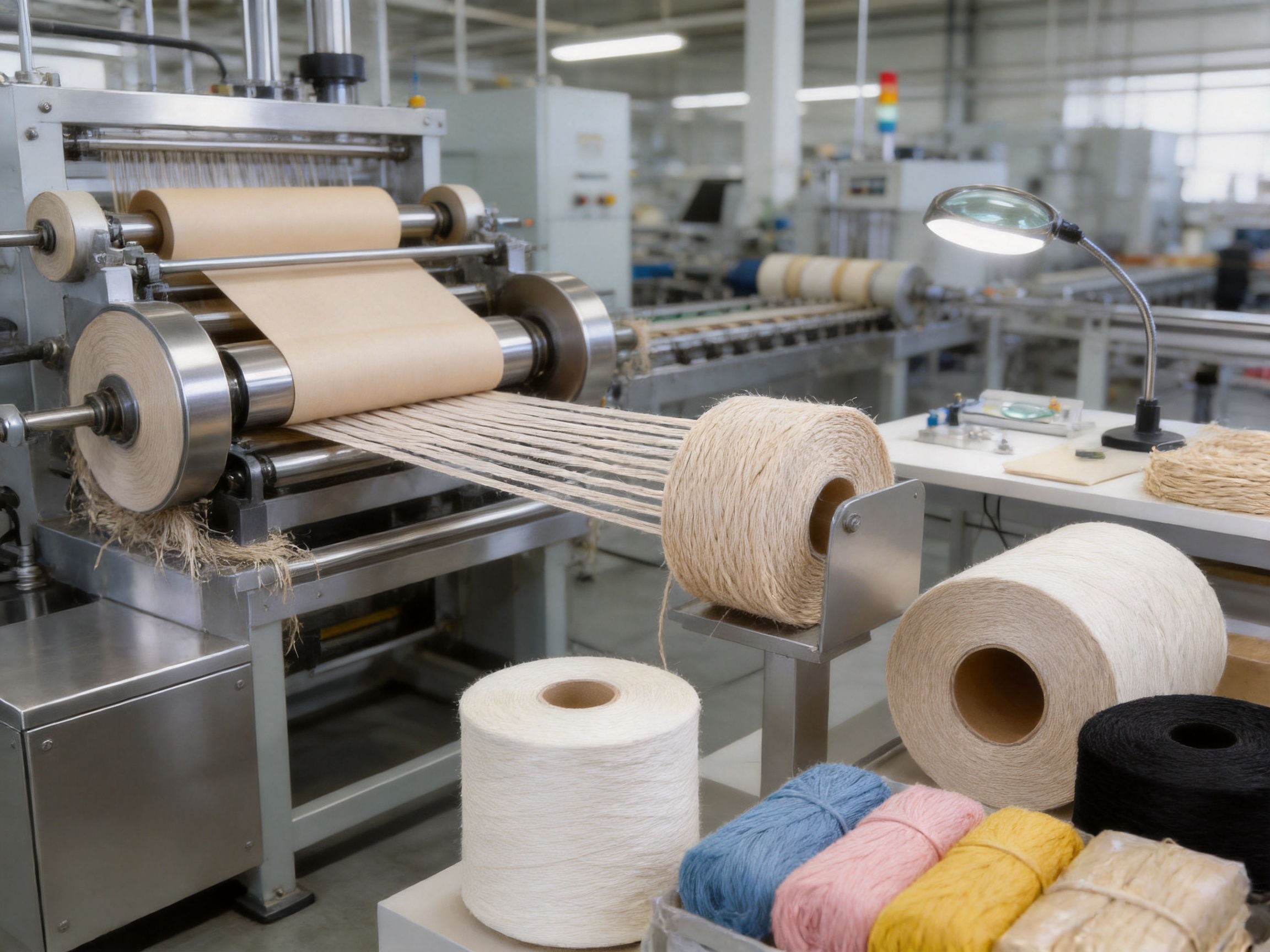
The performance of paper raffia fancy yarn depends on the quality of the specialty paper and the precision of subsequent converting processes. A reliable supplier must control material preparation, slitting, twisting, winding, packaging, inspection, and shipment as one integrated system.
Specialty Paper Selection
The process begins with raffia-specific specialty craft paper selected for suitable tensile performance, flexibility, appearance, and processing compatibility. The paper must be capable of being converted into narrow strips without excessive tearing or edge damage.
Paper selection also affects the final yarn’s stiffness, texture, color clarity, and resistance to deformation. For different applications, buyers may request softer paper for flexible weaving or a firmer structure for baskets, packaging ties, and products requiring stronger shape retention.
Controlled Slitting
Slitting converts the paper into narrow, consistent strips. This is a critical step because strip width directly influences yarn diameter, surface appearance, flexibility, and twisting behavior.
Accurate slitting helps reduce irregular edges and variations in strand size. It also supports the development of customized yarn diameters from approximately 1 millimeter to 7 millimeters, depending on the product design and application requirements.
For large-scale manufacturing, controlled slitting improves machine compatibility and helps woven-product producers maintain a predictable feeding process. It can also reduce unnecessary material loss during downstream twisting and winding.
Twisting and Strand Formation
After slitting, the paper strips are formed into the required yarn construction. The supplier can produce flat single strands, double-twisted strands, or triple and multi-strand twisted structures.
Twist level affects flexibility, tensile performance, visual density, and ease of use. Low twist generally produces a lighter and more flexible material. Medium twist provides a balanced structure for general applications. High twist and multi-strand construction improve strength and load-bearing performance for demanding packaging or larger woven products.
Because twist can be adjusted, buyers do not need to use a single universal material for every product. They can select a construction that matches the production method, finished-product dimensions, expected handling, and visual requirements.
Color Processing
Color is important for both decorative packaging and branded woven products. Standard color options include off-white, beige, black, macaron pink, blue, and yellow. Custom shades can also be developed through Pantone color matching, gradient designs, and mixed-color combinations.
A controlled color system helps maintain consistency across production batches. This is valuable for brand owners that use signature colors in packaging or sell coordinated collections through retail and e-commerce channels.
Color development should be confirmed through samples before mass production. Buyers should evaluate the shade under the intended lighting conditions and compare it with the final packaging, product surface, or brand artwork.
Winding and Forming
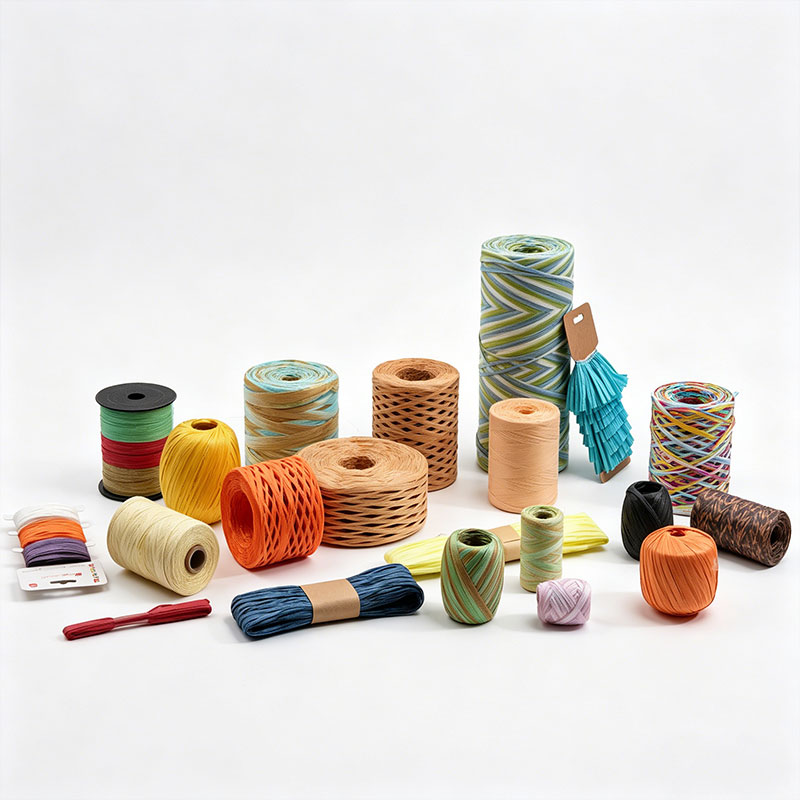
Winding determines how the yarn is presented, stored, displayed, and fed into production. The manufacturing system supports multiple winding formats, including egg rolls, small spool rolls, rugby ball rolls, balloon sphere rolls, hollow large rolls, and bundled packages.
Each format serves a different commercial or industrial purpose. Compact rolls are suitable for smaller retail or DIY units, while hollow large rolls and bundled packages are more appropriate for high-volume production and industrial packaging use.
Proper winding reduces tangling and helps protect the yarn during transportation. It also allows customers to align the material format with their own filling equipment, manual production process, retail display strategy, or repackaging requirements.
Compression Packaging and Shipment Preparation
Packaging is part of the product system rather than an afterthought. The supplier can provide OPP bags, white cardboard hang-tag cards, segmented winding cards, industrial bulk rolls, and OEM private-label packaging.
For wholesale distribution, 50-gram and 100-gram bags may provide a practical unit size. For retail displays, hang tags can present the product clearly while supporting logo printing. For DIY kits, two-color, three-color, or five-color segmented winding cards can simplify product assembly and create a coordinated consumer experience.
Industrial buyers can request customized weights, cartons, labels, and package configurations. This flexibility helps reduce repackaging work and allows the material to enter a brand’s existing sales or manufacturing system more efficiently.
Quality Control
An integrated quality-control system should cover raw material inspection, strip width, yarn diameter, twist, color, winding condition, package weight, and finished-product appearance.
Repeatable procedures are especially important for buyers operating across several factories or selling in multiple markets. A stable inspection system creates a common reference for samples, production orders, and future replenishment.
Quality checks can also be adapted to the customer’s application. A gift-packaging supplier may focus on visual uniformity and tying performance, while a woven-bag manufacturer may prioritize tensile behavior, twist consistency, and shape retention.
Paper Raffia Fancy Yarn
Product Structures and Application Selection
Flat Single Strand
The flat single strand is lightweight and flexible. It is suitable for openwork weaving, small decorative structures, lightweight gift-box tying, and applications where a flatter appearance is preferred.
Its lower-density structure can create a soft, natural-inspired visual effect. It may be especially useful for seasonal packaging, floral arrangements, craft kits, and woven surfaces with open spacing.
Double-Twisted Strand
The double-twisted strand provides a balanced combination of flexibility and strength. It is the most universal construction for general weaving, DIY projects, standard packaging, and small-to-medium finished products.
This structure is often a practical starting point for buyers developing a new product because it provides a broad range of processing possibilities. It can be tied, woven, arranged, and packaged without the excessive stiffness of some heavier structures.
Triple and Multi-Strand Twisted Yarn
Triple and multi-strand versions provide a stronger structure and improved load-bearing capability. They are suitable for larger woven products, industrial packaging, baskets, storage items, and applications where the material will experience more handling stress.
Multi-strand construction can also create a fuller visual appearance. Buyers may select this option when they want increased volume, a more pronounced rope-like effect, or stronger support within a woven form.
Applications in Weaving and Textile Manufacturing
Paper raffia yarn is suited to a wide range of woven and textile-style products. Its stiffness and shape retention allow it to function as more than a surface decoration; it can contribute to the structure and visual identity of the finished product.
Straw Bags and Tote Bags
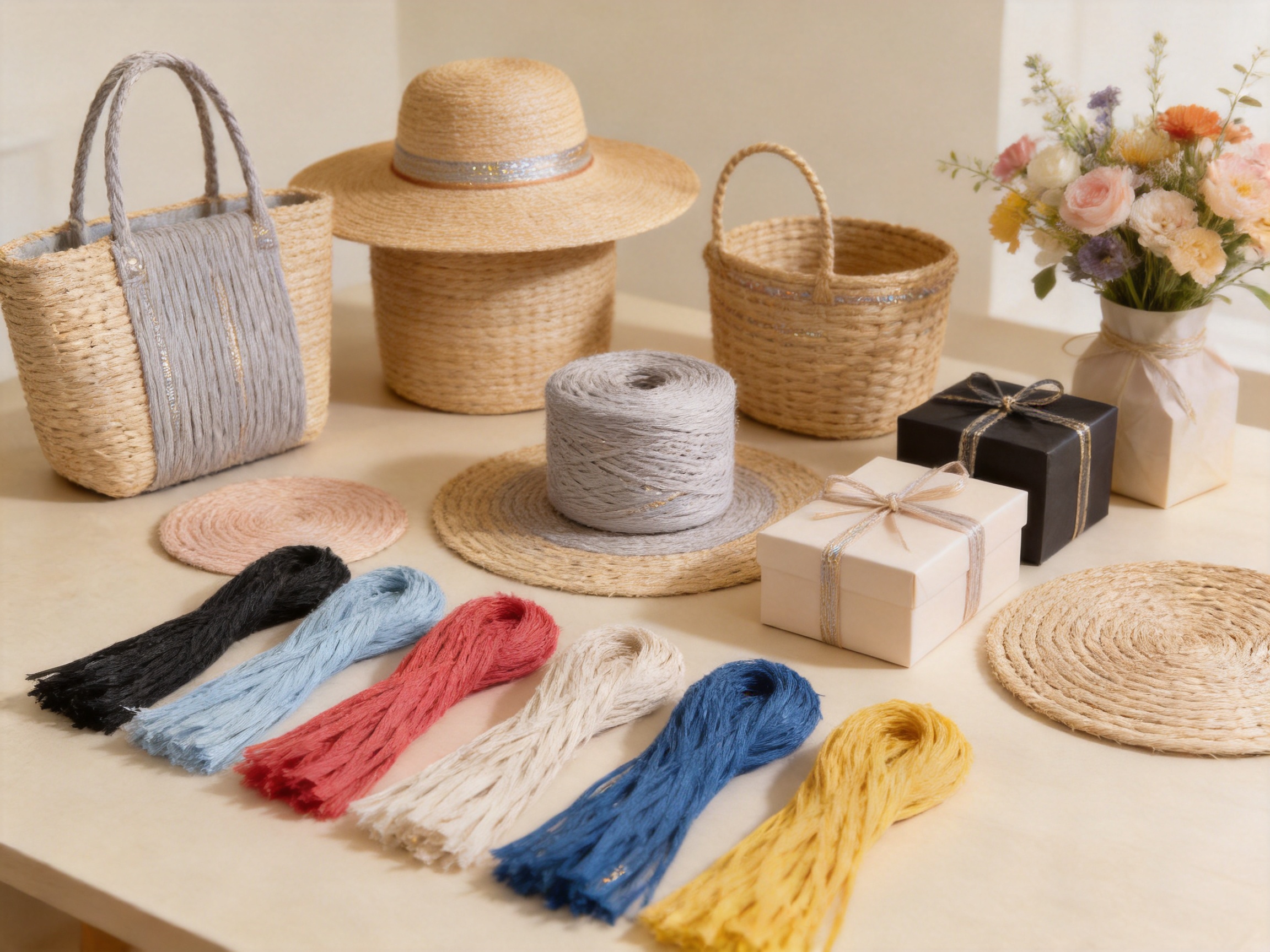
Paper raffia yarn can be used for straw-style bags, tote bags, woven handbags, and small fashion accessories. The paper texture helps create a natural seasonal appearance, while the controlled yarn size supports more uniform weaving.
Manufacturers can combine several colors to create stripes, panels, geometric patterns, or brand-specific designs. The yarn may also be blended with polyester or other materials when additional durability is required for everyday use.
Hats and Headwear
Hollow crochet hats, sun hats, fisherman hats, and other lightweight headwear can benefit from paper raffia yarn. The material’s shapeable structure helps manufacturers develop defined brims and controlled silhouettes.
Different twist levels can be selected according to the desired balance between softness and shape. A softer structure may be preferred for comfort and flexible designs, while a firmer yarn can support a more formal or architectural profile.
Home Textile and Storage Products
Coasters, placemats, table mats, storage baskets, trays, and decorative containers are additional applications. These products often require a material that is lightweight but capable of holding a stable shape.
Paper raffia yarn can be used alone or combined with other fibers. Metallic yarn blending can add a festive effect, while polyester blending may improve durability for products that experience frequent handling.
Openwork and Decorative Weaving
The flat single-strand construction is useful for openwork patterns, loose weaving, and decorative structures. Its relatively lightweight character allows designers to create visual volume without making the finished product excessively dense.
This makes it appropriate for seasonal home decoration, baskets with open sides, decorative panels, floral craft products, and creative displays.
Applications in Gift Packaging
Gift packaging is one of the most accessible commercial uses for paper raffia yarn. It can function as a tying material, filler, decorative accent, or coordinated packaging component.
Gift-Box Tying
Paper raffia yarn can serve as an alternative to fabric ribbons for gift boxes, product bundles, seasonal packages, and premium presentation sets. Its paper-based texture creates a handcrafted and environmentally conscious visual impression.
Single strands may be used for lightweight packages, while double-twisted or multi-strand versions can provide a stronger tie for larger boxes and heavier bundles. Custom colors allow packaging suppliers to match corporate identity, seasonal campaigns, or event themes.
Seasonal and Event Packaging
Christmas packaging, wedding favors, birthday gifts, retail promotions, and event packages can all use colored or blended paper raffia yarn. Metallic gold or silver blending can create a festive appearance, while pastel shades can support spring, wedding, and baby-product themes.
Because the yarn can be supplied in preconfigured retail or industrial formats, packaging companies can choose between ready-to-use units and bulk rolls for automated or semi-automated operations.
Retail Display Fillers
Paper raffia material can be cut, arranged, or combined with paper shreds as a filler for gift boxes, baskets, subscription packages, and retail displays. It adds texture and volume while helping stabilize products inside a package.
For brand presentation, color and winding format can be coordinated with the outer box, tissue paper, label, and other decorative components. This allows packaging suppliers to create complete visual systems rather than relying on unrelated materials.
DIY Kits and Cross-Border E-Commerce
Although the product is positioned primarily as a bulk industrial material, it is also suitable for businesses that develop standardized DIY kits and craft product lines. The important distinction is that the target buyer is a business, brand, distributor, or kit assembler rather than an individual purchasing a single small quantity.
DIY Craft Kits
Paper raffia yarn can be supplied as a component for kits involving weaving, crochet, gift wrapping, basket making, home decoration, and handmade accessories. Segmented winding cards containing two, three, or five colors can simplify kit assembly and provide a coordinated user experience.
Kit developers can specify the required color sequence, length, weight, label, and instruction format. This supports repeatable SKU development and makes it easier to reproduce the same kit across multiple production cycles.
Amazon, Etsy, and Shopify Product Lines
Cross-border e-commerce sellers often need materials that can be purchased in bulk, repackaged efficiently, and presented under a private label. Paper raffia yarn supports this model through custom packaging, logo printing, color selection, and standardized winding formats.
For e-commerce operations, packaging dimensions and product weight are important because they affect storage, fulfillment, postage, and marketplace fees. Customized 50-gram or 100-gram units may be suitable for retail-oriented products, while larger units can be used by professional customers and workshops.
Workshop and Education Materials
Handmade workshops, design schools, community programs, and creative studios can use the material for structured activities. Its consistent size and color help instructors prepare uniform lesson materials and reduce differences between student workstations.
Bulk packaging also allows organizations to purchase according to project schedules rather than relying on numerous small retail packs. This can improve inventory control and simplify the preparation of workshops or seasonal classes.
Blended Material Options
Paper raffia yarn can be developed with blended materials to create additional textures and performance characteristics. Blending ratios can be customized according to the customer’s design requirements.
Polyester Blending
Polyester blending can improve durability and resistance to handling. It may be suitable for everyday woven products, reusable bags, storage items, and applications where the yarn must withstand repeated use.
The proportion of polyester should be determined through sample testing because a higher synthetic content may change the texture, flexibility, appearance, and sustainability profile of the finished yarn.
Metallic Yarn Blending
Gold and silver metallic yarn blending adds visual shine and is suitable for festive packaging, holiday decorations, premium gift sets, and special events. Metallic accents can be used throughout the yarn or introduced as a contrasting strand.
This option allows buyers to create premium-looking materials without changing the fundamental paper raffia structure. It is particularly effective in combination with black, white, red, dark green, navy, or other seasonal colors.
Feather Yarn Blending
Feather yarn blending creates a softer and fluffier visual texture. It can support high-end handmade products, decorative accessories, fashion details, and creative gift packaging.
The combination of structured paper raffia and a soft decorative component can create contrast within a finished product. Such blends are best evaluated through prototypes because the final appearance depends on yarn diameter, twist, color, and the proportion of each material.
Packaging and Supply Formats
A major advantage of this product system is the number of available supply formats. Buyers can select packaging based on their distribution model, production method, and intended customer.
Supply Format |
Typical Purpose |
Customization Possibilities |
50 g or 100 g OPP Bag |
Wholesale distribution and compact retail units |
Label, color, weight, logo, and package artwork |
Hang-Tag Card |
Retail shelf display and branded product presentation |
Card design, logo printing, color identification, barcode area |
Segmented Winding Card |
DIY kits, gift sets, and coordinated multi-color products |
Two-color, three-color, or five-color combinations |
Small Spool Roll |
General crochet, weaving, and batch production |
Weight, diameter, label, and winding density |
Hollow Large Roll |
Industrial bulk supply and high-volume manufacturing |
Custom weight, carton configuration, and private label |
Bundled Package |
Packaging use and straight industrial supply |
Bundle size, strap, tag, carton, and shipment quantity |
The six principal winding forms are egg roll, small spool roll, rugby ball roll, balloon sphere roll, hollow large roll, and bundled package. Each format can be adjusted for weight and packaging requirements.
Egg roll winding is compact and helps reduce tangling for small DIY or wholesale units. Small spool rolls provide a universal format for crochet and standard production. Rugby ball rolls can hold larger quantities and offer a premium appearance for kits or retail displays.
Balloon sphere rolls are visually distinctive and may be useful where display appeal is important. Hollow large rolls provide a higher-volume industrial format, while bundled packages offer a straight and convenient form for packaging operations.
Customization and OEM/ODM Development
Paper raffia yarn is suitable for customers that need more than a standard catalog product. OEM and ODM services can support development from sample stage through mass production.
Color Customization
Color can be matched to Pantone references or developed as a special gradient, mixed-color, or two-tone combination. This is useful for brand packaging, seasonal collections, retail campaigns, and coordinated craft kits.
Diameter and Twist Customization
Yarn diameter can generally be customized within an approximate range of 1 millimeter to 7 millimeters. Twist may be specified as low, medium, or high according to the required softness, strength, and appearance.
Buyers should provide details about the intended use, weaving method, finished-product dimensions, and required handling performance. These details help the manufacturer recommend an appropriate construction rather than treating diameter as an isolated specification.
Coating and Post-Processing
Coating and other post-processing options may be developed for specific applications. A coating can influence surface feel, color intensity, moisture response, or visual effect, depending on the selected formulation and process.
Because post-processing can change the material’s environmental and performance characteristics, buyers should request samples and technical confirmation before approving mass production.
Private-Label Packaging
Private-label services may include logo printing on cards, cartons, hang tags, bags, and other packaging components. The manufacturer can also support packaging design, exclusive kit development, and customized product combinations.
This is valuable for wholesalers and e-commerce businesses that want to sell a branded material rather than an unmarked commodity. Consistent packaging can strengthen recognition and improve product presentation in retail stores and online listings.
Sample-to-Mass-Production Transition
Small sample orders are available for many custom projects, with a typical sample or standard production lead time of approximately 7 to 15 days, subject to specification and order confirmation.
A controlled sample-to-mass-production process helps buyers verify color, yarn diameter, twist, winding, packaging, and application performance before committing to larger volumes. It also provides an opportunity to refine the product specification and establish approval samples for future orders.
Environmental and Export Considerations
The paper-based structure supports sustainable supply-chain development and provides an alternative to some fully synthetic decorative materials. The product is designed around specialty craft paper rather than conventional natural-fiber harvesting, which can help improve consistency and simplify industrial sourcing.
The supplied material is described as compatible with common environmental requirements such as REACH and RoHS, with test reports available upon request. Buyers exporting to Europe, North America, or other regulated markets should request the relevant documentation and confirm that the finished product, packaging, coatings, dyes, and blended materials meet the requirements of the destination market.
Environmental suitability should be evaluated across the complete product. A paper-based yarn may have different recycling or biodegradability characteristics after blending, coating, metallic treatment, or attachment to synthetic packaging. Importers and brand owners should therefore review the exact specification rather than relying only on the general product category.
For procurement teams, documentation may include material declarations, test reports, color information, packaging specifications, and shipment records. Maintaining these documents supports internal quality systems and helps prepare for customer or regulatory inquiries.
Manufacturer Capabilities and Integrated Supply Chain
The manufacturer behind this product was founded in 2014 and originated from a craft-materials business unit established in 2010. Its development reflects a transition from trading and product sourcing toward integrated manufacturing of crinkle raffia paper shreds and fancy paper yarns.
The company operates a modern production base in Dongyang, Zhejiang Province, covering approximately 20,000 square meters and employing more than 200 professional staff. Its manufacturing chain includes raw-material processing, mass production, quality testing, finished-goods packaging, and shipment preparation.
This integrated structure is important for buyers seeking stable long-term supply. When several key processes are managed within one manufacturing system, the supplier can coordinate material preparation, slitting, twisting, winding, inspection, and packaging more efficiently than a fragmented sourcing model.
The factory has developed production and equipment capabilities for slitting, twisting, winding, and compression packaging. These processes are supported by standardized operating procedures and a repeatable quality-control system.
According to the supplied company information, annual production capacity exceeds 200 million pieces. This capacity enables the manufacturer to serve both standard orders and customized programs, subject to production scheduling, specification, and order volume.
The company serves customers in China and exports to Europe, North America, South America, Asia, and other regions. Its products are used in gift packaging, textile knitting, home decoration, and global retail supply chains.
Its reported customer experience includes work associated with major international and retail brands such as Costco, IKEA, LOKLIK, Disney, Lancôme, Chanel, Dior, and Primark. Such experience indicates familiarity with structured quality requirements, packaging coordination, delivery schedules, and large-scale supply-chain expectations.
Advantages of an Integrated Manufacturer
Fewer Coordination Points
When raw-material handling, yarn conversion, packaging, and shipment are coordinated by one manufacturer, buyers can reduce the number of external suppliers involved in a project. This may simplify communication, sample approval, production tracking, and issue resolution.
Better Customization Control
Customization is easier to manage when the same supplier controls the material and final packaging. A change to color, yarn size, twist, winding format, or label can be evaluated across the entire product system rather than passed between unrelated factories.
Scalable Order Management
The combination of production equipment, experienced staff, and standardized procedures supports the transition from small samples to recurring bulk orders. This is important for brands that begin with a limited market test and expand after confirming demand.
Quality Reproducibility
Repeatability is a core requirement for industrial buyers. A defined production process allows the manufacturer to retain reference samples, standardize inspection points, and reproduce approved specifications for later orders.
Packaging Efficiency
Finished-goods packaging and compression capabilities can improve shipment utilization and reduce the amount of manual work required after production. Buyers can select package formats appropriate for wholesale, retail display, DIY kits, or industrial bulk supply.
Procurement Benefits for Different Buyer Types
Wholesalers and Distributors
Wholesalers can select a combination of standard colors, popular yarn diameters, and compact packaging formats for distribution to craft stores, packaging companies, workshops, and manufacturers.
Hang tags, OPP bags, and standardized winding forms can help distributors build a clear product assortment. Custom branding may also allow a distributor to establish its own market identity.
OEM Woven-Product Manufacturers
Woven-product manufacturers can specify the yarn construction required for bags, hats, baskets, mats, and other products. By confirming diameter, twist, color, and package format in advance, they can improve production planning and reduce incoming-material variability.
Packaging Material Suppliers
Packaging suppliers can use paper raffia yarn for gift-box tying, basket filler, seasonal presentation, and premium decorative programs. Multi-strand versions may be chosen for heavier packaging, while flat strands can support lightweight presentation.
Cross-Border E-Commerce Sellers
E-commerce sellers can request private-label packaging, segmented color combinations, and standardized weights for online SKU development. The supplier’s OEM capability allows a seller to create differentiated products rather than competing only on generic material price.
Brand Supply-Chain Buyers
Brand buyers may use the material as part of a broader packaging or product-development strategy. Pantone matching, custom cards, logo printing, and repeatable bulk production help maintain a consistent brand experience across multiple product lines.
Technical Specification Overview
Item |
Available Specification |
Product Name |
Paper Raffia Fancy Yarn |
Raw Material |
Raffia-specific specialty craft paper |
Standard Colors |
Off-white, beige, black, macaron pink, blue, and yellow |
Custom Colors |
Pantone matching, gradient, and mixed-color options |
Weight |
Customizable, commonly approximately 50 g to 200 g |
Yarn Diameter |
Customizable, approximately 1 mm to 7 mm |
Twist Level |
Low, medium, or high twist |
Construction |
Flat single strand, double-twisted, triple-strand, or multi-strand |
Packaging |
Bag, hang-tag card, segmented card, spool, bulk roll, or bundle |
Environmental Position |
Paper-based structure; REACH/RoHS-compatible requirements supported, with reports available upon request |
Minimum Order Quantity |
Listed standard MOQ: 500; final MOQ depends on specification and packaging |
Typical Lead Time |
Approximately 7–15 days for standard production, subject to confirmation |
How to Select the Correct Specification
The right specification depends on the finished product and manufacturing method. Buyers should not select yarn solely by color or visual appearance. The following factors should be reviewed during product development.
Finished-Product Size
Larger bags, baskets, and storage products may require a larger diameter or multi-strand construction. Smaller accessories, decorative bows, and lightweight packaging may work better with a flat or double-twisted strand.
Required Flexibility
Openwork designs and detailed crochet patterns may require a lower twist or softer yarn. Structural baskets, firm mats, and products with defined edges may benefit from higher twist and greater stiffness.
Expected Handling
If the finished product will be repeatedly opened, carried, folded, or transported, a more durable construction should be evaluated. Polyester blending may be considered where additional durability is needed.
Visual Effect
The yarn can be selected for a natural, smooth, full, metallic, or fluffy effect. Blending options and winding density influence how the material looks at the point of sale.
Packaging and Distribution
Retail sellers may prefer compact bags, hang tags, or attractive sphere rolls. Manufacturers that consume large quantities may prefer hollow large rolls or bundled packages to reduce handling and packaging waste.
Quality, Storage, and Handling Recommendations
Paper raffia yarn should be stored in a clean, dry environment away from excessive moisture, direct water exposure, and conditions that may deform the winding. Storage conditions should be adapted to the specific product specification and packaging material.
During handling, buyers should avoid sharp objects or excessive pulling that could damage paper strands. Production staff should test the yarn on the intended equipment or weaving method before beginning a full production run.
For long-term supply, an approved sample should be retained as a reference. The reference should identify color, diameter, twist, winding form, package weight, and any blending or coating details. This makes future replenishment easier to verify.
Buyers should also inspect the first production shipment for package integrity, visible color variation, winding condition, and conformity with the confirmed order. Any technical concern should be reported with photographs, batch information, and a description of the application involved.
Customer Problems Solved
Paper raffia yarn is designed to address several common procurement and production problems.
Inconsistent Natural Materials
Standardized specialty paper and controlled processing help reduce variation in thickness, color, and strand form compared with loosely sorted natural materials.
Fragility of Some Straw Fibers
The reinforced paper structure and adjustable multi-strand construction can provide a more controlled balance of flexibility and strength for weaving and packaging.
Difficulty Scaling Handmade Inputs
Industrial slitting, twisting, winding, and packaging procedures allow the material to be produced in repeatable quantities for OEM and contract manufacturing programs.
Unstable Product Presentation
Custom colors, winding forms, cards, bags, and private-label packaging help brands create consistent product presentation across retail and online sales channels.
Unpredictable Procurement Costs
A structured material system can support more stable cost planning by reducing dependence on irregular natural-fiber supply and minimizing unplanned repackaging or sorting work.
B2B Positioning and Suitable Customers
Paper Raffia Fancy Yarn is positioned as an industrial and commercial raw material. It is best suited to buyers with recurring production, wholesale distribution, private-label development, packaging requirements, or bulk procurement needs.
Suitable customers include wholesalers, distributors, OEM manufacturers, packaging-material suppliers, cross-border e-commerce sellers, brand supply-chain teams, craft-kit developers, and contract manufacturers.
The product is not primarily designed for individual consumers who need a single small retail package or occasional hobby material. Commercial customers benefit most from its customization options, scalable manufacturing, packaging support, and supply-chain consistency.
For a new project, the purchasing process should begin with an application description and sample request. The buyer can then confirm the required diameter, twist, color, weight, winding form, packaging, and order quantity before moving to mass production.
Frequently Asked Questions
Q1: Is Paper Raffia Fancy Yarn easy to break?
No. Its multi-strand twisting structure provides adjustable tensile performance for industrial weaving and packaging applications. However, the actual strength depends on the selected diameter, twist level, strand construction, blending ratio, and handling conditions. Buyers should test the intended specification before full production.
Q2: Can the yarn be exported to Europe and the United States?
Yes. The material and production process are described as compatible with common REACH and RoHS environmental requirements. Test reports are available upon request. Importers should confirm the exact requirements of the destination country and review any additional requirements related to dyes, coatings, metallic fibers, packaging, or blended materials.
Q3: Can colors be customized?
Yes. Pantone color matching, gradient colors, mixed-color combinations, and special color development are available. A physical or approved digital color reference should be confirmed before mass production.
Q4: What is the minimum order quantity?
The listed standard MOQ is 500, but the final minimum order quantity may vary according to yarn specification, color, winding format, package type, and customization requirements. It should be confirmed for each project.
Q5: Do you support OEM packaging?
Yes. OEM services can include logo printing, hang tags, OPP bags, cartons, segmented cards, retail packaging, private-label development, and complete branding solutions.
Q6: What yarn diameter is available?
The yarn diameter can generally be customized from approximately 1 millimeter to 7 millimeters. The suitable diameter depends on the weaving method, product size, required stiffness, and desired appearance.
Q7: Which yarn structure is best for general use?
Double-twisted yarn is usually the most versatile option because it balances flexibility, strength, and ease of processing. Flat single strands are suitable for lighter and more open designs, while triple or multi-strand constructions are better for higher-strength applications.
Q8: Can the yarn be blended with other materials?
Yes. Polyester, metallic yarn, and feather yarn blending options are available. Custom blending ratios can be developed, but each blend should be tested for strength, surface feel, appearance, and environmental documentation.
Q9: Are samples available?
Small sample orders are supported for many projects. Typical sample or standard production timing is approximately 7 to 15 days, subject to the selected specification, packaging, and order confirmation.
Q10: What information should buyers provide when requesting a quotation?
Buyers should provide the intended application, desired color, yarn diameter, twist level, estimated order quantity, weight per unit, winding form, packaging requirements, logo or label details, destination market, and target delivery schedule.
Conclusion
Paper Raffia Fancy Yarn provides a practical bridge between natural-fiber appearance and industrial manufacturing requirements. Its paper-based structure, controllable stiffness, lightweight construction, adjustable twist, stable color system, and flexible winding formats make it suitable for weaving, packaging, DIY kit development, and global supply-chain programs.
Compared with irregular natural straw materials, it offers greater batch consistency, production stability, and cost-control potential. Compared with ordinary synthetic ribbons or decorative strings, it provides a more natural-inspired texture and can contribute structural value to woven products.
The manufacturer’s integrated capabilities in specialty paper processing, slitting, twisting, winding, compression packaging, quality inspection, and shipment preparation support both standard and customized orders. With OEM and ODM services covering Pantone matching, yarn dimensions, twist, blending, packaging, logo printing, and private-label development, the product can be adapted to the needs of wholesalers, manufacturers, packaging suppliers, brands, and cross-border e-commerce businesses.
For buyers seeking a repeatable, scalable, and customizable material for paper raffia products, the most effective approach is to begin with a defined application and sample specification. By confirming performance, appearance, packaging, and compliance documentation before mass production, businesses can establish a reliable material program for long-term growth.
References
1. Product specification and application information for Paper Raffia Fancy Yarn, supplied by Zhejiang Raffia Paper Products Co., Ltd.
2. Internal manufacturing information concerning specialty paper processing, slitting, twisting, winding, compression packaging, quality control, and OEM/ODM production.
3. General procurement principles for paper-based packaging materials, industrial yarns, woven-product inputs, and sustainable supply-chain development.
4. General environmental compliance references concerning REACH and RoHS requirements for products supplied to international markets.
5. General textile and packaging-material evaluation criteria, including yarn diameter, twist level, tensile performance, winding form, package weight, and batch consistency.
Product: Paper Raffia Fancy Yarn

 +86 15355323399
 kevin@raffia-paper.com
 No. 151 Guanshan North Road, Dongyang City, Zhejiang Province, China

Copyright © Zhejiang Raffia Paper Products Co., Ltd. All Rights Reserved.

Paper Raffia Yarn & Gift Packaging Factory