
 +86 15355323399
 En
En  中文简体
中文简体 日本語
日本語 Français
 Español
 Deutsch
 Türk
Türk عربى
عربى italiano
 русский
Raffia Flower Decorations: A Detailed Guide to Quality, Applications, Manufacturing, and Custom Packaging Solutions
Raffia Flower Decorations
Raffia flower decorations are an effective way to add softness, color, dimension, and handcrafted character to gift packaging, floral arrangements, seasonal displays, and creative projects. Unlike flat printed ornaments or ordinary paper fillers, these decorative flowers provide a stereoscopic appearance that gives packaging a more tactile and visually appealing finish. Their layered petals, natural colors, and flexible construction make them suitable for both commercial packaging and personal craft work.
This article examines raffia flower decorations in detail, including their materials, appearance, durability, applications, customization possibilities, quality considerations, and production process. It also explains how an experienced manufacturer can create stable, consistent, and scalable decorative products for retailers, gift companies, florists, event suppliers, and international distributors.
Raffia flower decorations are produced from a combination of cloth, non-woven fabric, and yarn. This material combination allows manufacturers to balance softness, structure, visual texture, and durability. The result is a decorative accessory that can be attached to gift boxes, wrapping paper, floral designs, baskets, craft products, wedding favors, and holiday packaging.
What Are Raffia Flower Decorations?
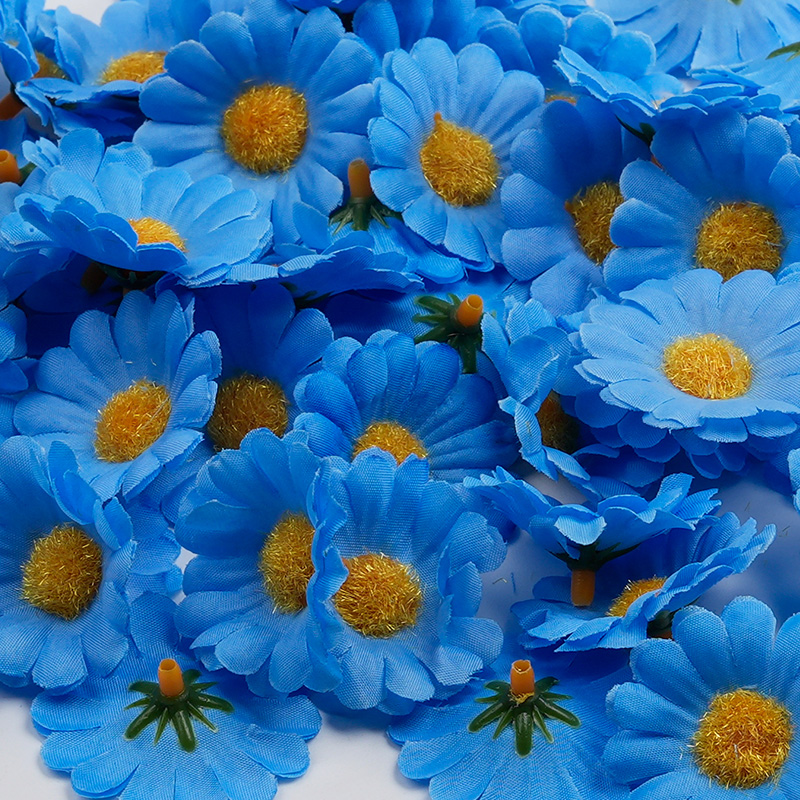
Raffia flower decorations are three-dimensional floral ornaments made by shaping and assembling fabric-based materials, non-woven fabric, yarn, or related decorative fibers. They are designed to resemble flowers while remaining lightweight, flexible, and easy to use in packaging and craft applications.
The flowers typically consist of multiple petals arranged around a central point. The petals are formed into a raised or layered structure instead of remaining completely flat. This stereoscopic design creates natural-looking depth and allows the decoration to stand out from the surface of a gift box, paper package, bouquet, or display item.
Although these products are called raffia flower decorations, their construction may involve several complementary materials. Cloth can provide softness and a refined surface. Non-woven fabric can supply shape retention and a stable petal structure. Yarn can be used to create texture, edging, decorative centers, or additional visual detail. Combining these materials gives the product a richer appearance than a single-material ornament.
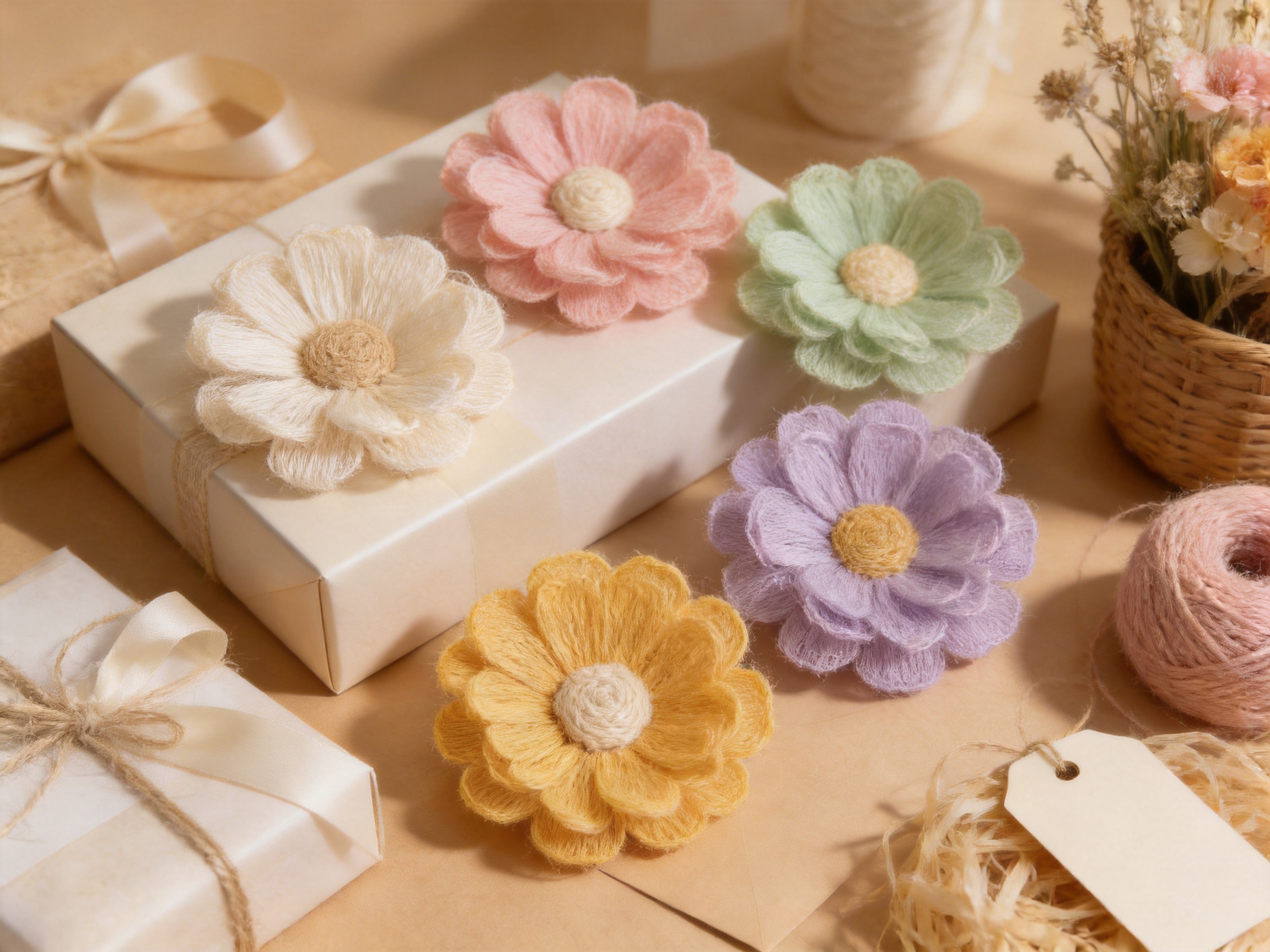
The flowers are commonly made in natural fresh colors, although customized color matching is also available. This flexibility allows buyers to coordinate flower decorations with brand colors, seasonal themes, wedding palettes, holiday collections, retail packaging, or specific product lines.
Key Product Features
Stereoscopic Petal Construction
The most important visual feature is the three-dimensional petal structure. Each petal is shaped and arranged to create volume, rather than simply being printed or cut into a flat form. This makes the decoration more noticeable and gives packaging a premium handmade appearance.
Raised petals can also create natural shadows and highlights. Under retail lighting, these variations in depth help the flowers appear more vivid. On gift boxes and wrapping paper, the dimensional surface provides contrast against smooth paper, cardboard, glass, metal, or textile packaging.
Soft and Delicate Texture
The use of cloth, non-woven fabric, and yarn creates a soft tactile surface. Compared with hard plastic ornaments or rigid molded accessories, these flowers feel more comfortable and less industrial. The soft petal texture is especially appropriate for gifts, baby-related products, wedding packaging, handmade goods, and seasonal craft designs.
A delicate texture does not mean that the product must be fragile. Through suitable material selection, forming, assembly, and quality inspection, the petals can retain their shape during normal handling, packing, storage, and transportation.
Natural Appearance
Natural fresh colors and textile-based materials give raffia flower decorations a warm and organic visual character. They can be used in rustic packaging, botanical themes, eco-conscious product presentation, and handmade designs. The flowers may also be combined with raffia paper, paper yarn, ribbons, shredded paper, gift tissue, baskets, and other natural-looking materials.
Lightweight Design
Because the flowers are made from fabric and non-woven materials rather than heavy rigid components, they add decorative value without substantially increasing package weight. This is useful for businesses that need attractive packaging while managing shipping costs, product handling, and storage space.
Durability and Shape Retention
A well-made decorative flower should remain stable during ordinary use. The product information specifies that the flowers are durable and not easy to fall off or deform. These qualities depend on proper petal forming, reliable assembly, controlled bonding or fastening, and suitable packaging during shipment.
Durability is particularly important for wholesale buyers. A flower that looks attractive at the factory but loses petals during transportation can create additional labor, customer complaints, and repacking costs. Consistent production procedures are therefore essential for commercial supply.
Flexible Color Matching
Standard natural and fresh color options are suitable for many gift and craft applications. For larger orders, customized color matching can help buyers maintain visual consistency across a complete packaging collection.
Color customization may be used for corporate gift boxes, wedding themes, holiday programs, retail campaigns, seasonal launches, or brand-specific packaging. A coordinated color system can include the flower decoration, paper raffia, wrapping paper, yarn, ribbon, tag, and box design.
Advantages Compared with Other Decorative Accessories
Raffia flower decorations compete with bows, plastic flowers, printed stickers, paper cutouts, foam ornaments, and flat fabric motifs. Each alternative has its own purpose, but raffia flowers offer several advantages for buyers seeking a soft, dimensional, and craft-oriented presentation.
More Dimension Than Flat Decorations
Flat stickers and printed designs can communicate a pattern or theme, but they do not provide much physical depth. Raffia flower decorations create a layered structure that can be seen from different angles. This makes a package appear more elaborate without requiring a complicated box shape or expensive printing process.
More Natural Than Conventional Plastic Ornaments
Plastic flowers can be highly uniform, but they may appear too rigid or synthetic for handmade, botanical, or premium gift concepts. Cloth and non-woven flowers offer a softer and more tactile alternative. Their fiber-based appearance can better complement paper, wood, woven baskets, and natural packaging materials.
More Tactile Than Printed Floral Patterns
Printed flowers are useful for high-volume packaging, but they are visually limited to the surface of the paper. A physical flower can be touched, lifted, and viewed as an independent accessory. This sensory quality contributes to the unboxing experience and can make a gift feel more personal.
More Flexible Than Fixed Packaging Components
A decorative flower can be attached to different surfaces or used as an independent accessory. It may be placed on the lid of a box, tied to a handle, secured to a wrapping sheet, added to a bouquet, or combined with a gift tag. This flexibility allows the same product to serve multiple packaging programs.
Suitable for Small and Large Creative Projects
Raffia flower decorations can be used by individual crafters, florists, event planners, packaging designers, retailers, and industrial gift suppliers. Their broad application range makes them easier to incorporate into mixed product collections.
Materials and Functional Characteristics
| Material | Primary Function | Visual or Functional Contribution |
|---|---|---|
| Cloth | Petal softness and surface coverage | Creates a gentle, refined, and textile-like appearance |
| Non-woven fabric | Shape support and structured forming | Helps petals retain volume and resist deformation |
| Yarn | Texture, edging, centers, or decorative detail | Adds fiber character and visual richness |
| Safe coating | Surface protection where applicable | Supports safe contact and improved product stability |
| Packaging materials | Protection during storage and shipment | Helps maintain shape, cleanliness, and batch organization |
Material selection should be based on the intended application. A flower used on a small gift box may prioritize a fine surface and delicate colors. A flower used in a larger floral display may require more volume and stronger shape retention. A product intended for automated or semi-automated packaging may need consistent dimensions and a stable attachment area.
For buyers developing a new design, it is useful to specify the desired petal softness, flower diameter, thickness, color, yarn texture, center design, attachment method, and packaging format. Clear specifications help reduce variation between samples and mass production.
Applications in Gift Packaging
Gift Boxes
Raffia flower decorations can be attached to box lids, corners, sleeves, or presentation cards. A single flower can serve as a focal point, while several flowers can create a garden or bouquet effect. This is useful for cosmetics, candles, confectionery, specialty foods, handmade products, jewelry, and seasonal gift sets.
The decoration may be fixed permanently during production or attached by the packer at the final stage. A removable design can provide flexibility for different product collections, while permanent attachment can ensure a consistent retail appearance.
Wedding Packaging
Wedding favors, invitation boxes, table gifts, and bridal accessories often require delicate decoration. Soft fabric flowers can coordinate with wedding colors and create a romantic handmade impression. They may be combined with neutral wrapping paper, lace, ribbon, paper raffia, or personalized tags.
Customized colors are particularly valuable in wedding applications because the decoration can follow the ceremony palette. Common approaches include matching flowers to invitation colors, bouquet tones, table settings, or seasonal floral arrangements.
Holiday Packaging
Holiday gift packaging benefits from decorative accessories that can be adapted to different themes. Flowers in warm natural colors can support autumn and harvest designs. White, silver, or soft pastel versions may be suitable for winter collections. Bright colors can be used for spring festivals, summer events, or children’s gift packaging.
Because the flowers are lightweight and easy to combine with other accessories, they can be included in seasonal packaging kits containing paper shreds, wrapping paper, tags, cords, and ribbons.
Luxury and Boutique Packaging
A premium package often depends on small details. A three-dimensional flower can add a handmade finishing touch to a boutique product without requiring complex structural packaging. When the color, texture, and attachment are carefully controlled, the accessory can reinforce the product’s perceived value.
Applications in Floral Art and Home Decoration
Raffia flower decorations are not limited to packaging. Florists and decorators may use them in wreaths, gift baskets, table displays, handmade bouquets, wall ornaments, seasonal arrangements, and creative installations.
Their soft construction allows them to be integrated with dried flowers, artificial greenery, paper flowers, natural raffia, wooden elements, and textile decorations. They can fill visual gaps in an arrangement or provide color and volume where natural materials are not available.
For home decoration, the flowers may be used in storage baskets, decorative jars, picture frames, curtain accessories, party displays, and handmade ornaments. Their light weight makes them suitable for projects where heavy components would be inconvenient.
Craft retailers can also sell the flowers as individual components or as part of themed kits. A kit might include several colors, complementary paper yarn, wrapping materials, and instructions for creating gift arrangements or decorative displays.
Manufacturing Process
Raw Material Preparation
Production begins with the selection and preparation of cloth, non-woven fabric, yarn, and related materials. Materials are checked for color, thickness, surface consistency, cleanliness, and suitability for the intended design.
Raw material control is important because variations in fabric density or yarn thickness can affect petal shape, flower volume, and final appearance. A professional production system uses repeatable material specifications to reduce differences between batches.
Color Coordination
For standard products, selected natural and fresh colors are prepared according to established specifications. For customized projects, color samples are reviewed before larger-scale production begins.
Color coordination requires attention to the relationship between the cloth, non-woven fabric, yarn, and any coating or attachment materials. The finished flower should appear visually balanced rather than having unrelated tones in different components.
Petal Cutting and Forming
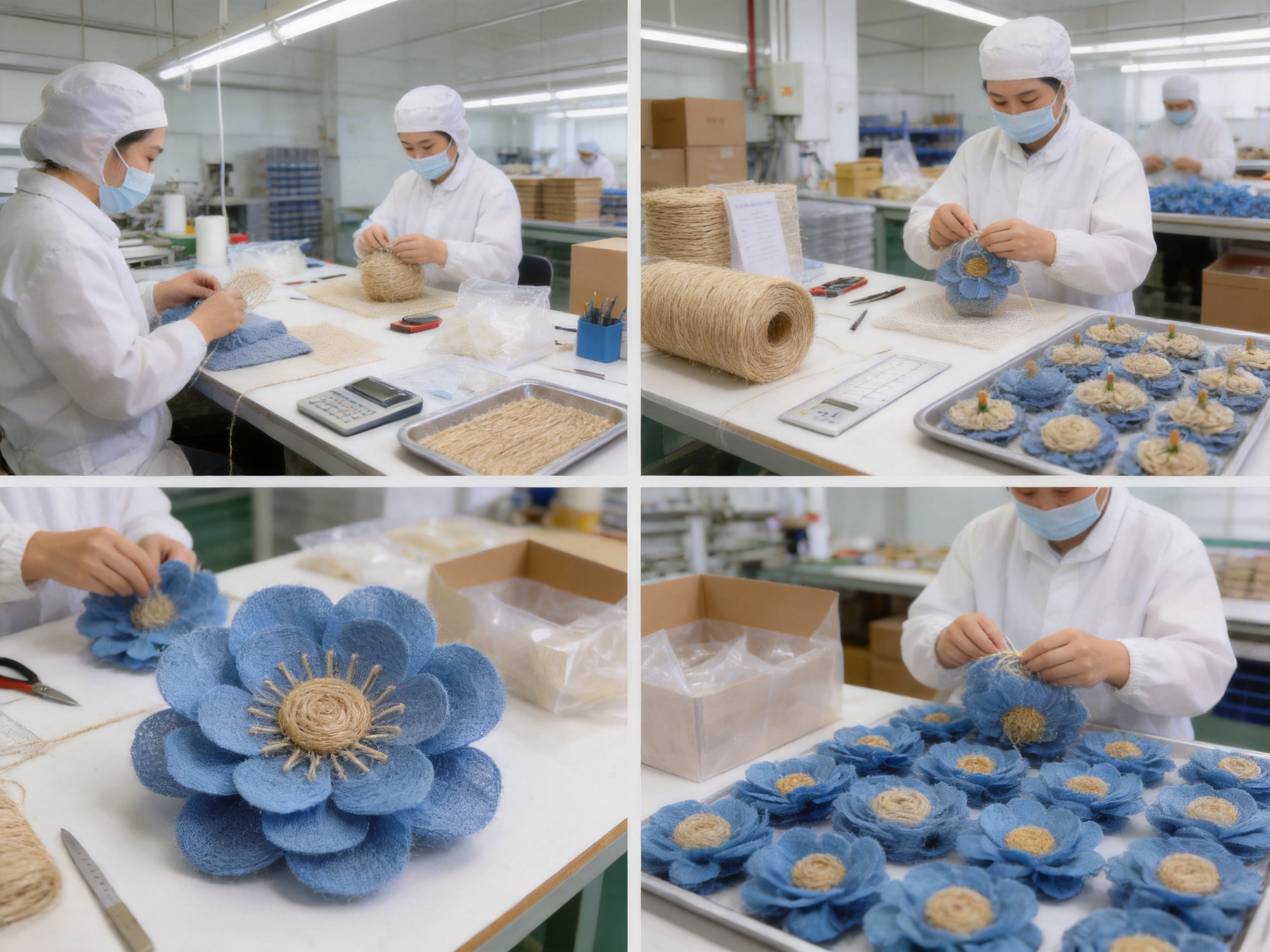
Fabric and non-woven materials are processed into petal components. Depending on the design, this may involve cutting, shaping, folding, pressing, or other forming procedures. The objective is to create petals with consistent dimensions and a suitable level of curvature.
Petal forming is one of the most important stages because it determines whether the finished flower has a strong stereoscopic appearance. If the petals are too flat, the product may lose its decorative impact. If they are too sharply folded, the flower may appear unnatural or become difficult to assemble.
Layering and Assembly
Individual petals are assembled around a center point. The number of petals, their angle, and their overlap must be controlled so that the flower appears balanced from multiple directions.
Reliable assembly also helps prevent petals from falling off during handling. The selected bonding, stitching, fastening, or combination method should be appropriate for the materials and expected application. Production workers or equipment must apply the method consistently across the batch.
Yarn Integration
Yarn may be added as an outline, central detail, decorative wrap, or textural element. Its thickness, twist, color, and placement influence the character of the final product.
Integration requires careful control because loose yarn ends can affect appearance and handling. A professional process includes trimming, securing, and inspecting yarn details before the product is packed.
Shape Adjustment
After assembly, each flower may require adjustment to ensure the petals are evenly distributed and the three-dimensional form is maintained. This stage helps correct minor differences caused by material flexibility or manual handling.
Shape adjustment is especially important for wholesale orders, where inconsistent flower forms can become visible when many pieces are displayed together. Uniformity supports a more professional presentation for retail customers.
Quality Inspection
Finished products are inspected for material defects, incomplete attachment, loose petals, uneven color, poor shaping, visible contamination, and deformation. Inspection can be performed during production and again before shipment.
Quality control should be based on clear standards. These may include acceptable size tolerance, color consistency, petal count, attachment strength, surface cleanliness, packaging quantity, and carton labeling.
Compression and Packaging
Decorative flowers must be packed in a way that protects them from excessive crushing while also using shipping space efficiently. Packaging design may include inner bags, grouped bundles, protective layers, cartons, and clear quantity labels.
For international shipments, organized packaging helps reduce counting errors and simplifies receiving operations. Buyers can request packaging formats that fit their warehouse, retail, or assembly procedures.
Integrated Manufacturing Strengths
A capable manufacturer offers more than a decorative product. It provides a complete system for material processing, product development, production, quality control, packaging, and delivery.
Zhejiang Raffia Paper Products Co., Ltd. was founded in 2014 and originated from a craft materials business unit established in 2010. The company developed from a trading enterprise into an integrated manufacturer specializing in crinkle raffia paper shreds and fancy paper yarns. This background gives the company experience across related material categories rather than limiting its operation to one isolated accessory.
The factory is located in Dongyang, Zhejiang Province, and covers a modern production base of approximately 20,000 square meters. With more than 200 professional employees, the company has the personnel and facility scale required to support product development, large-volume manufacturing, inspection, and shipment preparation.
Its production chain includes raw material processing, mass production, quality testing, and finished-goods packaging and shipment. This integrated structure can simplify communication and improve production coordination. Instead of relying entirely on separate external suppliers for every stage, an integrated factory can manage more steps within one organized system.
The company also continues to upgrade production equipment for slitting, twisting, winding, and compression packaging. These capabilities are closely related to raffia paper yarn and decorative packaging materials. They can support the development of coordinated product lines in which flower decorations are combined with paper raffia, fancy yarns, DIY cords, and wrapping products.
Annual production capacity exceeds 200 million pieces across its product operations. High capacity is valuable for distributors and retailers that need dependable replenishment, large seasonal programs, or multiple product designs. Capacity alone is not a substitute for quality, but when combined with standardized procedures, it can support stable commercial supply.
Quality Control and Batch Consistency
Batch consistency is one of the most important purchasing considerations for decorative accessories. A buyer may approve a sample, but the real test is whether subsequent production matches the approved appearance and specifications.
A replicable quality control system should address the following areas:
Material consistency: Cloth, non-woven fabric, and yarn should meet the agreed specifications for color, thickness, feel, and surface condition.
Dimensional consistency: Flower diameter, petal size, center position, and overall thickness should remain within acceptable tolerances.
Assembly reliability: Petals and decorative components should be firmly attached and should not separate easily during normal handling.
Color accuracy: Standard and customized colors should remain visually consistent between production lots.
Shape retention: Flowers should not be excessively flattened, twisted, or deformed when packed and unpacked according to the agreed method.
Surface cleanliness: Finished pieces should be free from obvious stains, loose fibers, excess adhesive, or packaging debris.
Quantity and labeling accuracy: Inner packs and cartons should contain the correct number of units and provide clear identification for warehouse handling.
These inspection points are especially important when decorations are used in coordinated packaging systems. A slight color or size difference may be noticeable when flowers are placed side by side on a retail display.
OEM and ODM Customization
OEM and ODM services allow buyers to develop products for specific markets, brands, packaging concepts, or customer groups. Customization may involve more than simply changing the color.
Shape and Size Customization
Buyers may request smaller flowers for jewelry boxes and favor packaging, medium flowers for gift boxes, or larger flowers for baskets and floral displays. Petal shape, petal count, center detail, and overall fullness can also be adjusted.
Color Customization
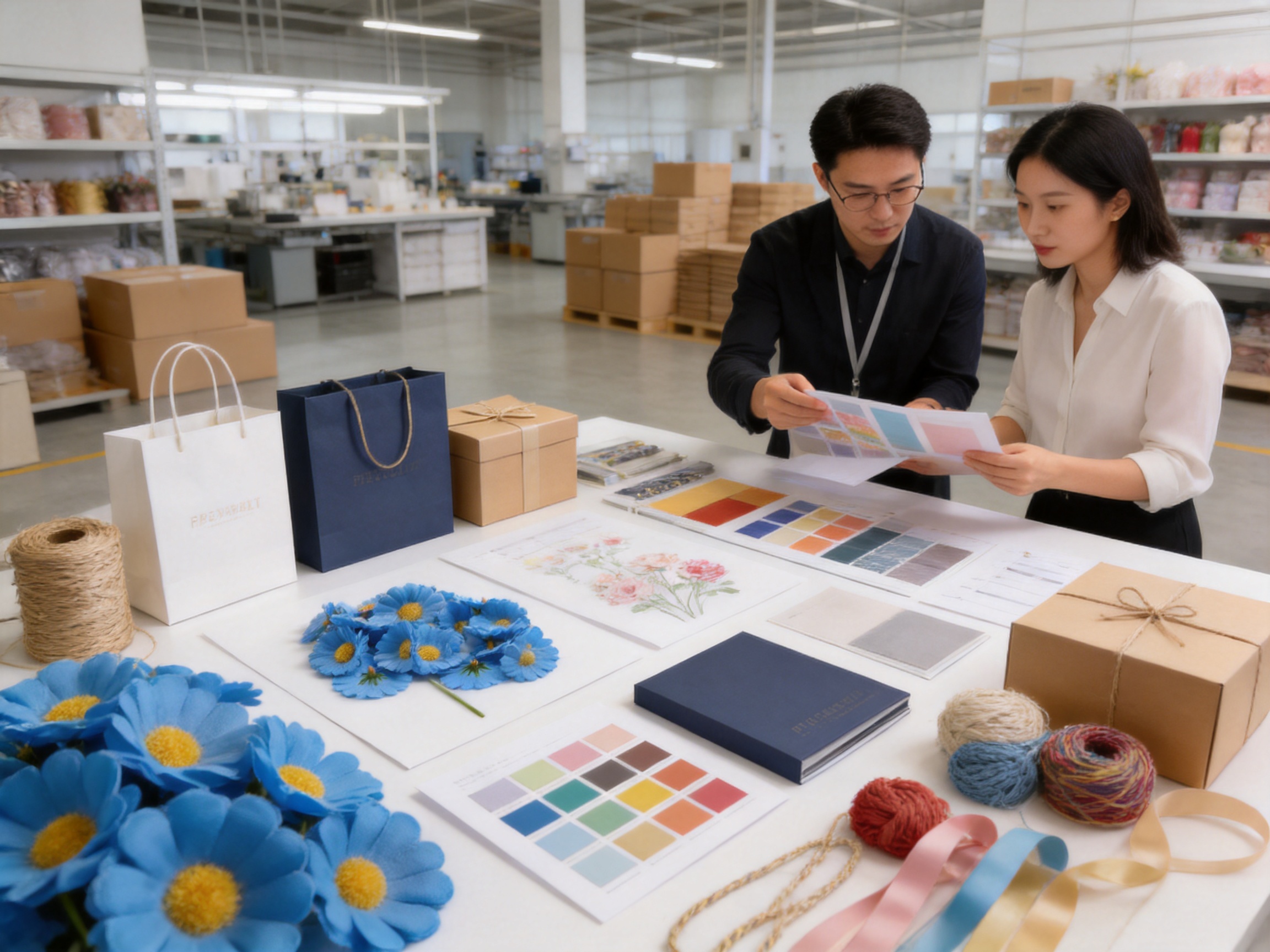
Custom colors can be matched to a brand identity, seasonal palette, event theme, or packaging collection. A buyer should provide physical samples, color references, or standardized color information whenever possible.
Material Customization
The balance between cloth, non-woven fabric, and yarn may be modified to achieve a softer, firmer, thicker, or more textured result. Material decisions should be evaluated together with the intended use and attachment method.
Packaging Customization
Products can be packed in bulk cartons, grouped bundles, retail-ready bags, display boxes, or customized branded packaging, depending on order requirements. Packaging customization can improve warehouse efficiency and support direct retail distribution.
Coordinated Product Development
A buyer may develop a complete decorative range containing flower decorations, raffia paper, paper yarn, DIY cords, fancy yarns, wrapping paper, and filler materials. Working with a supplier that already operates in these related categories can simplify sourcing and make it easier to create a coherent visual collection.
Safety and Responsible Product Selection
The product information specifies a non-toxic coating and safe contact. Buyers should still communicate the exact application, handling conditions, and any destination-market requirements before production.
Decorative flowers are generally used on packaging or craft items rather than as food-contact components. If the product will be used near food, cosmetics, children’s products, or sensitive applications, the buyer should request appropriate material and compliance documentation from the supplier.
Responsible product selection also includes reviewing packaging waste, shipment efficiency, material composition, and expected product life. Fiber-based decorative components may support a natural packaging concept, but buyers should evaluate the full product system rather than making broad environmental claims without verification.
How to Choose a Reliable Supplier
When comparing suppliers, buyers should examine manufacturing experience, production capacity, sample quality, customization capability, quality controls, communication, and delivery performance.
A supplier with experience in related raffia paper and yarn products may be able to offer more than a basic flower accessory. It may understand how flower decorations interact with filler, wrapping paper, paper cords, and gift packaging. This broader knowledge can help buyers avoid mismatched colors, incompatible textures, and inefficient packing formats.
It is advisable to request a pre-production sample before placing a large order. The sample should be checked for size, petal volume, softness, color, attachment strength, surface cleanliness, and packaging condition.
Buyers should also provide a written product specification. Important details include:
• Product name and intended application.
• Flower diameter and acceptable dimensional tolerance.
• Material composition and preferred texture.
• Color reference or approved physical sample.
• Petal design and center structure.
• Attachment method or required back surface.
• Packaging quantity and carton requirements.
• Inspection standards and acceptable defect limits.
• Required delivery schedule and shipment destination.
Clear specifications reduce misunderstandings and help the factory prepare accurate samples and quotations.
Comparison of Decorative Options
| Decorative Option | Dimensional Effect | Texture | Customization Potential | Typical Applications |
|---|---|---|---|---|
| Raffia flower decoration | High | Soft and fiber-based | High | Gift boxes, weddings, floral art, holiday packaging |
| Printed floral design | Low | Paper surface | High through printing | Mass-market wrapping and labels |
| Plastic flower | Medium to high | Rigid or smooth | Medium | Long-term displays and artificial arrangements |
| Paper cutout | Low to medium | Light and crisp | High | Cards, boxes, scrapbooking, event decoration |
| Ribbon bow | Medium | Soft or glossy | High | Gift wrapping, retail boxes, bouquets |
The best choice depends on the desired visual language and operating requirements. Raffia flower decorations are particularly suitable when the buyer wants a combination of dimensional form, soft texture, natural appearance, and flexible customization.
Sustainability and Packaging Considerations
Many buyers are looking for packaging accessories that communicate a more natural and craft-oriented image. Raffia flower decorations made with cloth, non-woven fabric, and yarn can support this visual direction. However, sustainability should be considered carefully, including material origin, coating composition, durability, packaging efficiency, and end-of-life handling.
A durable decoration may reduce replacement and waste caused by damage during use. Efficient carton packing can reduce unnecessary shipping volume. Coordinating multiple products from one supplier may also simplify logistics and reduce fragmented procurement.
Buyers seeking specific environmental attributes should request factual information and relevant documentation. Terms such as recyclable, biodegradable, compostable, or eco-friendly should only be used when they are supported by the actual material composition and applicable standards.
Design Ideas for Retail and Creative Brands
Natural Gift Collection
Combine neutral flower decorations with kraft-style boxes, natural raffia paper, paper filler, and simple tags. This arrangement works well for handmade soaps, candles, tea, stationery, and artisan foods.
Pastel Celebration Collection
Use soft pink, cream, blue, lavender, or peach flowers with light wrapping paper and delicate yarn. This collection can suit baby gifts, birthdays, bridal showers, and spring events.
Premium Beauty Packaging
Pair carefully selected flowers with rigid boxes, fine paper, satin-style ribbon, and restrained color matching. The flower can be placed on the lid as a single focal accent rather than used in large quantities.
Holiday Craft Kit
Offer several flower colors together with paper cords, filler, wrapping sheets, and instructions. Customers can use the components to create their own gift packaging, wreaths, cards, or table decorations.
Floral Display Accessories
Use flowers as supporting elements in dried-flower arrangements, baskets, wreaths, and event centerpieces. Their consistent shape can help fill spaces between larger botanical components.
Ordering and Project Development Process
A successful project usually begins with a clear design brief. The buyer should explain the product’s purpose, target market, expected order quantity, preferred colors, packaging method, and delivery schedule.
The supplier can then review the requirements and recommend materials, dimensions, construction methods, and packaging options. A sample or prototype should be evaluated before mass production.
After approval, the production team prepares materials and confirms the manufacturing specifications. During production, quality checks should be performed at relevant stages rather than only at the end. Finished products are then packed, labeled, and prepared for shipment.
For repeat orders, maintaining an approved sample and written specification is valuable. It creates a reference for color, size, structure, and packaging. This is especially important when orders are placed several months apart or supplied to different markets.
Company Manufacturing and Service Profile
Zhejiang Raffia Paper Products Co., Ltd. supplies raffia paper, paper raffia yarn, DIY cords, fancy yarns, gift packaging materials, raffia tape, and related decorative products. This product range supports customers that need coordinated materials for packaging, craft, textile, home decoration, and retail applications.
The company serves customers in China and exports to Europe, North America, South America, Asia, and other regions. Its products and services have been used by brands and retail organizations including Costco, IKEA, LOKLIK, Disney, Lancôme, Chanel, Dior, and Primark, according to the supplied company information.
Its service model emphasizes OEM and ODM support, exclusive brand customization, custom size development, long-term bulk order supply, batch consistency, and delivery coordination. These capabilities are relevant to buyers who need more than an off-the-shelf decoration.
The company’s manufacturing experience began with a craft materials business unit established in 2010, followed by the establishment of the current company in 2014. More than a decade of industry experience has allowed it to develop procedures for slitting, twisting, winding, compression packaging, quality testing, and shipment organization.
For raffia flower decoration buyers, the advantage of this background is the ability to source complementary items through a manufacturer familiar with raffia-based packaging materials. This may help create unified product colors, textures, and packaging formats across an entire collection.
Frequently Asked Questions
What materials are used to make raffia flower decorations?
The product is made from cloth, non-woven fabric, and yarn. These materials work together to provide soft petals, structure, texture, and a three-dimensional appearance.
Are the flowers flat or three-dimensional?
They are designed with stereoscopic petals. The layered petal construction creates visible volume and helps the decoration stand out from gift boxes, wrapping paper, floral arrangements, and display surfaces.
Can the flower color be customized?
Yes. Standard natural and fresh colors are available, and customized color matching can be discussed for suitable orders. Buyers should provide a color reference or approved sample whenever possible.
Are the flowers suitable for gift boxes?
Yes. Gift box decoration is one of the main applications. The flowers can be placed on box lids, sleeves, cards, handles, or other packaging surfaces.
Can they be used for weddings and holidays?
Yes. Their soft texture, dimensional form, and color flexibility make them suitable for wedding favors, invitation packaging, holiday gifts, seasonal displays, and celebration decorations.
Are the flowers durable?
The product is designed to be durable and not easy to fall off or deform during normal handling. Final performance depends on the selected materials, assembly method, packaging, and intended use.
Are the materials safe to handle?
The supplied product information specifies a non-toxic coating and safe contact. Buyers with specialized applications should confirm the exact material and compliance requirements before ordering.
Can the flowers be used with other raffia products?
Yes. They can be combined with paper raffia, raffia filler, fancy yarns, DIY cords, wrapping paper, ribbons, tags, and other gift packaging materials.
Does the manufacturer provide OEM and ODM services?
Yes. The company provides OEM and ODM solutions that may include exclusive brand customization, custom sizes, color development, packaging arrangements, and long-term bulk supply.
What should be confirmed before placing a bulk order?
Buyers should confirm the material composition, flower size, color, petal design, attachment method, packaging quantity, quality standards, order volume, delivery schedule, and any destination-market requirements.
Can a sample be requested?
A sample or prototype should generally be requested for customized or large-volume projects. It allows the buyer to check appearance, texture, color, structure, and packaging before mass production.
What types of companies can purchase these products?
Potential buyers include gift packaging companies, florists, event planners, craft retailers, importers, distributors, brand owners, retail suppliers, wedding suppliers, and manufacturers of handmade or specialty products.
Conclusion
Raffia flower decorations combine soft textile materials, stereoscopic petal construction, natural color options, and flexible application potential. They provide a practical alternative to flat printed decorations and rigid plastic ornaments when a product requires a more tactile, handcrafted, and dimensional appearance.
Their advantages include lightweight construction, delicate texture, shape retention, color customization, broad application range, and compatibility with gift packaging materials such as raffia paper, paper yarn, filler, cords, ribbons, and wrapping paper.
For commercial buyers, product quality depends on more than the visual appeal of a sample. Consistent raw materials, controlled petal forming, reliable assembly, careful inspection, efficient packaging, and dependable production capacity are all essential. An integrated manufacturer with experience in raffia paper, fancy yarn, and packaging materials can provide additional value by supporting coordinated product development and long-term supply.
With a modern production base, more than 200 professional employees, an integrated manufacturing chain, international service experience, and OEM and ODM capabilities, Zhejiang Raffia Paper Products Co., Ltd. is positioned to support customized raffia flower decoration programs for global packaging and craft markets.
For buyers seeking decorative accessories that make gifts more attractive, floral projects more expressive, and packaging more memorable, raffia flower decorations offer a flexible and commercially practical solution.
References
1. Product specification information for Raffia Flower Decorations, including materials, color options, texture, features, applications, and safety information.
2. Company profile and manufacturing information supplied by Zhejiang Raffia Paper Products Co., Ltd.
3. Internal product development considerations for textile-based decorative accessories and gift packaging materials.
4. General principles of packaging quality control, material inspection, batch consistency, and supplier qualification.
5. General design practices for gift packaging, floral art, seasonal decoration, and craft accessory development.
Product: Raffia Flower Decorations
 +86 15355323399
 kevin@raffia-paper.com
 No. 151 Guanshan North Road, Dongyang City, Zhejiang Province, China

Copyright © Zhejiang Raffia Paper Products Co., Ltd. All Rights Reserved.

Paper Raffia Yarn & Gift Packaging Factory